
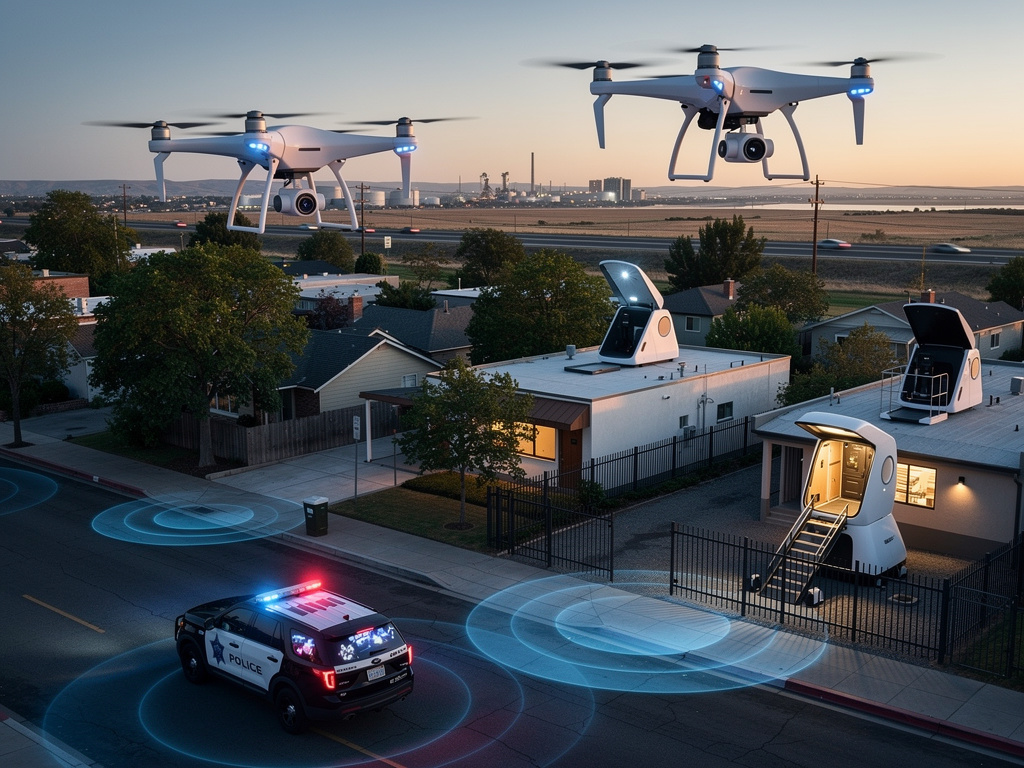
The city of Stockton, California, has taken a significant step toward integrating drone technology into its public safety operations. Through a program called Flock, the city has deployed a network of fixed-wing drones that can launch automatically in response to 911 calls and other emergencies. This initiative positions Stockton as one of the first communities in the United States to adopt such an automated aerial response system on a broad scale.
The program relies on small, fixed-wing drones manufactured by a company named Flock Safety. These devices sit inside compact ground stations placed at strategic locations throughout the city. When a dispatch call comes in, the nearest station releases a drone that climbs to a predetermined altitude and begins streaming live video back to police officers. The aircraft can remain aloft for roughly 40 minutes before returning to its base for recharging and another flight. Unlike multirotor drones that require trained pilots, these fixed-wing models operate with minimal human intervention once launched.
Stockton’s decision to adopt the system stems from years of struggling with limited police resources and high rates of certain crimes. City officials viewed the drones as a practical way to extend the reach of officers already stretched thin. Rather than replacing human responders, the aircraft serve as an additional set of eyes that can arrive at scenes faster than ground units in many cases. Early data shared by the city suggests response times have improved in areas covered by the drone stations.
According to reporting by The Next Web, the Flock system in Stockton marks an important test case for how municipalities might balance rapid technological adoption with community concerns. The article highlights both the potential benefits for law enforcement and the questions residents continue to raise about privacy and oversight. Those questions have followed the program since its early planning stages.
Privacy advocates expressed alarm when Stockton first announced its partnership with Flock Safety. They worried that constant aerial surveillance could chill free speech and create permanent records of people’s daily movements. In response, city leaders and the company worked to build several safeguards into the program. Drones only activate after a 911 call or when officers request support for an active incident. The video feeds are not stored indefinitely; most footage is deleted after a short retention period unless it becomes part of an active investigation. Audio recording is disabled by default, and the drones avoid flying over private property whenever possible.
Despite these measures, some residents remain skeptical. Community meetings have featured passionate debates about whether the technology represents smart governance or an unwelcome expansion of police power. Civil liberties groups have called for independent audits of how the system is used and who has access to the recorded material. Stockton officials say they welcome that scrutiny and have committed to publishing regular reports on drone deployments, flight durations, and how often the resulting video contributes to case resolutions.
The technical design of the Flock drones reflects a focus on reliability and simplicity. Each ground station houses multiple aircraft, allowing for back-to-back launches if needed. The drones use cellular networks to transmit video, which means they can operate beyond visual line of sight without requiring dedicated radio frequencies. Onboard cameras capture high-resolution images that officers can view through a secure web portal or mobile application. The system can also integrate with existing police software, letting dispatchers see drone feeds alongside ground unit locations on a single map.
One notable advantage of fixed-wing designs over traditional quadcopters is their efficiency in covering distance. A fixed-wing drone can travel several miles from its station in just a few minutes, providing an overhead view while patrol cars are still navigating traffic. This speed advantage proves especially useful in a city like Stockton, where some neighborhoods sit far from the nearest police station. Early tests showed drones reaching certain locations up to five minutes before ground responders, giving officers a preliminary understanding of the situation before they arrive.
The program has also drawn attention from other California cities and departments across the country. Police chiefs from smaller communities have visited Stockton to observe the system in action and discuss potential adoption. Larger agencies, however, have moved more cautiously, citing both cost and regulatory hurdles. The Federal Aviation Administration maintains strict rules about drone operations beyond visual line of sight, and many municipalities still lack clear policies for automated response systems. Stockton worked closely with the FAA to secure the necessary waivers, a process that took months of negotiation and required detailed safety documentation.
Funding for the initiative came from a combination of local budgets and federal grants aimed at improving community policing tools. The initial investment included the cost of ground stations, drones, training for dispatch staff, and the development of policies governing use. City leaders argue that these upfront expenses will pay off through reduced overtime, fewer hours spent searching for suspects, and better documentation of incidents. Whether those savings materialize remains a subject of ongoing evaluation.
Critics point out that technology alone cannot solve the underlying social issues that contribute to crime. They argue that resources devoted to drones might be better spent on youth programs, mental health services, or increasing the number of community officers who build relationships on the street. Supporters counter that the drones free up officers for exactly those kinds of interactions by handling the initial information-gathering phase of many calls.
Data collected during the first year of operation offers a mixed picture. In incidents involving stolen vehicles or fleeing suspects, drone footage frequently helped officers locate and apprehend individuals more quickly. The aerial perspective also proved valuable at large public gatherings where crowd dynamics can change rapidly. On the other hand, the drones showed limited usefulness for certain types of calls, such as domestic disputes inside homes where privacy rules prevent overhead viewing. Officials acknowledge that the technology works best as one tool among many rather than a universal solution.
The experience in Stockton reflects broader national conversations about the role of surveillance technology in American policing. Similar debates have played out around facial recognition software, automated license plate readers, and body-worn cameras. In each case, communities have had to weigh safety gains against risks to civil liberties. Stockton’s approach of launching the program with built-in limitations and public reporting requirements offers one model for how cities might introduce new tools without sacrificing transparency.
Flock Safety itself has expanded rapidly since its founding, supplying camera systems and now drone networks to hundreds of agencies. The company emphasizes that its products are designed to support law enforcement while respecting constitutional protections. It provides training materials that stress proper use and has developed software features that allow departments to set geographic exclusion zones where drones will not fly. Even so, the rapid growth of the industry has outpaced the development of comprehensive regulations, leaving individual cities to create their own rules.
Looking ahead, Stockton plans to expand the number of drone stations to achieve fuller coverage across its 65 square miles. Additional aircraft with improved low-light cameras and longer flight times are already under consideration. City staff continue to meet with community advisory boards to refine policies based on feedback. One proposal under discussion would allow residents to request that certain footage be reviewed by an independent oversight committee if they believe their privacy was improperly invaded.
The program has also sparked interest among academic researchers who see Stockton as a living laboratory for studying the societal impacts of automated aerial surveillance. Universities have approached the city about partnerships that would examine everything from effects on crime rates to changes in public perceptions of safety. Such studies could help other municipalities make more informed decisions about whether to follow Stockton’s example.
As more cities experiment with similar systems, the lessons learned in California’s Central Valley may shape national standards. Questions about data ownership, retention periods, and accountability mechanisms will likely require coordinated answers rather than a patchwork of local policies. Federal lawmakers have begun discussing legislation that would establish baseline privacy protections for drone operations, though progress has been slow.
For now, Stockton continues to refine its use of the technology while documenting both successes and shortcomings. The city’s experience demonstrates that introducing automated drones into everyday policing involves far more than simply installing equipment. It requires careful policy development, ongoing community dialogue, and a willingness to adjust course when problems arise. Whether this particular approach becomes a model for other communities or serves as a cautionary tale will depend on how effectively leaders balance the pursuit of greater safety with the preservation of individual freedoms.
The presence of these drones in Stockton’s skies has already altered the rhythm of police response in measurable ways. Dispatchers now consider aerial support as routinely as they request backup units. Officers on the ground report feeling better informed when they approach uncertain situations. At the same time, some residents say they experience a subtle but persistent awareness that their city is being watched from above. That tension between enhanced security and diminished anonymity sits at the heart of the debate and will likely persist as the program matures.
City officials maintain that the drone initiative represents one piece of a larger strategy to make Stockton safer and more responsive to its residents’ needs. They point to parallel investments in violence interruption programs and neighborhood policing teams as evidence that technology is not being treated as a standalone fix. The hope is that by combining human-centered approaches with smart tools, the city can address both immediate emergencies and long-term community health.
As Stockton gathers more data and refines its procedures, other municipalities will watch closely. The outcome of this experiment could influence how quickly and under what conditions automated drone response systems spread across the country. For residents of Stockton, the program has moved beyond theory and become part of daily life, bringing both the promised benefits and the anticipated concerns into sharp focus. The coming years will reveal whether this balance proves sustainable and whether the city’s pioneering effort ultimately strengthens trust between police and the community they serve.


 WebProNews is an iEntry Publication