
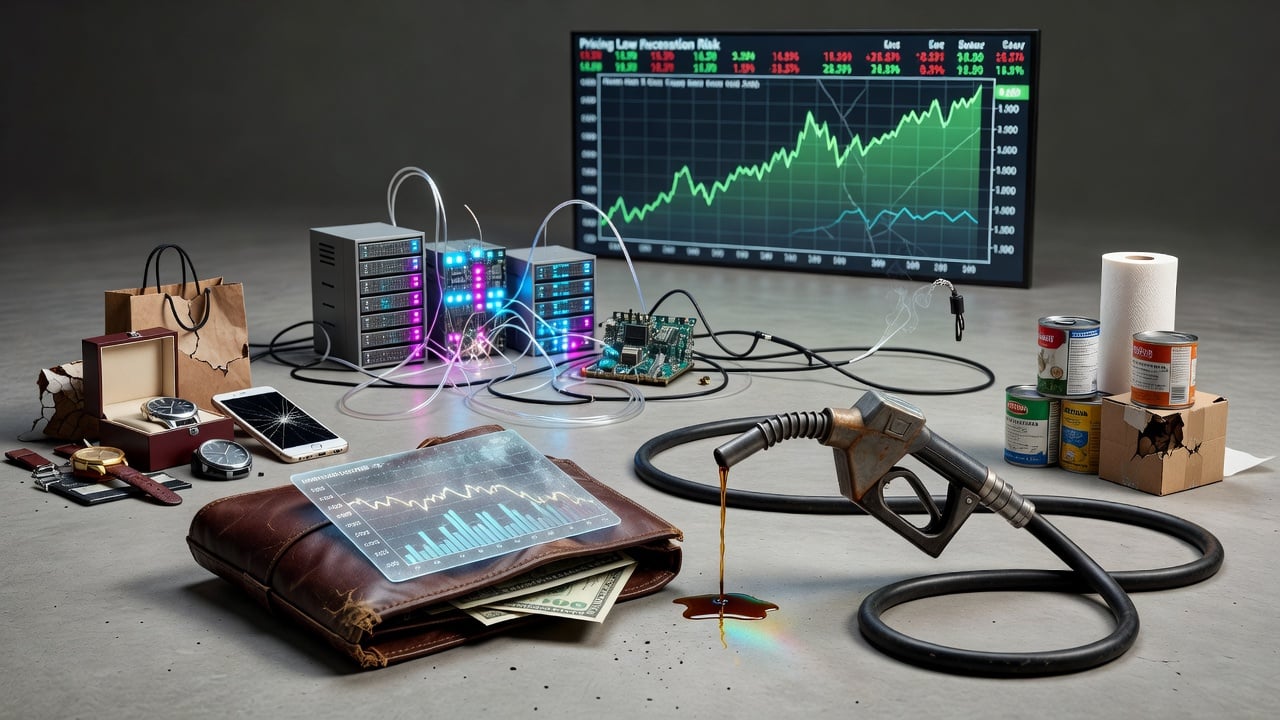
Steve Eisman built his reputation calling the housing bubble before it burst in 2008. The investor made famous in The Big Short now spots stress signals in American households. He warns the middle class shows signs of strain. Gas prices eat away at budgets that once felt flush from tax refunds.
The latest episode of his Real Eisman Playbook podcast features three consumer analysts from Evercore. Their message lands hard. The familiar K-shaped recovery, where the top pulled ahead while the bottom lagged, has morphed. Pressure now climbs into the middle. Yahoo Finance captured the exchange in detail on June 28, 2026.
Greg Melich, who follows Walmart, Costco and Home Depot, delivered the clearest line. “The middle is limping. That’s where the pressure is being felt.” Low-end consumers faced trouble for years. That squeeze has moved up the income ladder. Spring shopping looked strong thanks to tax refunds. But those dollars disappeared fast. “The refunds basically went into the gas tank,” Melich said, pointing to higher fuel costs tied to the recent Iran conflict.
Eisman listened. He pushed for specifics. The conversation revealed how higher-income households earning above $150,000 now join Walmart+ memberships. They discover the same box of Cheerios arrives quicker than from Amazon and costs about $2 less. Melich rejects the simple “trade-down” story. He calls it a “trade-in.” Affluent shoppers sample value and stay. Walmart+ may near an S-curve moment of faster adoption.
Yet the broader picture carries tension. Prediction markets price the odds of a U.S. recession by the end of 2026 at only 12 percent. Negative GDP growth sits near 11 percent on Polymarket. Those bets suggest calm. Eisman and his guests see fractures beneath the surface.
Apparel tells another story. Analyst Michael Binetti explained how Nike moved too aggressively on its direct-to-consumer shift. The company gave up shelf space to nimble rivals such as On Holding and Hoka, owned by Deckers Outdoor. Innovation from competitors kept coming. Eisman offered a sharper verdict. Nike has “lost tremendous mojo.”
Ralph Lauren followed the opposite path. It pulled inventory from discount racks and raised average prices 60 percent since 2018. The brand sits up 14 percent this year. Nike, by contrast, stands down 34 percent over the same stretch. The contrast highlights how pricing power and brand discipline separate winners from those losing ground.
This consumer strain fits into Eisman’s wider views on the economy. In October 2025 he described the U.S. as a “tale of two cities.” Growth appears decent on paper. Strip out AI spending and the picture changes. Yahoo Finance reported his calculation that 2025 GDP growth of 1.8 percent, worth roughly $530 billion, relies heavily on roughly $400 billion in AI infrastructure outlays by the largest tech firms. “The U.S. economy is not even growing, really, 50 basis points outside of AI,” he said then. Pockets of weakness must exist.
By 2026 his concerns around artificial intelligence have sharpened. Eisman sees risks in power constraints and diminishing returns from scaling large language models. He has questioned whether the current path of ever-larger models will continue to deliver breakthroughs. “The large language models, as they keep scaling, which is the model that everybody has, will start to lose their efficaciousness,” he told CNBC in late 2025. Improvement may slow rather than accelerate. That shift could curb chip demand from companies like Microsoft.
His latest comments, reported June 27, 2026, by Fortune, go further. Eisman argues many investors chase the wrong AI names. He criticizes hyperscalers for mounting capital intensity, eroding moats and the need to raise equity. “It’s very commoditized. People are switching constantly from one to the other. There are no moats.” Suppliers with protected positions offer better exposure. Nvidia, Arista and Cisco earn his interest as picks-and-shovels plays.
SpaceX draws particular skepticism. Eisman notes its roughly $19 billion in revenue resembles that of Kellogg’s. Yet the anticipated IPO valuation approaches 100 times sales. “SpaceX has the revenues of Kellogg’s… no one is going out of their way to buy Froot Loops,” he quipped. The S-1 filing mentions asteroid mining on page 71, a detail he ties to sci-fi ambitions rather than near-term business reality. He views the company as building a conglomerate across rockets, Starlink and AI at a time when conglomerates fall out of favor. Tesla fares no better in his assessment. “Tesla’s been a horrible failure for the past several years,” Eisman said. Promises of self-driving cars and robotaxis have not materialized while earnings have declined.
And yet Eisman stops short of calling for an imminent crisis. He has repeatedly stated he does not expect another financial meltdown like 2008. The banking system looks sounder. Consumers carry less problematic debt than before the last crash. In a September 2024 interview with Business Insider, he said AI investment differs from the dot-com telecom boom. “AI’s peak is still in the distance thoroughly. Call me a few years from now, and maybe we’ll have been overinvested.”
His podcast has become a platform for testing these ideas against fresh data. Episodes from 2025 and 2026 circle back to four themes: the uneven economy, questions around an AI bubble, risks in private credit and affordability challenges. In one 2025 wrap-up he compared the AI scaling thesis to flawed assumptions in subprime mortgages. The analogy carries weight from a man who profited by spotting that error.
So the middle class limps. Tax refunds vanish into fuel tanks. Nike struggles while Ralph Lauren thrives. AI spending masks softer growth elsewhere. And many of the most hyped stocks may rest on shaky assumptions about endless scaling and durable competitive advantages.
Eisman does not predict collapse. He flags imbalances. The K-shaped economy has grown uglier. The middle feels it now. Prediction markets dismiss recession risk. Shoppers at Walmart tell a more complicated tale. Higher-income households trade in for value. Lower- and middle-income families stretch budgets thinner. Retailers adapt or lose share. Brands that control pricing and avoid over-distribution hold an edge.
His AI views add another layer. Capital intensity rises. Power shortages loom as a binding constraint. Model improvements may plateau. Hyperscalers could face margin pressure and customer churn. Suppliers of essential infrastructure may capture more durable profits. The shift from asset-light software to heavy capital expenditure changes the sector’s character. It starts to resemble regulated industries with lower returns on capital.
Eisman watches these forces play out in real time. He interviews analysts who speak to merchants and suppliers daily. Their feedback shapes his outlook more than macroeconomic forecasts. The middle limps. Refunds fueled one strong season. Higher gas prices reversed some of that gain. Walmart gains from an unexpected influx of affluent customers. Nike pays for strategic missteps. Ralph Lauren proves discipline in distribution and pricing still matters.
The broader market prices in continued AI momentum. Eisman grows more selective. He likes the enablers rather than the platform builders in some cases. He questions valuations that imply perfection in execution and endless technological leaps. SpaceX may deliver on rockets and Starlink. Its AI efforts and overall cost structure raise doubts at current multiples. Tesla’s repeated delays on autonomy erode confidence.
Short-term, the consumer data he reviews shows resilience mixed with strain. Long-term, he worries the AI story could face physics limits on power and mathematical limits on scaling gains. The man who saw the housing crisis early does not shout fire in a crowded theater. He points to the exits and suggests investors study the exits carefully.
His track record commands attention. The middle class stress he highlights today may prove as telling as the subprime signals of two decades ago. Or it may represent a temporary adjustment after pandemic stimulus and inflation. Either way, Eisman listens to the analysts closest to the cash registers. Their message is clear. The middle is limping. And the AI boom that props up headline growth carries risks that grow harder to ignore.


 WebProNews is an iEntry Publication