
Medical training in the Middle East and North Africa builds elite clinicians but skips entrepreneurship entirely. “Medical education globally, and particularly across the Middle East and North Africa (MENA), is designed to produce master clinicians, yet it remains largely silent on the subject of entrepreneurship,” writes Medscape contributor Raghda Rashad, an Egyptian physician. Trained for evidence-based protocols, these doctors now confront accessibility gaps and low health literacy by launching ventures that blend clinical rigor with digital scale.
Rashad’s own path exemplifies the shift. As founder of Nawara Health, she created a platform delivering evidence-based digital education on women’s health, born from patient stories and personal insights unmet by traditional care. “Physician-led innovation is not merely an alternative career path; it is a vital necessity for the integrity and quality of healthcare development,” she asserts in the piece. MENA’s health-tech sector, holding just 1% of the global market, presents untapped potential—what Rashad calls a “blue ocean” free from saturated competition seen in North America or Europe.
High digital adoption among urban youth and policy backing fuel this momentum, yet hurdles persist. Regional accelerators, honed on fintech or e-commerce, push “fail fast” tactics ill-suited to health’s safety demands. “In health tech, safety and reliability must always take priority over rapid traction,” Rashad notes, as physicians navigate mismatched advice amid diverse systems blending public, private, and cash-pay models.
Mastering the Clinician-to-Founder Pivot
Success demands rewiring mindsets forged in med school. Rashad outlines essentials: tolerate ambiguity where guidelines rule clinics; accept startups devouring time on pitches over patients; master business basics for sustainability; and tailor solutions to MENA’s fragmented payers. “Embrace deep uncertainty and ambiguity: Clinical management follows structured guidelines, but early-stage ventures operate in environments where even well-designed plans lead to unexpected results,” she explains.
Physicians hold edges—patient focus trumps profit, data discipline informs strategy, tech serves humans, and peers become allies. This positions them to harmonize medicine’s caution with venture speed. Rashad, with a decade in maternal health, an MBBS from Ain Shams University, and an MSc from Oxford, embodies the hybrid: grounded yet scaling digital literacy for women across Egypt and Saudi Arabia.
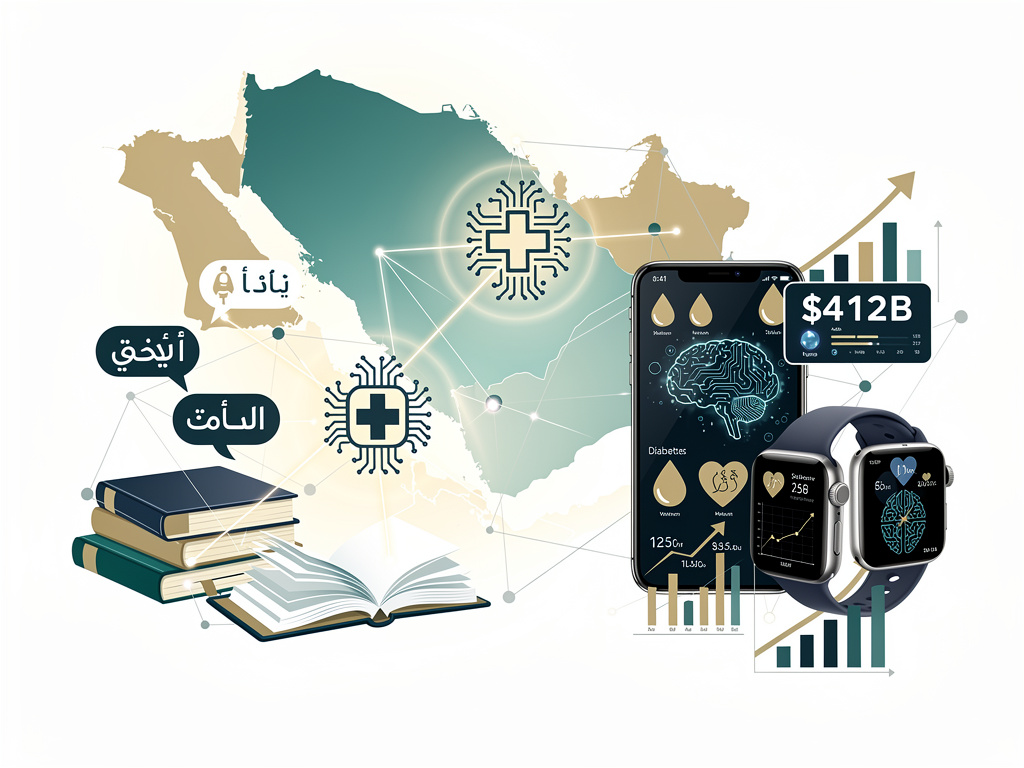
Beyond individuals, ecosystems accelerate. Abu Dhabi’s Hub71+ Life Sciences, launched in 2025, targets biotech and medtech as MENA healthcare swells toward $412 billion by 2032, per Economy Middle East. Qatar’s Cure by Deerfield accelerator selected 15 startups in November 2025, including KSA’s Adam for men’s health and UAE’s Valeo for at-home care, backed by Qatar Development Bank to forge a global hub.
Saudi Trailblazers in AI-Driven Detection
Saudi physician-entrepreneurs lead with tech tackling chronic burdens. Dr. Meshari F. Alwashmi, CEO of Amplifai Health, deploys AI-thermal imaging for diabetic foot ulcers, earning SFDA approval for its TFscan device. “Amplifai Health uses artificial intelligence (AI) and thermal imaging to make early health detection simple and accessible for everyone,” he told Entrepreneur Middle East at FII9. Collaborations with KAUST and Ministry of Health, plus Google Health AI training, enable global scaling, as he shared at Saudi House.
Dr. Adam Bataineh, internal medicine specialist, raised $400,000 pre-seed for Madeed in January 2026, led by Vision Ventures with angels like Mashhoor Aldubayan. The platform uses lab biomarkers for early disease flags, personalized protocols, and custom supplements, prioritizing prevention in Saudi Arabia. “Madeed is building an end-to-end preventive health platform focused on shifting healthcare away from reactive treatment toward early detection,” reports Wamda.
Funding surges validate the model. MENA health-tech startups pulled over $600 million by mid-2025, doubling 2024’s total, per Included VC’s Medium analysis of 224 founders. Sovereign funds drive 2026 allocations toward chronic care and remote tools, with consolidation looming for diagnostics leaders, notes GILC.
UAE and Egypt Fuel Femtech and Chronic Care
In the UAE, GCC telemedicine eyes 19.1% CAGR through 2033, propelled by initiatives like ‘Doctor for Every Citizen,’ per Entrepreneur. Femtech rises: Rashad’s Nawara empowers women beyond maternity, as she told Fast Company Middle East, where funding skews to fertility ignoring PCOS or endometriosis. Ovasave, UAE femtech, maps fertility to midlife with $1.2 million pre-seed.
Egypt’s doctor founders include Dr. Ahmed Fathy of MEDEX, redistributing near-expired drugs. Broader lists spotlight 224 ventures like Alma Health ($10 million Series A for chronic care) and GluCare.Health, slashing HbA1c 18.4% via AI-wearables, per Included VC. Vezeeta’s $40 million Series D underscores booking platforms’ scale across MENA.
Physician input ensures viability. “A natural tendency to prioritize clinical outcomes over pure profit,” Rashad observes. Forums like AHA MENA 2026 in Dubai and MedTech World Dubai (February 2026) convene them with investors, per event sites. Sovereign mandates shape flows: AI diagnostics, value-based models align with diabetes and cardio epidemics.
Investment Surge Meets Regulatory Realities
2025’s $3.5 billion MENA startup month, per Wamda, spilled into health amid turbulence. KLAIM’s $10 million Series A for claims payouts and i’SUPPLY’s $3 million financing highlight fintech-health crossovers. Yet physicians stress tailoring: MENA’s 1.58 hospital beds per 1,000—half global average—demands remote innovation amid brain drain.
Challenges linger: generic accelerators overlook clinical needs; heterogeneous payers complicate adoption. Rashad urges: “Design for heterogeneous systems: MENA healthcare systems span public, private, and out-of-pocket dominant models.” Accelerators like Cure bridge U.S.-MENA gaps, with demo days at Web Summit Qatar 2026.
For insiders, the play is clear: back physician founders blending stethoscope insight with startup grit. As Rashad concludes, their duty transcends ventures—ensuring innovations stay “safe, clinically grounded, and drives meaningful impact.” With markets maturing, 2026 positions MENA doctors to redefine care delivery.


 WebProNews is an iEntry Publication