
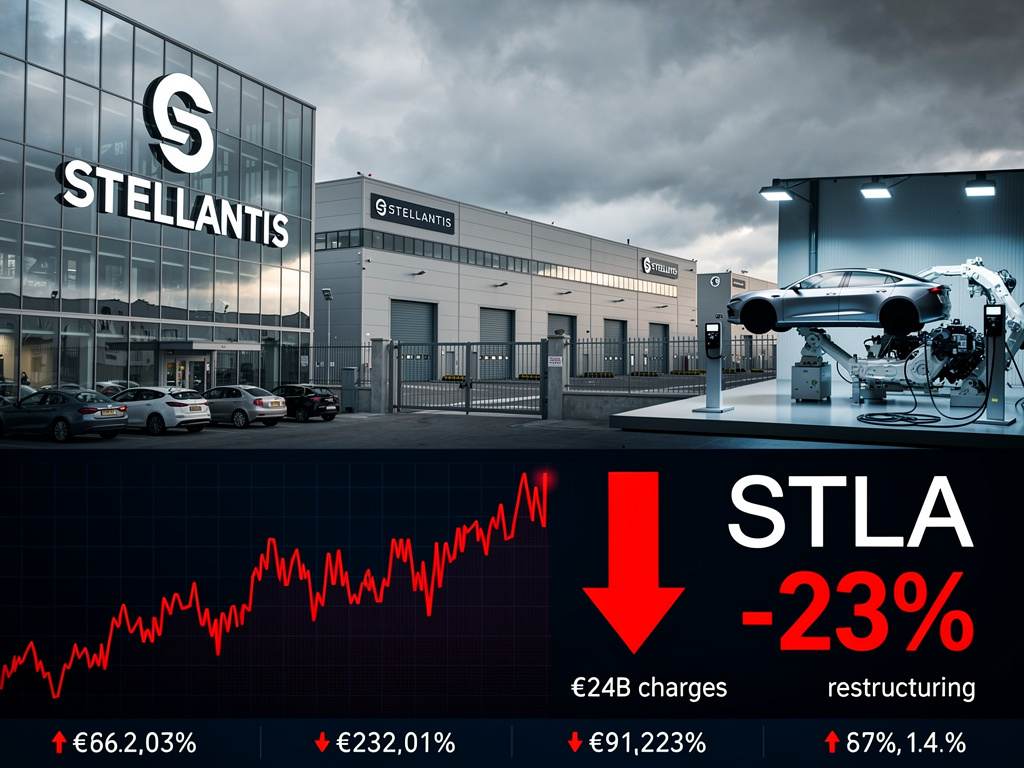
Stellantis NV, the transatlantic automaker born from the merger of Fiat Chrysler and PSA Group, saw its stock plunge roughly 23% after the company disclosed a massive financial hit tied to a sweeping business restructuring that has sent shockwaves through the global automotive industry. The reset, which encompasses billions in impairment charges, restructuring costs, and strategic pivots away from underperforming brands and markets, represents one of the most dramatic corporate overhauls in recent automotive history.
The company announced approximately €24 billion (roughly $26 billion) in total charges as part of what CEO Carlos Tavares’s successor and the board have characterized as a necessary reckoning with years of strategic missteps, shifting consumer demand, and the costly transition toward electric vehicles. The announcement, reported by CNBC, laid bare the depth of the challenges facing the world’s fourth-largest automaker by volume and raised urgent questions about whether the company can regain its footing in an increasingly competitive market.
A Reckoning Years in the Making
The roots of Stellantis’s current crisis stretch back well before the formal reset announcement. The company, which houses 14 brands including Jeep, Ram, Peugeot, Citroën, Maserati, and Alfa Romeo, had been grappling with declining market share in North America — historically its most profitable region — and sluggish adoption of its electric vehicle lineup in Europe. Inventory levels at U.S. dealerships had ballooned to uncomfortable levels throughout 2024 and into 2025, forcing the company to offer steep incentives that eroded margins.
Carlos Tavares, the hard-charging CEO who had been credited with wringing extraordinary profitability out of the merged entity in its early years, departed the company in late 2024 amid growing tensions with the board over the pace and direction of the turnaround strategy. His exit left a leadership vacuum that the board moved to fill while simultaneously confronting the financial consequences of decisions made during his tenure. The €24 billion charge encompasses impairment writedowns on several underperforming brands, costs associated with plant closures and workforce reductions, and provisions for winding down or restructuring electric vehicle programs that had failed to gain commercial traction.
The Electric Vehicle Pivot That Proved Too Costly
A significant portion of the massive charge is directly attributable to Stellantis’s troubled electric vehicle strategy. The company had committed tens of billions of euros to electrification under its “Dare Forward 2030” plan, which envisioned all European sales and 50% of U.S. sales being battery electric vehicles by the end of the decade. But consumer uptake of Stellantis EVs lagged far behind projections, particularly in the critical North American market where buyers showed persistent preference for the company’s profitable internal combustion engine trucks and SUVs.
The Fiat 500e, once positioned as a cornerstone of the company’s European EV push, struggled against fierce competition from Chinese manufacturers and Tesla. Meanwhile, the electric Ram 1500 REV pickup — a vehicle that was supposed to demonstrate Stellantis’s ability to electrify its most profitable nameplates — faced repeated delays and ultimately arrived in a market where EV truck demand had softened considerably. As reported by CNBC, the company is now recalibrating its electrification timeline and writing down assets associated with EV platforms and battery manufacturing joint ventures that no longer align with revised demand forecasts.
Brand Rationalization and the Pain of Pruning a 14-Brand Portfolio
Perhaps the most consequential element of the business reset involves the future of Stellantis’s sprawling brand portfolio. When the Fiat Chrysler-PSA merger was consummated in January 2021, the combined entity inherited 14 distinct automotive brands — a number that many analysts had long argued was unsustainable. The reset appears to confirm those concerns, with the company taking significant impairment charges against brands that have failed to justify their continued existence as standalone entities.
Maserati, the Italian luxury marque that Stellantis had invested heavily in reviving, has been a particular source of financial pain. Sales of the brand’s newest models, including the Grecale SUV and the GranTurismo, fell well short of targets, and the brand’s attempted push into electric luxury with the GranTurismo Folgore found few buyers willing to pay a premium for an electric Maserati when competitors from Porsche, BMW, and emerging Chinese luxury brands offered compelling alternatives. The writedown on Maserati alone is believed to represent several billion euros of the total charge, according to industry analysts tracking the restructuring.
North American Woes Compound the Crisis
Stellantis’s troubles in North America have been especially damaging given that the region historically generated the lion’s share of the company’s operating profit. The Jeep brand, once a seemingly unstoppable profit engine, saw its U.S. market share erode as competitors from Toyota, Hyundai-Kia, and Ford introduced compelling alternatives in the mid-size and compact SUV segments. The decision to push Jeep pricing aggressively upward — a strategy that worked brilliantly during the pandemic-era supply shortages — backfired spectacularly as inventory normalized and consumers balked at sticker prices that had climbed well beyond historical norms.
Ram, the company’s full-size truck brand, faced similar headwinds. While the Ram 1500 had carved out a loyal following, the brand lost ground to the Ford F-150 and the redesigned Chevrolet Silverado. Dealer frustration boiled over publicly, with the National Chrysler Dodge Jeep Ram dealer council issuing unusually blunt criticism of the company’s pricing strategy and product cadence. The business reset includes provisions for resetting dealer relationships, adjusting pricing strategies, and accelerating the introduction of refreshed models designed to recapture lost market share.
Workforce Reductions and Plant Closures Ripple Across Continents
The human cost of the restructuring is substantial. Stellantis has signaled that tens of thousands of positions will be eliminated across its global operations, with significant cuts expected at manufacturing facilities in Italy, France, and the United States. Several plants are slated for closure or conversion, including facilities that had been earmarked for EV production but are no longer needed under the revised electrification timeline.
In Italy, where Stellantis is the country’s largest private employer and a source of intense national pride, the restructuring has triggered political backlash. Italian government officials have publicly warned the company against abandoning its commitments to domestic manufacturing, and labor unions have organized protests at plants in Turin, Melfi, and Cassino. The French government, which holds a significant stake in Stellantis through its legacy PSA shareholding, has similarly expressed concern about the impact on French workers and has urged the company to explore alternatives to outright plant closures.
Investor Reaction and the Road Ahead
The market’s response to the reset announcement was swift and brutal. Stellantis shares, which had already declined significantly from their 2023 highs, plummeted approximately 23% on the news, wiping billions of euros from the company’s market capitalization and pushing the stock to multi-year lows. The selloff reflected not just the magnitude of the charges themselves but also deep uncertainty about whether the restructuring plan goes far enough to address the company’s fundamental competitive challenges.
Several Wall Street analysts downgraded the stock in the wake of the announcement. The consensus view among automotive sector analysts is that while the charges represent a necessary clearing of the decks, the company faces a long and uncertain road to recovery. Key questions remain unanswered: Which brands will ultimately survive the rationalization process? Can Stellantis develop competitive EV platforms without the massive capital expenditures it is now pulling back? And can the company rebuild relationships with dealers and consumers who have drifted toward competitors during the period of turmoil?
A Test Case for the Global Auto Industry’s Consolidation Era
Stellantis’s crisis carries implications far beyond the company itself. The mega-merger that created Stellantis was hailed as a template for how legacy automakers could achieve the scale necessary to survive the transition to electric and autonomous vehicles. If the combined entity — with its 14 brands, global manufacturing footprint, and diversified market presence — cannot make the economics work, it raises uncomfortable questions about the viability of similar consolidation strategies across the industry.
The €24 billion reset also underscores the perilous nature of the EV transition for traditional automakers. Companies that invested too aggressively in electrification are now writing down assets as consumer adoption has proceeded more slowly than anticipated, while those that moved too cautiously risk being left behind as the technology inevitably matures. Stellantis, caught somewhere in between, is now attempting to chart a middle course — but with significantly diminished financial resources and credibility. For an industry already contending with tariff uncertainties, Chinese competition, and shifting consumer preferences, the Stellantis saga serves as a sobering reminder that even the largest players are not immune to existential risk.


 WebProNews is an iEntry Publication