
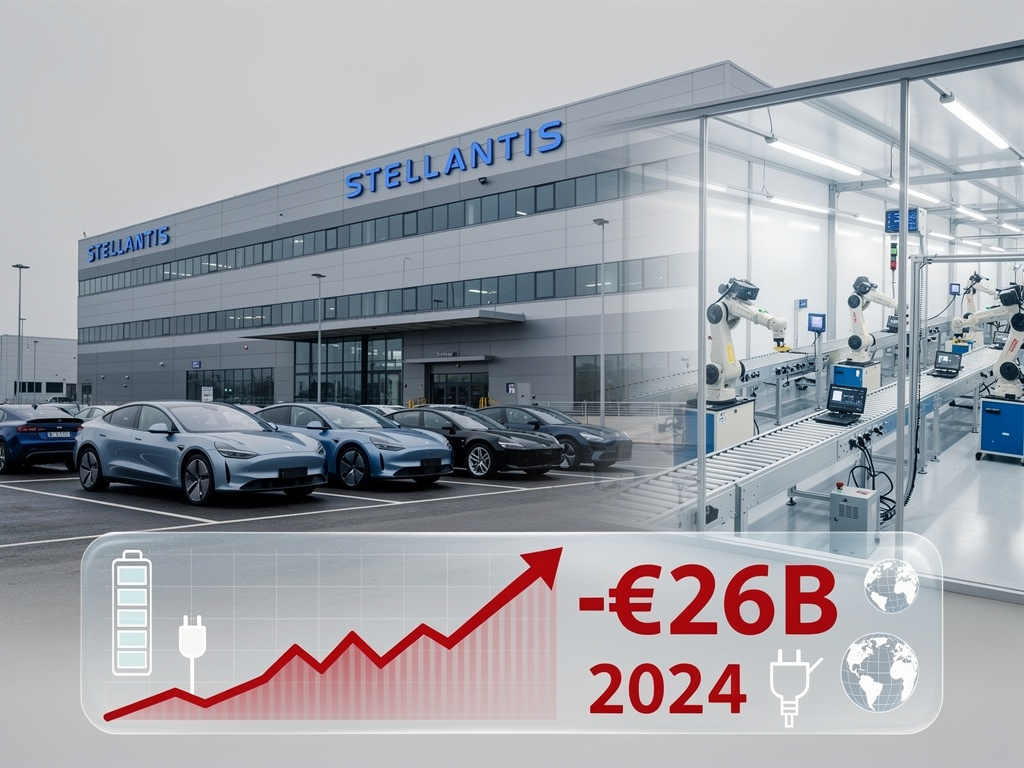
The automaker behind Jeep, Ram, Chrysler, Dodge, Peugeot, and Fiat has just posted one of the most punishing financial results in recent automotive history. Stellantis N.V., the transatlantic conglomerate born from the 2021 merger of Fiat Chrysler Automobiles and PSA Group, disclosed roughly €26 billion in combined charges and write-downs for 2024 — a figure that underscores the enormous cost of pivoting a legacy car company toward electrification while simultaneously managing a leadership crisis and cratering sales in North America.
The numbers, released alongside the company’s full-year 2024 earnings, paint a stark picture. Net revenues fell 17% year-over-year to €156.6 billion, while adjusted operating income collapsed to just €3.3 billion — a mere 2.1% margin, compared with a robust 12.8% margin the prior year. Net income swung to a loss of €1.8 billion, a dramatic reversal from the €18.6 billion profit Stellantis recorded in 2023. As Ars Technica reported, the company swallowed approximately €26 billion in costs as it fundamentally rethinks its electric vehicle strategy.
A Mountain of Write-Downs and One-Time Charges
The €26 billion figure is not a single line item but an aggregation of impairments, restructuring charges, and strategic reversals that rippled through nearly every division of the company. Stellantis took significant non-cash impairment charges tied to its battery-electric vehicle platforms, reflecting a sobering reassessment of future EV demand and the profitability of models already in the pipeline. The company also wrote down the value of certain joint ventures and technology investments that no longer align with its revised electrification timeline.
Among the most notable charges were those related to Stellantis’s multi-energy platforms, which were originally designed to support both internal combustion engines and battery-electric powertrains. The company has acknowledged that its earlier approach — attempting to build flexible architectures that could serve every propulsion type — proved more expensive and less efficient than anticipated. According to Ars Technica, the rethink involves pulling back from some previously announced EV launches and recalibrating production schedules to better match actual consumer demand, which has been softer than many automakers projected just two years ago.
North America: The Epicenter of Stellantis’s Pain
Nowhere has the downturn been more acute than in North America, historically Stellantis’s most profitable market. U.S. shipments plummeted, with the company losing significant market share across its Jeep, Ram, Dodge, and Chrysler brands. Dealer inventories ballooned in 2023 and early 2024 as the company pushed vehicles onto lots that consumers weren’t buying at sticker prices. The resulting wave of incentive spending and production cutbacks hammered margins. The North American adjusted operating margin, once the envy of the industry at well above 15%, fell into low-single-digit territory.
The problems in North America were compounded by an aging product lineup. Several key models — including the Jeep Grand Cherokee and Ram 1500 — faced intensifying competition from refreshed offerings by Ford, General Motors, and Toyota. Stellantis’s decision to push pricing aggressively during the post-pandemic seller’s market backfired when interest rates rose and consumers balked. Dealers, many of whom had publicly criticized former CEO Carlos Tavares for the pricing strategy, found themselves sitting on months of unsold inventory.
The Departure of Carlos Tavares and a Leadership Vacuum
The financial results also reflect the turbulence created by the abrupt departure of CEO Carlos Tavares in December 2024. Tavares, the hard-charging Portuguese executive who had engineered the FCA-PSA merger and was celebrated for his relentless cost-cutting, resigned amid growing tensions with the board of directors over the company’s strategic direction. His exit left Stellantis without a permanent chief executive at a critical juncture, with the board appointing chairman John Elkann to oversee operations on an interim basis while a search for a successor was conducted.
Tavares’s legacy is complicated. He delivered record profits in 2022 and 2023 through aggressive margin management, but critics argued he underinvested in new products and alienated the North American dealer network. His departure triggered a wave of additional executive changes, with several senior leaders leaving or being reassigned in the weeks that followed. The leadership instability added another layer of uncertainty for investors, employees, and business partners already rattled by the deteriorating financial performance.
Rethinking the EV Roadmap Under Pressure
Stellantis’s revised EV strategy represents a significant departure from the ambitious “Dare Forward 2030” plan that Tavares unveiled in early 2022. That plan called for more than 75 battery-electric models across the company’s 14 brands by the end of the decade, with the goal of achieving 100% BEV sales in Europe and 50% in North America by 2030. The company pledged to invest more than €30 billion in electrification and software through 2025.
Reality has intervened. Consumer adoption of EVs, while still growing, has not followed the hockey-stick trajectory that many automakers and analysts predicted. In the United States, EV market share growth has slowed, with hybrids and plug-in hybrids gaining favor among buyers who want improved fuel economy without the range anxiety and charging infrastructure challenges associated with fully electric vehicles. Stellantis has responded by delaying or canceling certain EV launches and increasing its investment in hybrid powertrains — a pragmatic pivot that mirrors similar moves by Ford, General Motors, and Mercedes-Benz.
Battery Partnerships and Supply Chain Recalibrations
The write-downs also reflect shifting economics in Stellantis’s battery supply chain. The company had entered into multiple joint ventures to build gigafactories in North America and Europe, including partnerships with Samsung SDI and LG Energy Solution. Some of these projects have been scaled back or delayed as the company reassesses how much battery capacity it will actually need in the near term. The overcapacity risk in the global battery market — driven by massive Chinese investment in cell production — has further complicated the calculus.
Stellantis’s joint venture with Samsung SDI to build a battery plant in Kokomo, Indiana, has been a focal point of scrutiny. While the project is still moving forward, the timeline and production targets have been adjusted. The company is also exploring alternative battery chemistries, including lithium iron phosphate (LFP) cells, which are cheaper to produce and better suited for mass-market vehicles, even if they offer lower energy density than the nickel-manganese-cobalt (NMC) cells used in most current EVs.
European Operations and Regulatory Headwinds
In Europe, Stellantis faces a different but equally challenging set of pressures. The European Union’s stringent CO2 emissions regulations are pushing automakers to sell more EVs regardless of consumer demand, with steep fines for non-compliance. Stellantis must balance the need to meet these regulatory targets against the reality that many European consumers — particularly in Southern and Eastern Europe — cannot afford the premium prices that EVs still command relative to comparable combustion-engine vehicles.
The company’s European brands, including Peugeot, Citroën, Opel, and Fiat, have introduced a range of electric and electrified models, but sales volumes have been inconsistent. Fiat’s new electric 500, for example, has struggled to match the sales success of its combustion-powered predecessor, partly due to its higher price point. Meanwhile, competition from Chinese automakers like BYD and MG (owned by SAIC Motor) is intensifying in Europe, putting additional pressure on Stellantis’s market share and pricing power in its home continent.
What Comes Next for the Transatlantic Giant
Stellantis’s board has signaled that the search for a new CEO is a top priority and that the next leader will be tasked with stabilizing operations, rebuilding relationships with dealers and unions, and charting a more realistic path to electrification. The company has also announced a renewed focus on cost reduction, targeting billions of euros in savings through streamlined operations, platform consolidation, and workforce adjustments.
Investors have reacted with a mixture of alarm and cautious hope. Stellantis shares have fallen significantly from their 2023 highs, reflecting the market’s skepticism about the company’s near-term prospects. However, some analysts argue that the massive write-downs represent a kitchen-sink quarter — a deliberate effort to clear the decks so that the incoming CEO can start with a cleaner balance sheet and more realistic expectations. The dividend, a key attraction for European investors, has been cut, but the company insists it remains committed to returning capital to shareholders over the medium term.
An Industry-Wide Cautionary Tale
Stellantis’s €26 billion reckoning is not merely a company-specific story. It is a cautionary episode for the entire global auto industry, which collectively committed hundreds of billions of dollars to electrification based on demand projections that now appear overly optimistic. Ford has acknowledged billions in losses from its EV division. General Motors has delayed several EV programs. Volkswagen is closing factories in Germany for the first time in its history. The transition to electric mobility remains inevitable in the long run, driven by regulation, technology improvements, and shifting consumer preferences — but the path is proving far more expensive and uncertain than the industry’s leaders promised their shareholders just a few years ago.
For Stellantis, the immediate task is survival and stabilization. The company still possesses formidable assets: iconic brands, a global manufacturing footprint, significant scale in both Europe and North America, and a product pipeline that, once refreshed, could restore competitiveness. But the €26 billion charge is a blunt reminder that in the auto business, strategic miscalculations compound quickly — and the bill, when it finally arrives, can be breathtaking.


 WebProNews is an iEntry Publication