
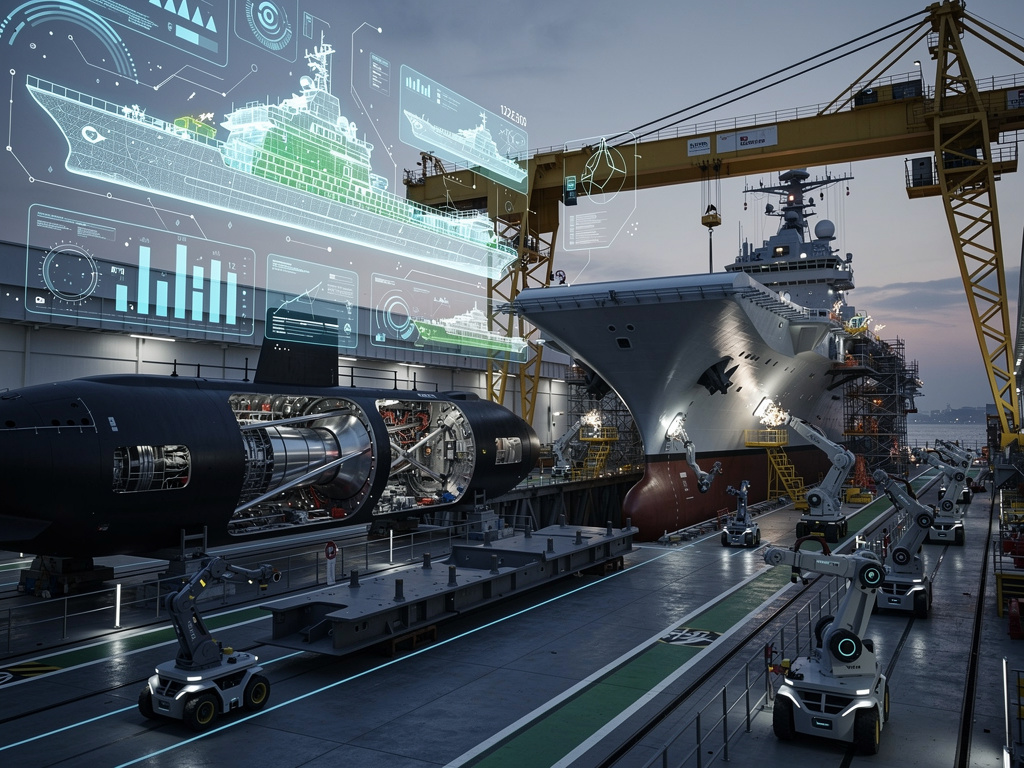
The largest military shipbuilder in the United States is making a calculated wager that artificial intelligence — not just the chatbot variety, but the kind that understands physics, spatial reasoning, and the brutal realities of bending steel — can fix what decades of labor shortages, cost overruns, and schedule delays have broken.
Huntington Ingalls Industries, the Virginia-based company responsible for building every nuclear-powered aircraft carrier in the U.S. Navy's fleet and a significant share of its submarines, is actively exploring what the industry calls "physical AI" to overhaul how ships get designed, planned, and constructed. The initiative, first reported by Business Insider, represents one of the most ambitious attempts yet to bring advanced AI into heavy industrial manufacturing — a sector that has historically resisted the kind of digital transformation that swept through software, finance, and logistics years ago.
Physical AI is not a chatbot. It's not a large language model summarizing documents or drafting emails. The term refers to AI systems that can perceive, model, and interact with the three-dimensional physical world — think digital twins of entire shipyards, robotic systems that can weld in confined spaces, and simulation engines that predict how a 100,000-ton aircraft carrier will behave under stress before a single plate of steel is cut. Nvidia CEO Jensen Huang has called physical AI the next frontier for the technology, and his company's Omniverse platform — designed to create photorealistic, physics-accurate digital simulations — sits at the center of much of this work.
Huntington Ingalls has been in conversations with Nvidia about applying these capabilities to shipbuilding, according to the Business Insider report. The shipbuilder's interest isn't academic. It's existential.
American shipbuilding is in crisis. The U.S. Navy's fleet has shrunk from nearly 600 ships during the Reagan era to roughly 290 today, even as China's navy has grown to become the world's largest by hull count. The submarines and carriers that Huntington Ingalls builds are years behind schedule and billions over budget. The Columbia-class ballistic missile submarine program — the Pentagon's top acquisition priority — has already seen delays, and the Virginia-class attack submarine production line can't keep pace with demand. The Navy wants two Virginia-class boats per year. It's been getting closer to one and a half.
The reasons are familiar and stubborn. A shrinking industrial base. An aging workforce with specialized skills that take years to develop. Shipyard infrastructure that in some cases dates to World War II. And a design-to-production pipeline that still relies heavily on two-dimensional drawings, manual processes, and tribal knowledge passed between generations of craftsmen.
Physical AI won't solve all of that. But Huntington Ingalls appears to believe it can address enough of it to matter.
Consider the problem of planning work inside a submarine under construction. Nuclear submarines are among the most complex machines ever built — denser with systems, piping, cabling, and equipment than almost any other manufactured object. Sequencing the installation of thousands of components in the right order, ensuring workers have access to tight spaces before those spaces get sealed off by subsequent work, and coordinating the flow of materials through a shipyard that might employ 25,000 people — these are combinatorial problems of staggering complexity. They are also precisely the kind of problems that AI systems, particularly those capable of spatial reasoning and optimization, are well suited to attack.
A digital twin of an entire shipyard — one that models not just the ship being built but the cranes, dry docks, workforce movements, and supply chain logistics in real time — could allow planners to simulate thousands of construction sequences and identify optimal paths that no human team could compute manually. Nvidia's Omniverse platform is designed to enable exactly this kind of large-scale physical simulation, and it's already being used in automotive manufacturing, warehouse robotics, and infrastructure planning.
Applying it to shipbuilding would be a different order of magnitude in complexity. But the payoff would be proportional.
The timing of Huntington Ingalls' exploration aligns with broader pressure from the Pentagon and Congress to modernize the defense industrial base. The Navy's 2024 shipbuilding plan calls for significant fleet growth over the next three decades, but achieving those numbers with the current production infrastructure and workforce is widely regarded as unrealistic without major changes to how ships are built. Secretary of the Navy Carlos Del Toro has repeatedly emphasized the need for shipyard modernization, and the Shipyard Infrastructure Optimization Program — a $21 billion effort to upgrade the Navy's four public shipyards — is already underway, though it focuses on maintenance facilities rather than new construction.
Private shipyards like those operated by Huntington Ingalls and its chief competitor, General Dynamics' Bath Iron Works and Electric Boat divisions, will need to find their own paths to higher productivity. AI is increasingly seen as part of the answer.
General Dynamics' Electric Boat subsidiary, which partners with Huntington Ingalls on submarine construction, has also been investing in digital tools and automation, though it has been less public about specific AI initiatives. The competitive dynamics between the two companies — and the Navy's interest in fostering innovation across its supplier base — could accelerate adoption if one builder demonstrates measurable gains.
The workforce question looms over everything. Shipbuilding is physically demanding, highly skilled work. Welders, pipefitters, electricians, and nuclear-qualified technicians don't appear overnight. Huntington Ingalls' Newport News Shipbuilding division and its Ingalls Shipbuilding yard in Pascagoula, Mississippi, have both struggled with recruitment and retention, a problem shared across American manufacturing. Physical AI could help in two ways: by automating some of the most dangerous or repetitive tasks, and by making remaining human workers more productive through better planning, augmented reality guidance, and predictive maintenance tools that reduce rework.
Rework is a killer in shipbuilding. When something is installed incorrectly or out of sequence on a submarine, fixing it can require tearing out completed work, sometimes at enormous cost. The Navy has estimated that rework accounts for a significant percentage of total construction labor hours on major shipbuilding programs. An AI system that catches design conflicts before they reach the shop floor, or that optimizes installation sequences to minimize the risk of errors, could save hundreds of millions of dollars per ship.
That's not speculation. It's arithmetic.
The broader industrial AI market is moving fast. Companies like Siemens, with its Xcelerator platform, and Dassault Systèmes, with its 3DEXPERIENCE suite, have been building digital twin and simulation capabilities for manufacturing for years. But the integration of generative AI and physics-based simulation — what Nvidia and others are now calling physical AI — represents a new capability tier. These systems don't just model what exists; they can generate new designs, optimize processes, and predict failures in ways that previous-generation tools could not.
For Huntington Ingalls, the challenge will be integration. Shipbuilding programs span decades. The design tools, production planning systems, and quality assurance processes in use today were built over many years and are deeply embedded in how work gets done. Introducing AI into that environment requires not just new software but new workflows, new training, and — perhaps most difficult — new institutional trust in machine-generated recommendations.
Shipbuilders are conservative for good reason. When you're building a nuclear reactor inside a submarine that will operate submerged for months, there is zero tolerance for error. The verification and validation requirements for any AI system used in design or production would be extraordinary. And the classified nature of much of the work adds another layer of complexity — AI systems trained on sensitive data must operate within strict security boundaries.
None of this is insurmountable. But it means the path from exploration to production deployment will be measured in years, not months.
Still, the strategic logic is compelling. China's shipbuilding capacity dwarfs America's by a factor of more than 200 to 1 in commercial tonnage, according to a 2024 report from the Office of Naval Intelligence. While military shipbuilding is a different discipline than commercial construction, the underlying industrial capacity — the workforce, the supply chains, the infrastructure — is related. The United States cannot out-build China hull for hull. It must out-think and out-engineer its way to a competitive fleet. Physical AI is one of the most promising tools available for doing so.
Huntington Ingalls' stock has reflected the defense sector's broader strength in recent years, buoyed by rising Pentagon budgets and bipartisan support for naval expansion. But investors have also punished the company when program delays and cost growth have surfaced. Demonstrating that AI can bend the cost and schedule curves — even modestly — would be significant for the company's valuation and for the Navy's confidence in its industrial partners.
The company hasn't disclosed financial details of its AI investments or a specific timeline for deployment. That's typical for early-stage industrial technology programs, particularly in the defense sector where competitive and security considerations limit public disclosure. But the fact that Huntington Ingalls is engaging with Nvidia — a company whose market capitalization now exceeds $2.5 trillion, driven largely by AI demand — signals the seriousness of the effort.
And it signals something else. The era of shipbuilding as a purely artisanal, labor-intensive craft may be ending. Not because the skills of welders and pipefitters are becoming obsolete — they aren't, and won't be for a long time — but because the planning, coordination, and optimization layers above the shop floor are ripe for transformation. The ships themselves will still be built by human hands. But the intelligence guiding those hands may increasingly come from machines that can see the entire construction process in ways no human mind can.
For an industry that traces its American roots to the Continental Navy of 1775, that's a profound change. And for a nation that depends on naval power for its security and its global position, it may be an essential one.


 WebProNews is an iEntry Publication