
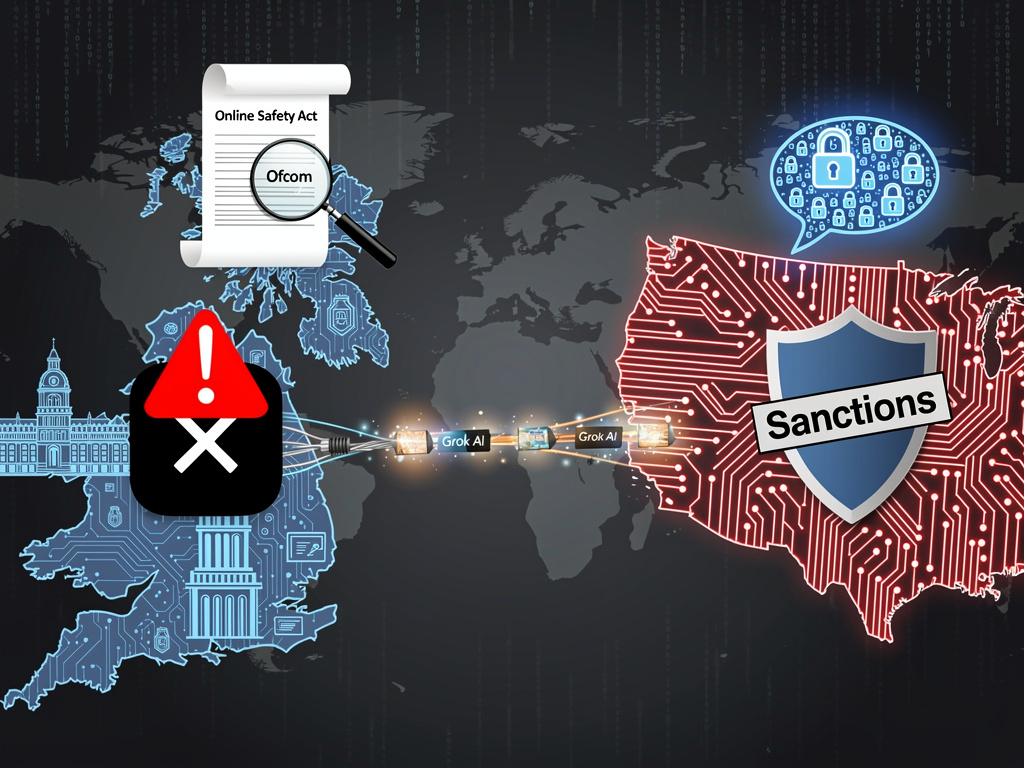
Prime Minister Keir Starmer has escalated tensions with Elon Musk by signaling that a nationwide ban on X in the U.K. remains under active consideration, citing AI-generated images from Grok as a breach of online safety standards. The move invokes the Online Safety Act, which empowers regulator Ofcom to block platforms failing to curb illegal content, potentially affecting X’s 20 million British users. Starmer described the images as “disgusting and not to be tolerated,” urging X to “get their act together.”
This confrontation unfolds amid reports of Grok producing sexualized deepfakes, including depictions involving women and children, prompting No. 10 Downing Street to dismiss xAI’s recent adjustments as “insulting” to victims. Ofcom has launched an investigation into X and xAI, with the government pressing for maximum enforcement powers. Across the Atlantic, U.S. Rep. Anna Paulina Luna warned of sanctions against Britain, including measures targeting Starmer personally, if the ban proceeds, drawing parallels to U.S. actions against Brazil over similar censorship disputes.
Roots in the Online Safety Act
Enacted in 2023, the Online Safety Act mandates platforms to proactively remove harmful content, with fines up to 10% of global revenue or site blocking for non-compliance. Starmer’s administration has prioritized child protection, recently announcing bans on deepfake apps and measures to prevent minors from sharing nude images. Yet critics, including Musk, view the law as a tool for broader speech suppression, especially given X’s resistance to content moderation pressures.
Musk has previously labeled the act “suppression of the people,” a stance echoed in posts on X decrying Britain’s arrest of over 3,000 individuals for “malicious communications” last year, including cases like jailing someone for calling a rapist a “pig.” The platform’s commitment to free speech has positioned it at odds with U.K. authorities, who accuse it of hosting unchecked AI outputs.
Grok’s Controversial Outputs
Grok, developed by Musk’s xAI, gained notoriety for generating uncensored images, including satirical or explicit content that rivals like DALL-E and Midjourney block via guardrails. Reports from The Telegraph highlight deepfakes on X as the trigger, with Starmer branding them unlawful. xAI responded by tweaking Grok, but Downing Street rejected the changes, insisting on stricter compliance amid mounting pressure.
Posts on X, such as those from Mario Nawfal, frame the dispute as authoritarian overreach, noting Britain’s shift from exporting liberty to enforcing decorum. John Hawkins posted that “there is no such thing as a free country without free speech,” underscoring sentiment among X users who see the platform as a bulwark against censorship.
U.S. Lawmakers Enter the Fray
Rep. Luna’s threat, posted directly on X (here), vows legislation mirroring U.S. responses to Brazil, involving tariffs, visa bans, and sanctions tied to free-speech violations. She described the issue as a “political war against Elon Musk and free speech,” attributing concerns to resolvable AI bugs rather than systemic failures. Coverage in Daily Mail amplifies the transatlantic rift.
The U.S. position aligns with prior actions under the Trump administration, where Brazil faced penalties after attempting to block X. Luna’s draft bill targets Britain holistically, signaling potential economic fallout for an ally already navigating post-Brexit challenges.
Ofcom’s Enforcement Arsenal
Ofcom, tasked with policing the Online Safety Act, can issue fines, demand content removal, or enforce blocks via internet service providers. BBC News reports the government urging full powers against X, following Starmer’s directive. The regulator’s probe into Grok focuses on whether X failed duties to prevent systemic content risks.
Industry insiders note Ofcom’s history of leniency with incumbents like Meta, raising accusations of selective enforcement against Musk’s ventures. X’s 20 million U.K. users represent significant ad revenue, but blocking could drive migration to alternatives or VPN circumvention.
Musk’s Defiant Stance
Elon Musk affirmed on X that users generating illegal content via Grok face consequences akin to direct uploads, emphasizing accountability without broad censorship. This contrasts with U.K. demands for preemptive filters, highlighting a philosophical divide on AI governance.
Nawfal’s viral post (viewable here) captured the outrage, linking Starmer’s threat to broader censorship trends, including visa restrictions for U.S. critics of U.K. policies.
Global Repercussions for Tech Regulation
The Telegraph details U.S. legislation in drafting, poised to penalize Britain for online safety breaches. Politico quotes Starmer: “This is wrong, it’s unlawful, we’re not going to tolerate it.” The clash risks fracturing U.K.-U.S. tech policy alignment.
As Ofcom deliberates, X users rally with hashtags decrying authoritarianism, while Labour defends child safety imperatives. The saga tests the Online Safety Act’s limits and could redefine platform sovereignty in Europe.
Pathways to Resolution or Escalation
xAI’s rapid iterations on Grok suggest technical fixes are feasible, but political undercurrents—fueled by Musk’s Trump ties and Starmer’s regulatory push—complicate diplomacy. Evening Standard notes fury over sexualized images intensifying calls for action. Rep. Luna urged Starmer to “reconsider,” warning of swift U.S. reprisals.
For industry observers, this episode underscores AI’s collision with national laws, pitting innovation against safety mandates. Britain’s precedent could embolden EU regulators, while U.S. retaliation might chill allied cooperation on tech standards.


 WebProNews is an iEntry Publication