
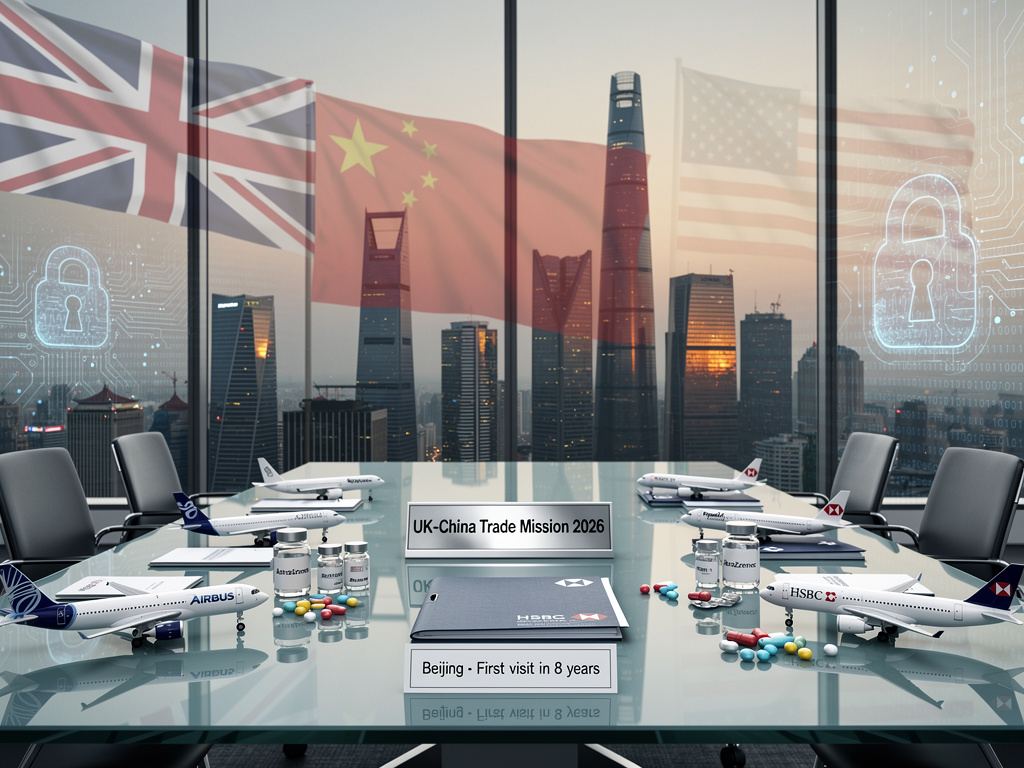
British Prime Minister Keir Starmer landed in Beijing on January 28, 2026, flanked by nearly 60 executives from top firms, marking the first UK leader’s visit to China in eight years. The three-day trip to Beijing and Shanghai underscores London’s push to revive trade ties amid global tensions, with executives from Airbus, AstraZeneca, and HSBC leading a delegation that includes representatives from BP, Rolls-Royce, Jaguar Land Rover, GSK, British Airways, and the London Stock Exchange Group. Starmer aims to meet President Xi Jinping and Premier Li Qiang on Thursday, focusing on financial services, life sciences, and creative industries, as a government statement outlined plans to “push for access in areas where better co-operation with China would boost growth and deliver prosperity for the British people.”
Corporate Powerhouse Delegation Takes Flight
Executives like AstraZeneca CEO Pascal Soriot, HSBC Chairman Brendan Nelson, GSK Chair Sir Jonathan Symonds, Airbus general counsel John Harrison, and British Airways Chief Commercial Officer Colm Lacy are central to the mission, signaling deep business interest despite security concerns. The group also features leaders from Aberdeen Group, Octopus Energy, Diageo, Prudential, and cultural outfits like the National Theatre and Science Museum. Chancellor Rachel Reeves and Business Secretary Peter Kyle accompany Starmer, highlighting the economic stakes. A revamped UK-China CEO Council, involving firms such as Schroders and Standard Chartered, is set to launch, reviving echoes of the pre-2018 “golden era,” according to Reuters.
China’s Ministry of Commerce noted the large delegation reflects the UK’s eagerness to deepen ties, preparing deliverables for the visit and a 2026 China-UK Business Council meeting, as reported by China Daily. Yet, the trip follows London’s approval of a controversial mega-embassy near the Tower of London, greenlit by Communities Secretary Steve Reed after spy chiefs deemed risks manageable, a move that cleared the path but drew spy fears.
Security Shadows Over Economic Outreach
Intelligence worries prompted the delegation to ditch the government jet and use disposable devices amid ongoing Chinese hacking operations like Salt Typhoon, with U.S. sources warning of exposure risks. Starmer dismissed phone hack claims en route, insisting “there’s no evidence of that. We’ve got robust schemes, security measures in place.” Former Security Minister Tom Tugendhat criticized the measures, posting on X that the group was using a “burner plane.” Conservative shadow foreign secretary Priti Patel slammed the visit, stating “the evidence is overwhelming that China poses a serious threat to our national security and it is clear Keir Starmer is going to China without any leverage,” per BBC News.
Starmer vowed a “clear-eyed and realistic” approach, emphasizing that economic cooperation won’t compromise national security. “He will be clear that we will not trade economic co-operation for our national security. He will raise the areas where we disagree with China,” the government said, as detailed in CNBC. Issues like Hong Kong pro-democracy figure Jimmy Lai’s conviction and espionage allegations loom large, with former Hong Kong governor Lord Chris Patten urging Starmer to raise Lai’s case or risk appearing “pathetic,” according to The Standard.
The prime minister framed engagement as essential: “Without meaningful dialogue, we make no progress at all. Sticking our heads in the sand and refusing to engage would be a staggering dereliction of duty.” He previously described non-engagement as “just staggering,” aligning with prior outreach by Foreign Secretary David Lammy and Reeves, who secured £600 million in investments last year.
U.S. Tensions Fuel Pragmatic Pivot
Starmer’s journey coincides with strained UK-U.S. relations under President Donald Trump, whose threats over Greenland, the Chagos Islands, and NATO contributions have unsettled allies. “I’m a pragmatist, a British pragmatist applying common sense,” Starmer said, rejecting a binary choice between the U.S. and Europe, as quoted by Reuters. Recent visits by Canada’s Mark Carney, Ireland’s Michael Martin, South Korea’s Lee Jae Myung, and Finland’s Petteri Orpo highlight Beijing’s openness amid Washington’s unpredictability.
Analysts see limited breakthroughs, with The Guardian calling it a “very low bar,” citing China’s economic slowdown and UK leverage gaps. Pressure mounts over British Steel in Scunthorpe, now state-controlled after Chinese owner Jingye’s pullback. Pharma leaders like Soriot praise China’s “China speed” for R&D acceleration, fueling life sciences hopes.
Historical chill followed Theresa May’s 2018 trip, triggered by Hong Kong crackdowns and Huawei’s 5G ban. Starmer seeks a pragmatic reset post-2024 election, prioritizing growth amid domestic economic pledges. Beijing welcomed Starmer with flowers at the airport, setting a cordial tone for talks on mutual financial benefits and beyond.
Pharma and Finance Lead Sector Surge
AstraZeneca and GSK executives eye expanded clinical trials and market access, while HSBC’s Nelson pushes financial services liberalization. Aviation players Airbus and Rolls-Royce target manufacturing and joint ventures, with Jaguar Land Rover seeking EV supply chain stability. Cultural ties via the National Theatre aim to bolster creative exports, per The Guardian.
The delegation’s breadth—from Barclays to Intercontinental Hotels Group—signals a comprehensive economic thaw. China Daily’s commerce spokesperson stressed bilateral preparations, positioning the visit as a cooperation milestone. As Starmer proceeds to Shanghai Friday for local executive meetings, outcomes could redefine UK-China dynamics amid superpower strains.


 WebProNews is an iEntry Publication