
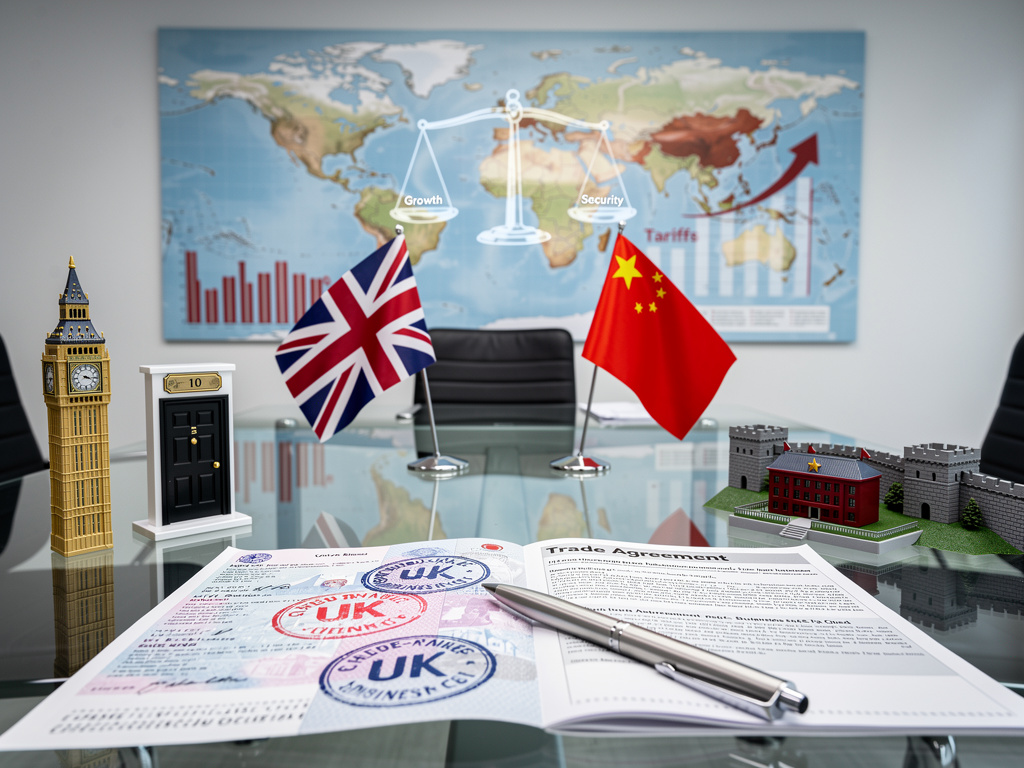
British Prime Minister Keir Starmer’s four-day visit to China, kicking off on January 28, 2026, marks the first such trip by a UK leader in eight years and signals a deliberate pivot toward warmer ties with Beijing. Meeting Chinese President Xi Jinping in Beijing’s Great Hall of the People on January 29, Starmer pushed for a “more sophisticated relationship” that balances economic opportunities with candid dialogue on disagreements. Xi, in turn, expressed readiness for a “long-term and consistent strategic partnership,” acknowledging past “twists and turns” that harmed both nations. The summit yielded immediate wins, including visa-free travel for Britons staying under 30 days—a concession aligning the UK with 50 other countries—and progress on slashing Chinese tariffs on Scotch whisky.
Accompanied by over 50 business executives from firms like AstraZeneca, HSBC, GSK, Airbus, and Jaguar Land Rover, Starmer addressed the delegation upon arrival, declaring, “On this delegation, you’re making history.” AstraZeneca announced a $15 billion investment in China during the visit, underscoring the commercial stakes. Agreements also expanded cooperation in education, healthcare, finance, AI research, biological sciences, and new energy, while Beijing pledged to foster a fair environment for Chinese firms in the UK. Starmer described the talks as “positive” with a “productive outcome,” affirming the relationship is now in a “good, strong place.” CNBC detailed these pacts, highlighting Starmer’s call for British firms to seize openings in the world’s second-largest economy.
From Ice Age to Strategic Partnership
Relations plummeted under prior Conservative governments, swinging from a “golden era” proclaimed by Theresa May in 2018 to an “ice age,” as Starmer put it en route to Beijing. Tensions escalated over Beijing’s 2020 Hong Kong national security law—imposed after pro-democracy protests in the former British colony—allegations of Chinese espionage targeting UK politicians and officials, and cyberattacks linked to China-based tech firms, prompting UK sanctions in December 2025. The UK trade deficit with China swelled 18% to £42 billion ($58.1 billion) in the year to June 2025, per official data, amid a deteriorating business climate where 60% of British firms reported tougher operations, according to a December 2025 British Chamber of Commerce in China survey. Reuters noted Starmer’s post-meeting optimism, quoting him affirming Xi as someone he could “do business with.”
Starmer raised human rights concerns directly, including the detention of British citizen Jimmy Lai, convicted in December under Hong Kong’s security law, and Uyghur treatment in Xinjiang. Human Rights Watch UK Director Yasmine Ahmed urged Starmer to press for Lai’s release and spotlight Hong Kong’s freedoms erosion. Shadow Home Office Minister Alicia Kearns criticized the trip sans preconditions on Lai. Yet Starmer insisted on a “clear-eyed” approach, maintaining “guardrails” on security while pursuing growth. The UK recently approved a controversial new Chinese embassy in London after years of delays over espionage fears, a move Xi had raised in their first call in August 2024. The Guardian covered Starmer’s balancing act on infrastructure limits and human rights pressure.
Business Blitz Fuels Economic Push
The delegation’s heft—nearly 60 firms and cultural groups—reflects Starmer’s growth mandate post-2024 election. He told leaders, “Everything you’re doing here… is focused on how do we benefit people at home.” Priorities span financial services, creative industries, life sciences, and clean energy, with British consumers eyeing affordable Chinese EVs, solar panels, and turbines. No firm exits from China are underway despite challenges, though expansion remains cautious. Starmer invoked Xi’s parable of blind men mistaking an elephant’s parts for unrelated objects, arguing deeper engagement reveals the full picture. The New York Times framed the visit as promoting business ties amid US-Europe strains.
Xi criticized “unilateralism, protectionism, and power politics” eroding global order, urging major powers to uphold international law lest the world revert to a “jungle-like” state—a veiled swipe at US policy. Starmer echoed calls for joint work on climate change and stability “during challenging times.” Both leaders pledged high-level dialogue continuity. NPR highlighted their “comprehensive strategic partnership” amid uncertainty.
Navigating Trump’s Shadow
Starmer’s timing coincides with a flurry of Western visits to Beijing: Canada’s Mark Carney secured a trade deal slashing EV and canola tariffs; Ireland’s Michael Martin made his first trip in 14 years; Finland’s Petteri Orpo and South Korea’s Lee Jae Myung followed. Trump threatened 100% tariffs on Canada for China dealings and plans his own Beijing visit in April. Starmer rejected choosing between superpowers, stressing US ties on defense and trade remain paramount. Beijing touts itself as a stable partner versus Washington’s volatility. Fudan University’s Wu Xinbo called the visit a “restart under a new situation.” Al Jazeera noted the thaw in frosty ties.
Opposition Leader Kemi Badenoch decried the trip, saying she’d prioritize aligned nations over one “undermining our economy.” Starmer countered that ignoring China defies national interest. Cultural gestures—like gifting Xi a Manchester United-Arsenal match ball—aimed at personal rapport, potentially aiding Ukraine peace efforts via Chinese leverage. BBC News live updates confirmed visa-free gains and Starmer’s national interest rationale.
Security Guardrails Hold Firm
UK policy bars Chinese investment in sensitive telecoms and nuclear plants, with ongoing scrutiny of firms like offshore wind giant Mingyang. Starmer dodged questions on Mingyang turbines for UK farms, noting no decision yet. Cooperation on English Channel human trafficking was announced post-meeting. Xi praised past Labour governments’ contributions, signaling preference for Starmer’s steadiness. As Starmer heads to Shanghai, the visit cements a pragmatic reset: economic upside with security vigilance, positioning the UK amid superpower flux. Reuters analyzed the US tensions navigation.


 WebProNews is an iEntry Publication