
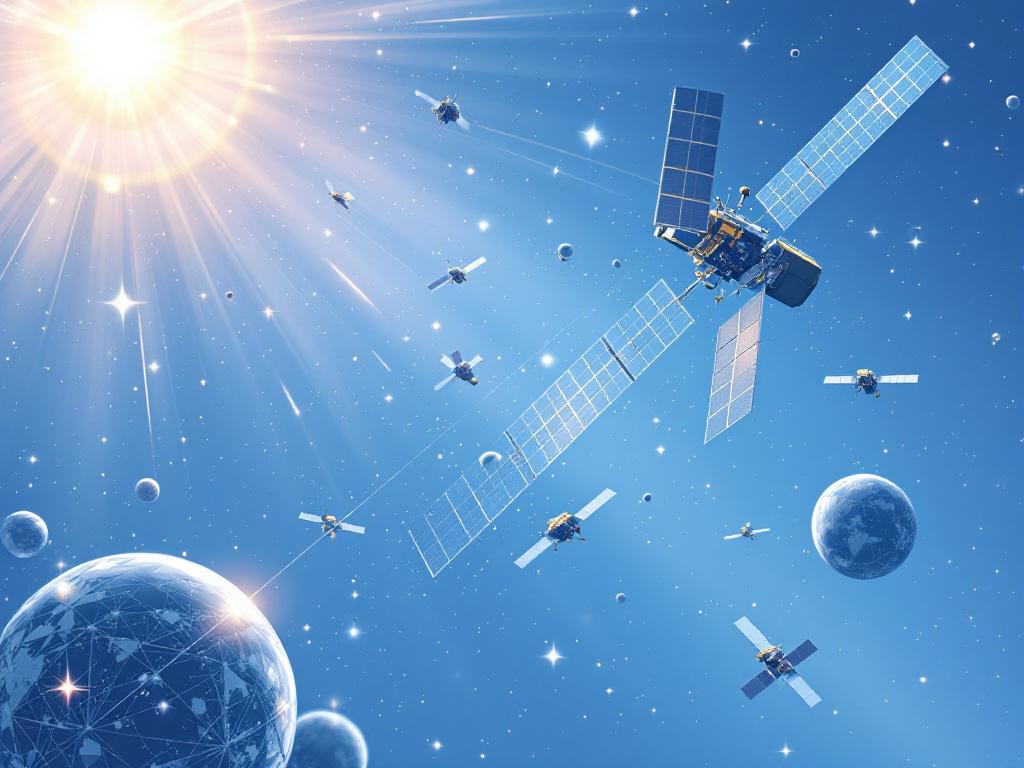
Orbiting Shadows: Satellite Swarms Eclipse the Cosmos for Hubble and Fellow Telescopes
The Hubble Space Telescope, orbiting Earth since 1990, has long been a beacon for astronomers, capturing stunning images of distant galaxies and nebulae free from the distortions of our planet’s atmosphere. But a new threat looms not from below, but from all around: the rapid proliferation of satellites in low-Earth orbit. Recent studies reveal that these artificial constellations, designed to beam internet and communications services worldwide, are now casting unwanted light into Hubble’s field of view, potentially contaminating a significant portion of its observations. This issue, once confined to ground-based observatories, has escalated to space itself, prompting urgent calls for mitigation from the scientific community.
At the heart of the problem are megaconstellations like SpaceX’s Starlink, which already boasts thousands of satellites and plans for tens of thousands more. These satellites reflect sunlight, creating streaks across astronomical images. A groundbreaking NASA study, led by Spanish astrophysicist Alejandro Serrano Borlaff, warns that if proposed launches proceed, bringing the total to over 500,000 satellites, at least one in three Hubble images could be affected. The research, published in Nature, simulates the impact on Hubble and other space telescopes, highlighting a future where pristine cosmic views become increasingly rare.
This isn’t just a hypothetical concern. Current data from Hubble already shows satellite trails in about 3% of its exposures, a figure that’s climbing as more satellites are deployed. The study’s projections are stark: by the 2030s, with constellations fully realized, Hubble’s wide-field instruments could see contamination in up to 39% of images. For newer telescopes like NASA’s SPHEREx, the European Space Agency’s ARRAKIHS, and China’s Xuntian, the outlook is even grimmer, with over 96% of images potentially marred by bright streaks averaging a surface brightness that rivals faint astronomical targets.
The Mechanics of Celestial Interference
To understand the severity, consider how space telescopes operate. Unlike ground-based ones, which can sometimes dodge urban glow by relocating to remote sites, orbiting observatories like Hubble are fixed in their paths, circling Earth every 97 minutes. Satellites in low-Earth orbit, typically at altitudes of 300 to 600 kilometers, zip through these telescopes’ fields of view at high speeds, reflecting sunlight that appears as intrusive lines in long-exposure images. The NASA study modeled this using detailed orbital dynamics, factoring in satellite brightness, density, and the specific observing strategies of various telescopes.
One key insight from the research is the role of satellite altitude and reflectivity. Starlink satellites, for instance, are designed with anti-reflective coatings, but as noted in reports from EL PAÍS English, promised improvements by Elon Musk have not fully materialized. The study estimates that without further mitigations, the average number of satellite trails per Hubble exposure could rise to about 1.2, with brighter ones posing the most disruption to faint-object astronomy.
Industry insiders point out that the problem extends beyond visible light. Radio frequency interference from these satellites could also jam sensitive instruments, though the current focus is on optical pollution. A 2021 report from the Center for Space Policy and Strategy, detailed in a document available at Aerospace Corporation, emphasized that while temporary fixes exist for single satellite passes, the sheer volume of planned deployments demands coordinated global strategies.
Broader Implications for Astronomical Research
The ramifications for science are profound. Hubble’s contributions, from measuring the universe’s expansion rate to discovering exoplanets, rely on unblemished data. Contaminated images require time-consuming processing to remove streaks, and in worst cases, entire datasets become unusable. For missions like SPHEREx, which aims to map the sky in infrared to study galaxy formation, satellite interference could slash effective observing time by more than half, inflating costs and delaying discoveries.
Astronomers are not alone in their concerns. Posts on X, formerly Twitter, from users including those affiliated with NASA and the European Southern Observatory, reflect growing sentiment that light pollution is eroding humanity’s view of the stars. One post highlighted how over 80% of the world’s population can no longer see the Milky Way due to terrestrial lights, a plight now extending to space. Another shared concerns from 2019 about Starlink’s initial launches, underscoring that the issue has been brewing for years.
Regulatory bodies are beginning to take notice. The Federal Communications Commission in the U.S. has started requiring satellite operators to assess astronomical impacts, but international coordination remains fragmented. The International Astronomical Union has advocated for darker satellite designs and orbital restrictions, yet enforcement is challenging in the privatized space sector.
Technological Countermeasures and Industry Responses
In response, some companies are experimenting with solutions. SpaceX has tested visors on Starlink satellites to reduce reflectivity, though effectiveness varies with orbital position. A piece in Big Think explores adaptive optics and software algorithms that could filter out satellite trails post-capture, but these are bandaids rather than cures, especially for space-based systems where real-time adjustments are limited.
For future telescopes, designers are considering higher orbits to escape the densest satellite belts. The James Webb Space Telescope, stationed at Lagrange Point 2 a million miles from Earth, avoids much of this clutter, but not all missions can afford such distant placements. The NASA study proposes a multi-pronged approach: dimming satellites through material science, optimizing telescope scheduling to avoid peak satellite traffic, and establishing “dark sky” orbital zones free from commercial deployments.
Critics argue that without binding regulations, voluntary measures will fall short. Elon Musk’s earlier dismissal of ground-based concerns—suggesting astronomers move to space—now rings ironic as even Hubble faces the same fate. As reported in The Register, the proliferation of low-Earth orbit communications satellites is likened to rabbits multiplying unchecked, overwhelming the orbital environment.
Voices from the Field and Future Projections
Interviews with astronomers paint a picture of frustration mixed with determination. Alejandro Serrano Borlaff, in discussions referenced in the Nature paper, stresses that this is the first study to quantify space telescope vulnerabilities comprehensively. He warns that without intervention, the next decade could see a “tipping point” where astronomical productivity plummets.
On X, posts from figures like science communicator Massimo highlight the cultural loss: the Milky Way, once a guide for navigation and inspiration, is vanishing for billions. A New York Times post from 2023 noted early photobombing in Hubble images, a trend that’s accelerated. Meanwhile, NASA’s Webb Telescope account discusses challenges in visible light observations, indirectly underscoring why infrared alternatives might gain prominence.
Looking ahead, projections from Forbes suggest that by 2035, satellite light could “blind” space telescopes, compromising up to 96% of images. This has spurred calls for international treaties akin to those governing radio spectrum, perhaps under the United Nations’ Committee on the Peaceful Uses of Outer Space.
Balancing Innovation with Preservation
The tension between commercial space ambitions and scientific pursuits is palpable. Satellite megaconstellations promise global connectivity, bridging digital divides in remote areas, as detailed in a Reuters article at Reuters. Yet, this boon comes at a cost to astronomy, a field that has driven technological spin-offs from CCD cameras to medical imaging.
Experts advocate for collaborative frameworks where satellite operators share orbital data in real-time, allowing telescopes to shutter during passes. Software advancements, such as AI-driven image restoration, are in development, but they require vast computational resources. A Phys.org piece at Phys.org reports that nearly all space telescope data could be contaminated, urging immediate action.
Ultimately, the challenge is to foster a shared orbital realm. As satellite numbers swell, preserving the darkness of space becomes essential not just for science, but for humanity’s enduring quest to understand the universe. Initiatives like those from the Springer Nature group, as posted on X, emphasize minimizing contamination to sustain effective research.
Pathways to a Clearer Orbital Future
Moving forward, policy innovations could include incentives for “stealth” satellites with minimal reflectivity. International workshops, such as those planned by the American Astronomical Society, aim to bridge gaps between industry and academia. The KTEN news report at KTEN warns of the surge threatening multiple telescopes, reinforcing the need for unified standards.
Education plays a role too. Public awareness campaigns, amplified on platforms like X, could pressure companies to prioritize sustainability. For instance, posts from ESO highlight global light pollution statistics, drawing parallels to the orbital crisis.
In the end, safeguarding space telescopes like Hubble requires a delicate balance: harnessing the benefits of satellite technology while ensuring the stars remain visible for generations of astronomers to come. As the orbital environment grows crowded, proactive measures today could prevent a future where the cosmos is shrouded in artificial glow.


 WebProNews is an iEntry Publication