
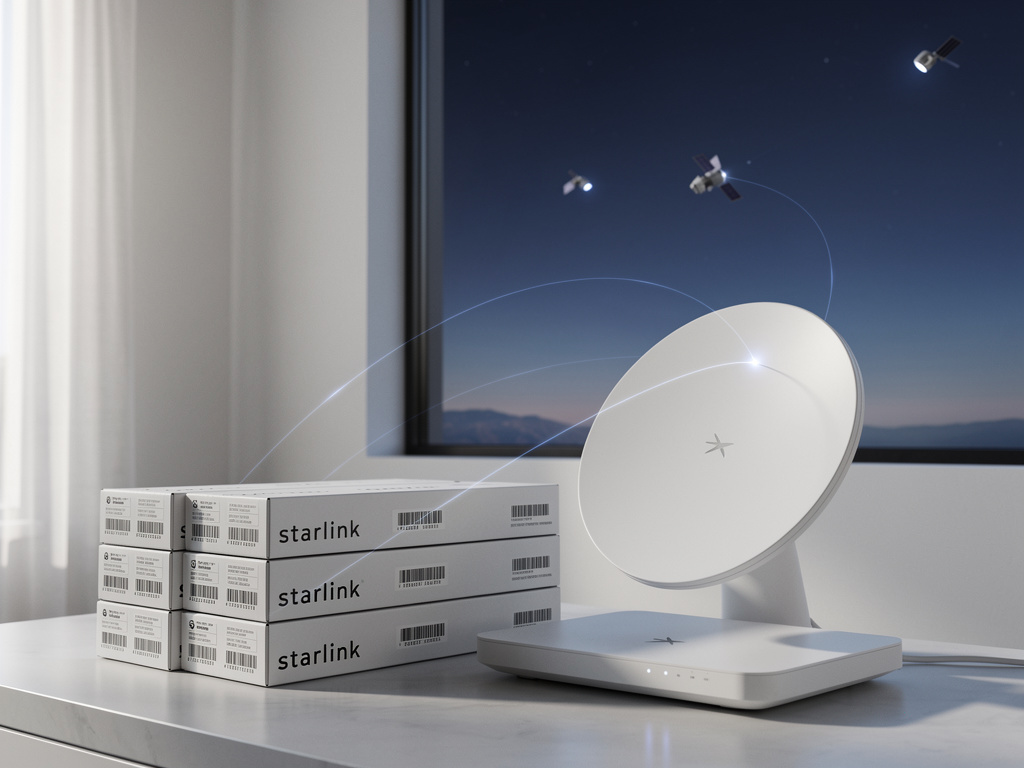
Starlink has introduced a new hardware rental option that charges users $10 per month for the satellite dish and related equipment, a move that mirrors long-standing practices in the cable television and traditional broadband industries. According to a report from Ars Technica, the satellite internet provider owned by SpaceX now allows customers to avoid the upfront cost of purchasing the dish outright, which typically runs several hundred dollars, in exchange for this recurring monthly fee added to their service bill.
This development marks a significant shift in how Starlink structures its customer offerings. Previously, the company required buyers to pay for the hardware in full before activation, a model that created a high barrier to entry for many potential subscribers. The rental program lowers that initial financial hurdle, making the service more accessible to households that prefer spreading costs over time rather than making a large one-time payment. Early reports indicate the rental dish remains the standard rectangular phased-array antenna that Starlink has deployed in recent years, complete with the integrated router and necessary cabling.
The decision to adopt a rental model brings Starlink closer to the operational strategies used by established cable and fiber providers. Companies like Comcast, Charter Spectrum, and AT&T have offered equipment rentals for decades, typically charging between $10 and $15 monthly for modems, routers, or set-top boxes. These fees generate substantial ongoing revenue while ensuring the provider retains ownership and control over the hardware. In many cases, customers never truly own the devices in their homes, and returning them upon cancellation becomes a required step to avoid additional charges.
For Starlink, the rental approach could accelerate subscriber growth in markets where the upfront hardware expense has deterred adoption. Rural communities, maritime users, and international customers in developing regions often face economic constraints that make a several-hundred-dollar purchase difficult. By allowing new users to begin service with little more than a standard installation fee and the first month’s service plus rental charge, Starlink stands to attract a broader audience. The company has not yet disclosed whether the rental option will be available in all regions or limited to specific countries initially.
Analysts suggest the rental fee also serves another purpose: it creates a steady income stream that helps offset the substantial costs associated with manufacturing and launching the thousands of satellites required to maintain the constellation. Each Starlink satellite represents a considerable investment, and the ground terminals must meet high standards for reliability in varied weather conditions. By retaining ownership of the dishes, Starlink can more easily manage repairs, upgrades, and recycling of equipment that reaches the end of its useful life. Customers who rent will likely be responsible for returning the hardware in working condition if they decide to cancel service, similar to cable company policies.
The introduction of the $10 monthly rental comes at a time when Starlink continues to expand its global footprint. The service now operates in dozens of countries, with regulatory approvals pending in many more. Performance has improved markedly since the early days of the beta program, with download speeds frequently exceeding 100 Mbps and latency dropping below 40 milliseconds for many users. These gains have positioned Starlink as a viable alternative to traditional broadband in areas where fiber or cable infrastructure remains unavailable. Yet the service still carries relatively high monthly fees compared with urban cable packages, often ranging from $90 to $150 depending on location and plan type. Adding the hardware rental increases the total monthly commitment further, a factor that could influence customer decisions.
Consumer advocates have mixed reactions to the new rental program. On one hand, it reduces the risk for users who want to test the service without committing to an expensive purchase. If the connection fails to meet expectations or if the household relocates to an area with better terrestrial options, the renter can return the equipment without having spent hundreds of dollars on hardware that might have limited resale value. On the other hand, the cumulative cost of rental fees can exceed the original purchase price after roughly two years of service. Customers who remain with Starlink long term may ultimately pay more by renting than they would have by buying the dish at the outset.
Starlink has structured the rental terms to address some of these concerns. Reports from Ars Technica indicate that the company will continue to sell the hardware outright for those who prefer ownership. The purchase option may appeal to users planning extended use in remote locations where replacement parts or technical support could prove challenging. Ownership also potentially allows for modifications or easier resale on secondary markets, though Starlink maintains strict policies against unauthorized alterations to its equipment.
The rental model introduces new operational considerations for the company. Starlink must now manage a fleet of returned terminals, inspect them for damage, refurbish where possible, and redeploy them to new customers. This process resembles the logistics already perfected by cable operators, who maintain large inventories of modems and routers. Efficient handling of returned equipment will determine whether the rental program improves profitability or creates unexpected overhead. SpaceX has demonstrated remarkable capability in reusing rocket components, and observers expect the company to apply similar efficiency principles to its terrestrial hardware.
Installation procedures appear largely unchanged under the rental program. Users still mount the dish with a clear view of the northern sky in most Northern Hemisphere locations, connect the provided cables, and activate service through the Starlink app. The app guides alignment and provides real-time performance data. Because the hardware remains the property of Starlink, the company can push firmware updates and monitor performance metrics more aggressively, potentially leading to faster identification and resolution of network issues.
Competitive pressure may have influenced the timing of this announcement. Traditional internet service providers have faced criticism for their equipment rental fees, with some municipalities and consumer groups calling for regulations that would require companies to allow customers to use their own modems and routers. Starlink enters this arena with the advantage of proprietary technology; its phased-array antennas and custom routers are not easily replaced by third-party devices. The $10 rental fee positions the company as competitive with cable providers while maintaining control over the specialized equipment necessary for satellite communication.
International markets could respond particularly well to the rental option. In parts of Africa, Latin America, and Southeast Asia where Starlink has begun rolling out service, the cost of hardware has sometimes exceeded average monthly incomes. Local partners and distributors have occasionally absorbed part of the upfront cost to stimulate adoption, but a standardized rental program offers a cleaner, more scalable solution. Governments interested in expanding rural connectivity may view the lower entry barrier as beneficial for public-private partnerships aimed at bridging the digital divide.
Despite the apparent advantages, challenges remain. Starlink must ensure that rental customers receive the same level of support and performance as those who purchase their equipment. Any perception that renters receive inferior service or slower replacement times could damage the company’s reputation. Additionally, the company will need to develop clear policies regarding liability for damaged or lost equipment. Weather events, accidental damage, or theft could create disputes over replacement costs if not addressed transparently in the rental agreement.
The broader satellite internet sector watches these developments closely. Competitors such as Amazon’s Project Kuiper and the European-backed OneWeb are preparing their own consumer offerings. How Starlink structures its hardware pricing could set expectations across the industry. If the rental model proves successful in driving subscriber numbers while maintaining healthy margins, other providers may adopt similar approaches rather than requiring large upfront purchases.
Customer feedback collected through online forums and social media suggests strong interest in the rental program. Many express relief at the reduced initial outlay, particularly those who have been waiting for Starlink availability in their areas. Others voice caution about long-term costs and seek detailed comparisons between buying and renting over various time periods. Starlink has not yet published an official calculator, though third-party analyses shared on community sites attempt to model the break-even point based on current pricing.
As Starlink scales its constellation toward tens of thousands of satellites, ground terminal strategy becomes increasingly important. The ability to recycle and redeploy dishes could reduce material costs and environmental impact over time. The company has already demonstrated progress in making terminals more energy efficient and easier to manufacture. The rental model aligns with a circular economy approach in which hardware remains in active use rather than sitting idle after a customer cancels service.
Regulatory bodies in various countries may examine the rental fees as part of their oversight of Starlink’s operations. Some nations have imposed conditions on spectrum usage or required certain levels of domestic investment. How the rental program affects affordability and competition against local telecom providers could factor into future licensing decisions. Starlink has argued that its service brings connectivity to regions where traditional infrastructure would be prohibitively expensive to deploy, and the rental option strengthens that argument by further lowering barriers.
Looking ahead, the company may expand the rental concept beyond the basic terminal. Future iterations could include bundled options for additional routers, mesh network nodes, or specialized maritime and aviation hardware. Each segment of the Starlink business presents unique requirements, and flexible pricing structures could help address them. For now, the $10 monthly dish rental represents a pragmatic adaptation of proven tactics from the cable industry to the realities of satellite broadband.
The introduction of this program reflects Starlink’s maturation from an experimental service to a mainstream provider. By adopting familiar billing practices, the company signals its intention to compete directly with established internet service providers on their own terms while preserving the technological advantages inherent in its low-Earth orbit network. Customers now have greater flexibility in how they access high-speed internet in locations previously cut off from reliable connectivity. Whether the rental model ultimately benefits consumers more than the company will depend on individual usage patterns, geographic location, and the evolving competitive environment. For many households, however, the option to begin service without a large initial investment will prove decisive in choosing Starlink over waiting for fiber expansion or accepting slower legacy connections.


 WebProNews is an iEntry Publication