
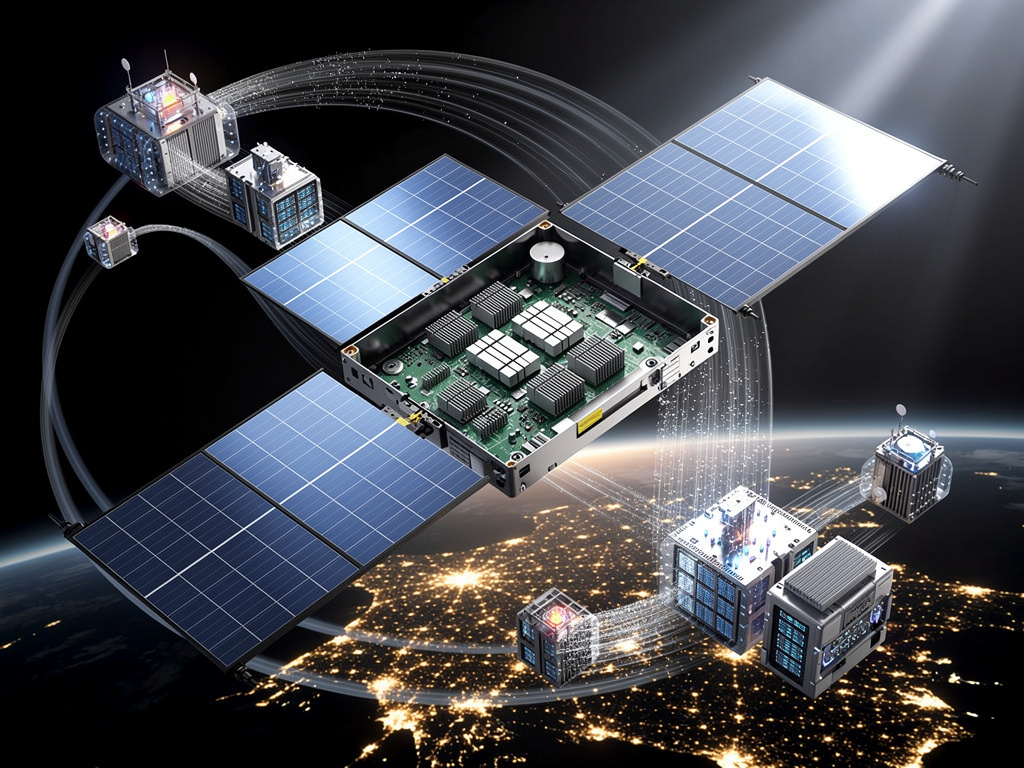
In a groundbreaking feat that merges the frontiers of artificial intelligence and space exploration, a startup named Starcloud has successfully trained an AI model aboard a satellite orbiting Earth. This milestone, achieved with backing from chip giant Nvidia, signals a potential shift in how compute-intensive tasks like AI training could be offloaded from power-hungry terrestrial facilities to the vast expanse of orbit. The company’s Starcloud-1 satellite, equipped with Nvidia’s advanced GPUs, ran Google’s open-source Gemma model, marking what experts hail as the first instance of large language model training beyond Earth’s atmosphere.
The initiative addresses one of AI’s most pressing challenges: escalating energy demands. Traditional data centers on Earth consume enormous amounts of electricity, often straining grids and contributing to environmental concerns. By contrast, orbital setups can harness uninterrupted solar power, potentially slashing costs and emissions. According to reports, Starcloud’s satellite leverages this abundant energy source, demonstrating that space-based computing isn’t just theoretical but practically viable.
Details from the project reveal that the training process involved fine-tuning the Gemma model on a dataset transmitted from Earth, with computations handled entirely in orbit. This not only proves the feasibility of remote AI operations but also highlights the role of high-speed laser communications for data transfer between ground stations and satellites. Industry observers note that such advancements could pave the way for more complex AI workloads in space, reducing latency for global applications.
Pioneering Orbital Compute: Starcloud’s Bold Leap
Starcloud, a participant in Nvidia’s Inception program for startups, launched its satellite in late 2025, as detailed in a NVIDIA Blog post. The company projects that space-based data centers could offer energy costs up to 10 times lower than their Earth-bound counterparts, thanks to the vacuum of space providing natural cooling and solar panels delivering constant power without the interruptions of night or weather.
This development comes amid a broader push by tech titans to explore extraterrestrial infrastructure. Elon Musk’s SpaceX and Jeff Bezos’ Blue Origin are both investing heavily in orbital data centers, viewing them as a solution to AI’s power crisis. A recent article in Interesting Engineering outlines how these rivals believe space facilities can overcome earthly limitations, with Bezos predicting that gigawatt-scale AI training clusters will operate in orbit within the next decade or two.
Posts on X, formerly Twitter, reflect growing excitement among tech enthusiasts. Users have speculated on how fleets of AI-equipped satellites could form distributed computing networks, linked by laser beams for seamless data sharing. One prominent thread emphasized the scalability of orbital systems, noting that they could handle the exponential growth in AI demands without overburdening terrestrial power grids.
Rivalry in the Stars: Bezos, Musk, and the AI Arms Race
The competition between Bezos and Musk extends beyond rocket launches into the realm of AI infrastructure. Blue Origin has reportedly spent over a year developing specialized hardware for orbital computing, focusing on thermal management in the harsh vacuum environment. Meanwhile, SpaceX’s Starlink constellation could provide the backbone for low-latency data relays, enabling real-time AI interactions from space.
Geopolitical dimensions add another layer to this evolving field. Recent news highlights a race between the U.S. and China, with Beijing making early moves in space-based supercomputing. An analysis in the South China Morning Post describes how both nations are vying for dominance, with orbital platforms potentially transforming global connectivity and intelligence capabilities.
Environmental considerations are crucial here. While space offers clean solar energy, launching satellites contributes to orbital debris and requires significant upfront emissions from rockets. A piece in Scientific American warns of these trade-offs, pointing out that space-based computing might ease Earth’s energy burden but introduces new challenges like managing waste heat in zero gravity and ensuring sustainable orbital practices.
Technical Hurdles and Innovations Driving Progress
Delving deeper into the technology, Starcloud’s success with the Nvidia GPU in orbit involved overcoming radiation exposure, which can corrupt data in space. Engineers implemented robust error-correction algorithms and shielded hardware to maintain computational integrity. The satellite’s design, as covered in various tech outlets, incorporates vacuum-compatible cooling systems that dissipate heat more efficiently than water-based methods on Earth.
Looking ahead, experts project that by 2027, companies like Google and SpaceX could deploy full-fledged orbital data centers. A discussion in Space.com explores the logistical challenges, including the need for advanced propulsion to maintain orbits and automated systems for on-the-fly repairs, given the impossibility of human intervention.
Sentiment on X underscores the innovative potential, with posts praising how space could enable “AI running on AI” without earthly constraints. One user highlighted the role of Starship rockets in deploying massive compute payloads, suggesting that low Earth orbit could become a hub for decentralized intelligence, free from national borders or cable dependencies.
Economic Implications for AI’s Future Expansion
Economically, the shift to orbital AI could reshape investment patterns in the tech sector. With AI firms like OpenAI planning trillion-dollar annual spends on infrastructure, space offers a scalable alternative. Reports indicate that orbital setups might reduce operational costs dramatically, making advanced AI accessible to more players and accelerating innovation in fields like drug discovery and climate modeling.
However, regulatory hurdles loom large. International space law, governed by treaties like the Outer Space Treaty, must evolve to address commercial data centers in orbit. Questions of data sovereignty arise: Who owns the AI models trained in international airspace? Policymakers are already debating these issues, as evidenced by discussions in industry forums.
Furthermore, the integration with existing networks is key. Starcloud’s model relies on ground-to-space data beaming, but future systems could involve satellite-to-satellite training, minimizing Earth dependency. This vision aligns with Google’s proposals for solar-powered orbital ML infrastructures, as shared in technical papers and echoed in X conversations about laser-linked satellite fleets.
Global Competition and Collaborative Opportunities
China’s advancements add urgency to Western efforts. Beijing’s plans for orbital supercomputers, as reported, aim to leverage space for edge computing in remote areas, potentially giving it an advantage in AI-driven surveillance and research. In response, U.S. firms are accelerating partnerships, with Nvidia’s involvement in Starcloud exemplifying how chipmakers are pivotal to this new frontier.
Collaborative ventures may emerge, blending public and private resources. NASA’s interest in space computing could lead to joint projects, enhancing scientific applications like analyzing astronomical data in real time. Yet, challenges persist, including the high cost of launches—currently around $2,000 per kilogram via SpaceX’s Falcon 9, though Starship promises reductions.
On X, tech insiders speculate that orbital AI could democratize access, allowing startups in developing nations to tap into powerful compute without building massive facilities. This optimism is tempered by concerns over monopolization, with posts warning that space could become another arena dominated by billionaires like Musk and Bezos.
Visionary Pathways: From Prototype to Orbital Dominance
Starcloud’s achievement, while pioneering, is just the beginning. The satellite trained a relatively small model, but scaling to hyperscale operations will require constellations of hundreds or thousands of units. Innovations in modular satellite design, where components can be swapped via robotic arms, are under development to ensure longevity.
Energy efficiency remains a focal point. Orbital solar farms could beam power back to Earth, but for AI, the direct use in space avoids transmission losses. As one X post noted, this setup could enable continuous training cycles, unbound by planetary rotations.
Ultimately, this convergence of AI and space tech promises to redefine computational boundaries. By moving intensive processes off-planet, humanity could unlock unprecedented capabilities, from simulating complex physics to advancing personalized medicine, all while preserving Earth’s resources for other needs.
Navigating Risks in the Orbital AI Era
Risks abound, from cyber vulnerabilities in space—where hacks could disrupt critical AI operations—to the proliferation of space junk. Mitigation strategies include international standards for deorbiting defunct satellites and advanced encryption for data links.
Industry insiders, drawing from sources like the Technology.org, emphasize that success hinges on cost reductions. With launch prices dropping, orbital AI could become economically competitive within years, potentially outpacing ground-based alternatives in efficiency.
Public perception, as gauged from X trends, mixes awe with skepticism. Some users envision a future where AI in space aids global challenges like disaster prediction, while others fear it could exacerbate inequalities if access is controlled by a few corporations.
Strategic Horizons for Tech Leaders
For companies, the strategic imperative is clear: invest now or risk falling behind. Nvidia’s early bet on Starcloud positions it as a leader in space-grade hardware, with GPUs optimized for radiation-hardened environments.
Broader adoption might see AI models trained on orbital data from telescopes or Earth observation satellites, enhancing accuracy in real-world applications. As detailed in a DNYUZ report, this could lead to investments exceeding trillions, fueling a new space economy.
In this dynamic arena, the fusion of AI and orbit isn’t merely innovative—it’s transformative, setting the stage for a future where computation knows no earthly bounds.


 WebProNews is an iEntry Publication