
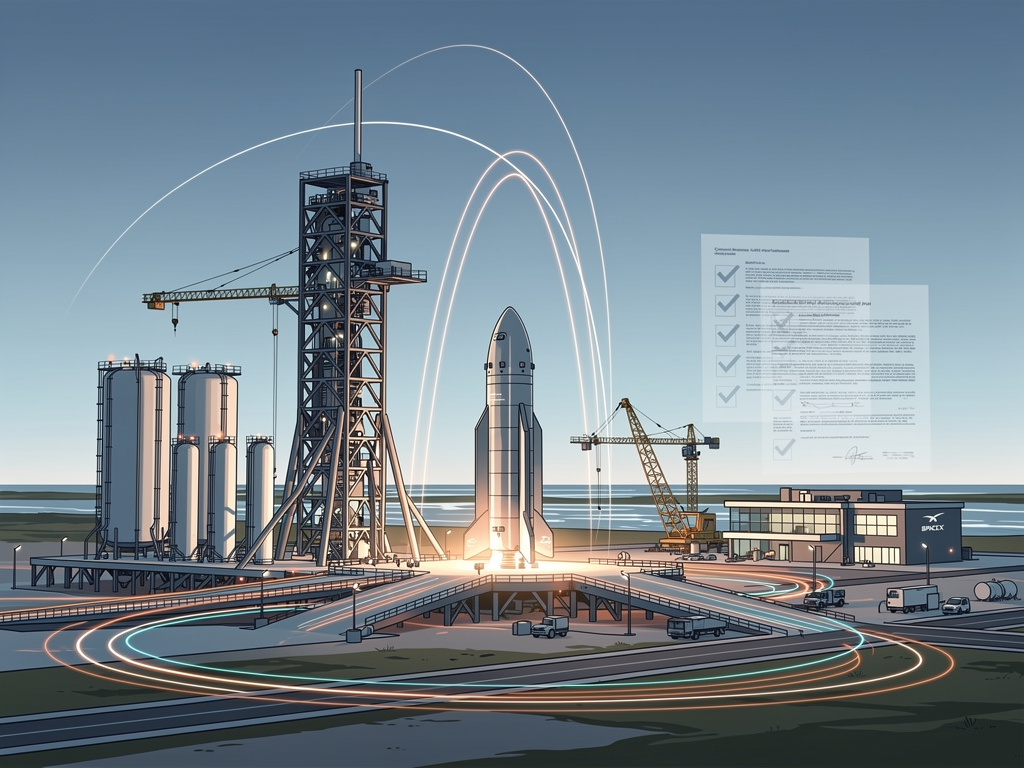
After months of relative silence along the southern tip of Texas, SpaceX’s sprawling Starbase facility in Boca Chica is once again buzzing with activity — a signal that the company’s ambitious Starship program is gearing up for its next critical phase of flight testing. The lull that settled over the site following a series of dramatic test flights in 2024 and early 2025 appears to be ending, and industry watchers are paying close attention to what comes next for the largest and most powerful rocket ever built.
As reported by Ars Technica, SpaceX’s Starbase operations have entered a new tempo. Workers, vehicles, and heavy equipment have been spotted across the facility in increasing numbers, and the company’s manufacturing and launch infrastructure is being actively prepared for what is expected to be a renewed cadence of Starship test flights. The pause in launches, which stretched longer than many observers anticipated, was not a sign of stagnation but rather a period of intensive behind-the-scenes engineering work, hardware iteration, and regulatory coordination.
The Strategic Pause: Why SpaceX Took Its Foot Off the Gas
SpaceX’s Starship development has always followed an iterative philosophy — build, test, fail, learn, rebuild, and fly again. But the gap between recent flights was notable. Following the dramatic achievements of previous integrated flight tests — including the successful catch of the Super Heavy booster by the launch tower’s mechanical arms, a feat that stunned the aerospace world — SpaceX appeared to pull back from its breakneck testing pace. According to Ars Technica’s reporting, this period was used to incorporate lessons learned from prior flights into both the vehicle hardware and the ground systems at Starbase.
The reasons for the pause were multifaceted. SpaceX needed time to address technical findings from previous missions, some of which revealed issues with the upper-stage Starship vehicle’s thermal protection system, propellant management, and in-flight performance. Additionally, the company has been navigating an evolving regulatory environment with the Federal Aviation Administration, which must license each launch attempt. The FAA’s oversight process, while sometimes a source of friction for SpaceX, is a necessary step in ensuring public safety for launches conducted from the southernmost point of the Texas Gulf Coast, adjacent to residential areas and ecologically sensitive habitats.
Hardware on the Move: What’s Happening on the Ground
Recent observations from Starbase — documented by the dedicated community of space enthusiasts, photographers, and journalists who monitor the site around the clock — show a clear uptick in activity. New Starship upper stages and Super Heavy boosters have been spotted in various stages of assembly and preparation inside SpaceX’s massive production tents and the high bay assembly building. Transport vehicles have been moving hardware between production areas and the launch site with increasing frequency, suggesting that a new flight vehicle stack is being readied.
The launch infrastructure itself has also seen significant work. SpaceX has been upgrading and refurbishing the Orbital Launch Mount and the tower’s “chopstick” catching arms — the mechanical system designed to pluck the returning Super Heavy booster out of the sky. These ground systems are arguably as revolutionary as the rocket itself. The ability to catch and rapidly reuse a booster without the need for landing legs or a separate landing pad is central to SpaceX’s vision of making Starship operations as routine and rapid as commercial airline turnarounds. Upgrades to the water deluge system, propellant tank farms, and integration hardware have all been observed, per Ars Technica’s account of the renewed activity.
The Bigger Picture: Why Starship’s Timeline Matters
The urgency behind Starship’s development extends far beyond SpaceX’s own corporate ambitions. NASA’s Artemis program is counting on a lunar-optimized variant of Starship to serve as the Human Landing System (HLS) that will return astronauts to the surface of the Moon. Under the current Artemis III mission plan, a Starship HLS must be ready to receive crew in lunar orbit and ferry them to the lunar surface — a mission that requires not just a working Starship but also the demonstrated ability to refuel the vehicle in Earth orbit using multiple tanker flights. Every month of delay in Starship testing has cascading implications for NASA’s lunar timeline, which has already been pushed back multiple times.
Beyond NASA, the U.S. Department of Defense has expressed growing interest in the capabilities that Starship could provide, from rapid global cargo delivery to the deployment of large national security payloads. Commercial satellite operators, too, are watching closely. Starship’s cavernous payload fairing — the largest ever designed for an orbital rocket — promises to revolutionize how satellites and space stations are designed, potentially allowing for much larger, more capable spacecraft to be launched in a single mission. The economic implications are staggering: if SpaceX can achieve even a fraction of the reusability and cost reduction it projects for Starship, the per-kilogram cost of reaching orbit could drop by an order of magnitude compared to current launch vehicles.
Regulatory Crosswinds and Environmental Reviews
One of the persistent challenges for SpaceX at Starbase has been the regulatory process. The FAA’s launch licensing requirements, combined with environmental reviews conducted in coordination with the U.S. Fish and Wildlife Service, have at times created bottlenecks. The Boca Chica site sits near sensitive tidal flats and wildlife refuges, and each new launch configuration or significant change to operations can trigger additional review. SpaceX CEO Elon Musk has publicly voiced frustration with the pace of regulatory approvals, arguing that the process is too slow for the rapid iteration that SpaceX’s development model demands.
However, the regulatory framework exists for substantive reasons. Previous Starship launches have caused localized environmental impacts, including debris scattering and damage to nearby infrastructure during the program’s early, more explosive test phases. The FAA and environmental agencies have worked to establish a framework that allows testing to proceed while mitigating risks to public safety and the environment. As SpaceX ramps up for a new round of flights, the company will once again need to secure FAA launch licenses, a process that both sides have sought to streamline in recent months.
Competition and the Global Race for Super-Heavy Lift
SpaceX does not operate in a vacuum. While Starship remains the most advanced super-heavy-lift vehicle in development, other players are making moves. China’s space program has been accelerating work on its own super-heavy-lift rocket, the Long March 9, which is designed to support that nation’s lunar exploration ambitions. In Europe, discussions continue about next-generation launch vehicles, though none are as far along as Starship. Blue Origin, Jeff Bezos’s space venture, has begun flying its New Glenn rocket, which, while smaller than Starship, represents a significant new entrant in the heavy-lift market.
The competitive dynamics add another layer of urgency to SpaceX’s Starship timeline. The company’s dominance in the global launch market — already commanding a majority share thanks to the Falcon 9 — could be further cemented if Starship achieves operational status. Conversely, prolonged delays could open the door for competitors to close the gap, particularly in the lucrative government and national security launch sectors where reliability and schedule confidence are paramount.
What Comes Next for Starbase and Starship
As Starbase comes alive again, the aerospace community is watching for several key milestones. The next integrated flight test will be closely scrutinized for improvements to the Starship upper stage’s reentry and landing capabilities — an area where previous flights have encountered difficulties. SpaceX’s long-term goal is to recover and reuse both the Super Heavy booster and the Starship upper stage, a feat that would make the entire system fully reusable and unlock the economics that Musk has long promised.
Orbital refueling demonstrations are also on the horizon. NASA’s HLS contract requires SpaceX to prove that it can transfer propellant between Starship vehicles in orbit — a technology that has never been demonstrated at the scale required. Successfully pulling off orbital refueling would be a watershed moment not just for SpaceX but for the entire space industry, enabling missions to the Moon, Mars, and beyond that are currently impossible with existing technology.
For now, the renewed activity at Starbase is a welcome sign for those invested in the future of spaceflight. The quiet period is ending, and the next chapter of Starship’s story — one that could redefine what is possible in space — is about to be written on the launch pad at Boca Chica.


 WebProNews is an iEntry Publication