
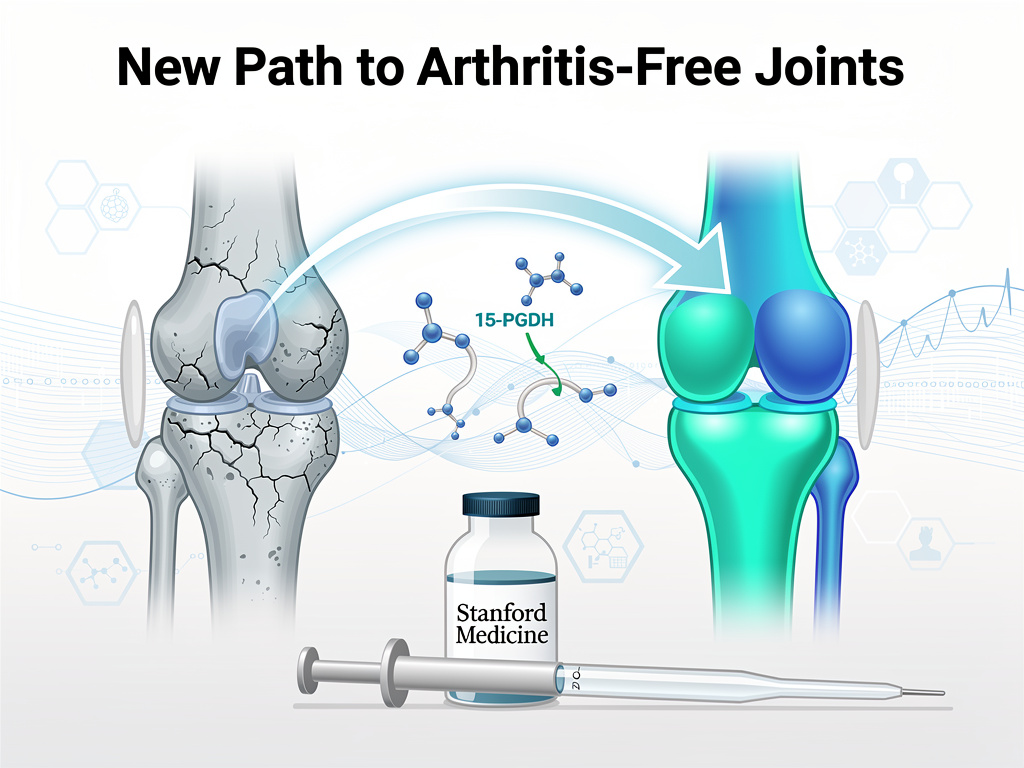
In a potential seismic shift for orthopedics, Stanford Medicine researchers have pinpointed a single protein whose inhibition triggers cartilage regeneration in aging and injured joints, offering a path to sideline knee replacements for millions. Published in Science (DOI: 10.1126/science.adx6649), the study demonstrates that blocking 15-hydroxyprostaglandin dehydrogenase—dubbed a “gerozyme” for its age-related surge—restores hyaline cartilage in old mice knees and halts osteoarthritis post-injury. Human samples from replacement surgeries echoed the effect after just one week.
“This is a new way of regenerating adult tissue, and it has significant clinical promise for treating arthritis due to aging or injury,” said Helen Blau, PhD, professor of microbiology and immunology at Stanford and senior author, in a statement from Stanford Medicine News. The breakthrough sidesteps stem cells, reprogramming existing chondrocytes to a youthful state via elevated prostaglandin E2 levels.
Protein Culprit in Joint Decay
15-PGDH levels double in knee cartilage as mice age, degrading prostaglandin E2 essential for tissue repair. In young joints, low 15-PGDH supports robust matrix maintenance; in elders, its rise fuels inflammation, degradation genes, and fibrocartilage over superior hyaline type. Older mice injected intraperitoneally or intra-articularly with a small-molecule inhibitor saw thinned cartilage thicken uniformly, per histological analysis reported in ScienceDaily.
Chondrocyte single-cell RNA sequencing revealed stark shifts: inflammatory, 15-PGDH-expressing cells dropped from 8% to 3%; fibrocartilage markers from 16% to 8%; hyaline cartilage genes surged from 22% to 42%. Treated mice regained normal gait and weight-bearing, unlike controls developing osteoarthritis within weeks, as detailed in the Science paper.
Injury Prevention Breakthrough
For trauma models mimicking ACL tears—common in athletes and leading to 50% osteoarthritis risk—twice-weekly inhibitor shots for four weeks post-injury prevented disease onset. Treated mice bore full weight on affected legs and moved fluidly, contrasting controls with doubled 15-PGDH and rapid joint breakdown, per Stanford Report.
“Cartilage regeneration to such an extent in aged mice took us by surprise. The effect was remarkable,” noted Nidhi Bhutani, PhD, associate professor of orthopaedic surgery and co-senior author, in SciTechDaily. Lead authors Mamta Singla, PhD, instructor of orthopaedic surgery, and Yu Xin (Will) Wang, PhD, now at Sanford Burnham Prebys, drove the experiments.
Human Tissue Responds Swiftly
Ex vivo human cartilage from end-stage osteoarthritis knees—replete with matrix and chondrocytes—treated for one week showed plummeting 15-PGDH producers, slashed degradation genes, and nascent hyaline regeneration. No stem cell mobilization occurred; resident cells reprogrammed, mirroring murine results, as shared in Men’s Journal.
Gerozyme’s Broader Toll
Blau’s team coined “gerozymes” in 2023 for age-upregulated enzymes eroding function. 15-PGDH fits, previously tied to muscle atrophy—its block boosted mass and endurance in old mice. Prostaglandin E2 elevations aid regeneration across muscle, nerve, bone, colon, liver, and blood, per prior Blau lab work cited in Stanford Medicine.
“Millions of people suffer from joint pain and swelling as they age. It is a huge unmet medical need. Until now, there has been no drug that directly treats the cause of cartilage loss,” Bhutani emphasized in India Today. Osteoarthritis burdens one in five U.S. adults, costing $65 billion yearly in care.
Clinical Path Accelerates
Phase 1 trials of an oral 15-PGDH inhibitor for muscle weakness proved safe in healthy volunteers, paving for arthritis studies. Stanford patents on cartilage applications license to Epirium Bio, co-founded by Blau (with equity), as noted in Euro Weekly News. Intra-articular injections could target knees directly.
No Stem Cells Required
Unlike prior efforts seeking articular cartilage progenitors—elusive despite bone stem cell successes—this reprograms mature chondrocytes. “We were looking for stem cells, but they are clearly not involved. It’s very exciting,” Blau told Good News Network. Mechanism: prostaglandin E2 at physiological boosts promotes repair sans excess inflammation.
Economic Stakes Soar
With projections nearing 1 billion global cases by 2050, per Daily Mail, success could slash replacement surgeries—800,000 knees, 500,000 hips annually in the U.S. alone. Biotech eyes preventive “tune-ups” for at-risk athletes or elders, echoing prior Stanford cartilage work in Stanford Medicine 2020.
Expert Reactions Ripple
Orthopedists hail the targeted approach over symptom palliation. “The mechanism is quite striking and really shifted our perspective about how tissue regeneration can occur,” Bhutani said in ScienceAlert. Regenexx notes overlaps with PRP/BMAC boosting prostaglandin E2 naturally, per New Regeneration Orthopedics.
Trial Horizons Emerge
Epirium plans cartilage trials soon, leveraging muscle data. “Phase 1 clinical trials of a 15-PGDH inhibitor for muscle weakness have shown that it is safe and active… Imagine regrowing existing cartilage and avoiding joint replacement,” Blau envisioned in Business Standard. Hurdles remain: scaling human efficacy, dosing, long-term safety amid osteoarthritis’s multifactorial nature.
Market Moves Afoot
News sparked investor buzz; Epirium, backed by Stanford IP, eyes expansion. Patient forums buzz with trial pleas, from 63-year-olds dodging surgery to runners post-repairs, as seen in SciTechDaily comments. No X/Twitter surges noted yet, but orthopedics watches closely.
Paradigm Pivot Looms
This gerozyme block redefines osteoarthritis from inevitable wear to targetable decline, promising pills or shots over prosthetics. “Our hope is that a similar trial will be launched soon to test its effect in cartilage regeneration. We are very excited about this potential breakthrough,” Blau concluded in ScienceDaily. For industry, it’s a $65 billion rethink.


 WebProNews is an iEntry Publication