
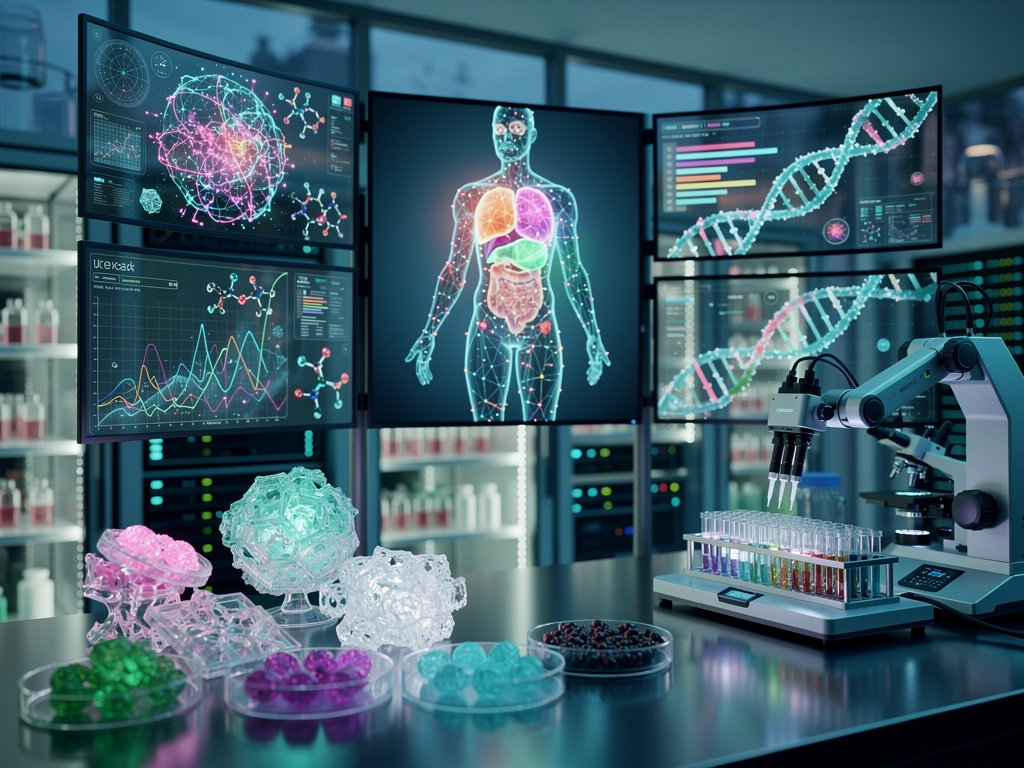
Stanford professor James Zou eyes a $1 billion valuation for his new startup, Human Intelligence. The company aims to raise $100 million. It builds AI systems to probe human physiology. Sources close to the matter shared details with Bloomberg. Zou’s lab laid the groundwork with a physiology foundation model published in Nature Medicine this year.
Human Intelligence shifts AI from text to biology. Traditional models crunch words. These handle multimodal health data—vitals, imaging, labs. The goal: predict disease progression, simulate organ responses. No more siloed diagnostics. Instead, integrated body-wide forecasts.
Zou didn’t comment. But his track record speaks. PhD from Harvard in 2014. Gates Scholar at Cambridge. Simons fellow at Berkeley. Joined Stanford in 2016. Now associate professor of biomedical data science, with CS and EE courtesy roles. Two Chan-Zuckerberg Biohub awards. Sloan Fellowship. NSF CAREER. Awards from Google, Amazon, Adobe.
His lab’s output dazzles. EchoNet analyzes echocardiograms. FDA cleared it after a trial where it beat sonographers. Published in Nature in 2020, trial results in 2023. SyntheMol generates small molecules against antibiotic-resistant bacteria. Nature Machine Intelligence, 2024. Named New York Times ‘Good Tech.’
And the Virtual Lab. AI agents mimic a research team. Principal investigator delegates. Specialists debate hypotheses. Critics spot flaws. They designed 92 nanobodies for SARS-CoV-2. Two validated with better binding. Nature, August 2025. “It’s essentially a laboratory made of algorithms, but we’re teaching AI to think like a scientist, not just compute like a machine,” Zou told Stanford Medicine News.
From Lab Breakthroughs to Startup Scale
Virtual Biotech followed. Preprint February 2026. Eleven agents spawned 37,000 sub-agents. Annotated 56,000 clinical trials. Found cell-type-specific gene drugs 48% more likely to reach market. 32% fewer adverse events. This compresses drug discovery timelines. No waiting for human teams.
Human Intelligence commercializes this. Physiology foundation model as core tech. Bloomberg Law noted the lab’s January 2026 Nature Medicine paper as its first iteration. SleepFM likely predicts sleep disorders from multimodal data. Details sparse, but it fits the pattern: AI reading body signals like language.
Market timing perfect. AI-healthcare hit $18.1 billion in 2025. Projections: $223 billion by 2033. Q1 2026 saw $11 billion in drug discovery and diagnostics funding. Global VC: $297 billion, 80% AI. Forty-seven new unicorns minted. Per The Next Web.
Competition fierce. Xaira Therapeutics raised $1.3 billion. Isomorphic Labs: 508 million euros, $3 billion partnerships. Recursion swallowed Exscientia. Insilico’s AI drug hit Phase II, Hong Kong listing filed December 2025. Hippocratic AI at $1.64 billion. OpenEvidence: $210 million at $3.5 billion. None cleared Phase III pivotal trials yet.
Big Tech piles in. Microsoft’s Copilot Health, March 2026. OpenAI’s ChatGPT Health, January. Anthropic’s Claude for Healthcare. Google DeepMind’s AlphaFold. WHOOP hit $10 billion with $575 million Series G, 2.5 million users, $1.1 billion run rate.
Comparables boost Zou’s pitch. Fei-Fei Li’s World Labs reached $1 billion in four months, now over $10 billion. Anthropic bought Coefficient Bio for $400 million. Talent commands premiums.
Zou’s prior ventures? Gradio, acquired by Hugging Face in 2021. His lab spawned or advised over ten companies. Eric Topol calls him “one of the most prolific and creative A.I. researchers in both life science and medicine.” From a 2023 podcast.
Physiology AI: Bottlenecks and Breakthroughs
Biology resists computation. Regulatory hurdles. Institutional inertia. Raw complexity. AI agents tackle all stages: target ID, design, trials prediction. Virtual Lab agents self-train via ‘Agent School’—reading papers, data dives. Human oversight: just 1% of ops.
“AI scientists won’t replace people. But they can work alongside us, helping us test more ideas, ask better questions, and move discoveries into the clinic faster,” Zou said. From the Stanford piece. Envy creeps in. “I’m envious of the AI agents because their meetings are much more efficient than mine.”
Investors bet big because results validate. EchoNet’s FDA win proves clinical edge. Virtual Lab’s nanobodies: real-world impact. Physiology models promise body simulation. Predict heart failure from echoes and vitals. Forecast drug responses across organs.
Risks loom. No AI drug finished Phase III. Data biases plague biomed AI. Zou’s work pushes fairness—diverse populations, robust evals. His 2021 Nature Medicine paper dissected FDA AI approvals.
But momentum builds. Q1 2026 VC frenzy signals conviction. Human Intelligence joins unicorns-in-waiting. If Zou delivers, physiology becomes programmable. Drug timelines shrink. Patients win faster therapies.
The body as code. Zou’s writing it.


 WebProNews is an iEntry Publication