
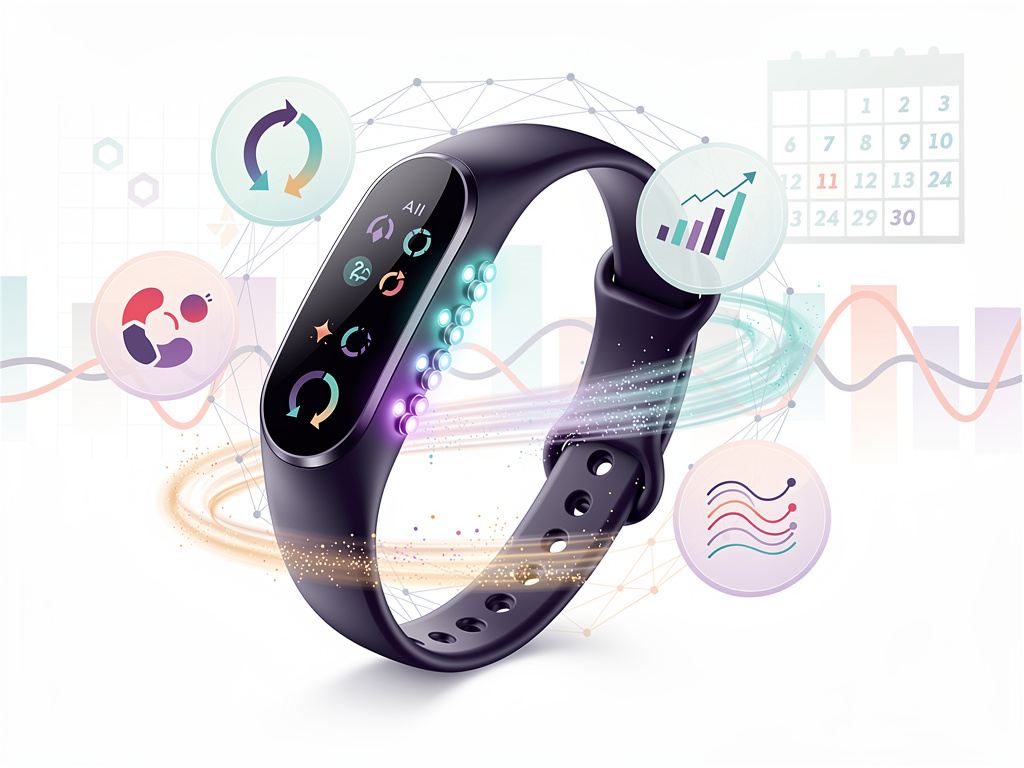
Jenny Duan graduated from Stanford last weekend. At 21, she already leads a company that just raised $11.6 million. Her co-founder, Abhinav Agarwal, finished his master’s a year earlier. Together they built Clair Health. The goal sits on the wrist. A jewelry-like band tracks estrogen, progesterone, LH, FSH and PdG in real time. No needles. No urine sticks. Just continuous data.
The round, disclosed Tuesday, came from Khosla Ventures leading with checks from a16z Speedrun, Brydge Club, Treehub, Cartan Capital, AGI House, Insiders VC, 23andMe co-founder Anne Wojcicki and Stephanie Coleman. (TechCrunch)
Investors see a market ready for better tools. Women still rely on calendar apps, occasional blood tests or temperature proxies that miss the full picture. Clair wants to change that equation. The device uses 10 biosensors, including a novel biomagnetic one. It captures more than 130 proprietary biomarkers across cardiovascular, thermoregulatory, autonomic and electrodermal signals. Machine learning then maps those signals to hormone patterns.
Accuracy claims stand out. The system reportedly hits 94% agreement with daily urine tests for cycle phase identification. (Fortune) Early beta users already wear prototypes. Shipments begin in November at $369 for the hardware plus $9.99 a month for the app. Preorders opened quickly. The first 5,000 founding-member slots sold out. A 25,000-person waitlist formed.
The Technical Challenge Few Have Solved
Standard wearables fall short here. Apple Watch, Oura or Whoop rely on familiar sensors — optical PPG, temperature, accelerometers. Those work for heart rate or sleep. They don’t deliver direct hormone insight. Clair started differently. The founders didn’t set out to build hardware first. They asked what continuous hormone tracking would require. Then they engineered the stack.
A biomagnetic sensor sits at the core. Voice input supplements it. During onboarding, users speak for a few minutes. Clair’s custom AI analyzes voice biomarkers to classify cycle phase faster than symptom checklists allow. “What we found is that in women’s health and in the current state of apps, women can’t communicate a large amount of symptoms because the apps are built for only specific ones. With our voice stack, we are giving our users a way to communicate their own problems in their own way,” Duan told TechCrunch.
The app doesn’t just log data. It reports on inflammation markers, bloating signals, energy shifts, pace of aging and rate of perceived exertion. It tracks all four menstrual phases instead of anchoring to the first day of bleeding. That matters for women dealing with irregularities, PMDD, endometriosis or perimenopause symptoms. Data flows to doctors. Patients arrive with numbers, not vague descriptions.
Privacy sits front and center. Processing happens on the device and phone. No raw data leaves for external servers. The company calls it zero-knowledge and HIPAA-compliant. Early coverage from Stanford noted the same emphasis. (Stanford Daily)
Clair’s site lists clear targets: training and recovery optimization, fertility planning, general hormonal awareness, and support through perimenopause and menopause. It claims validation against FDA-registered at-home tests. An independent clinical trial continues. FDA clearance sits on the roadmap after the initial wellness launch. (Clair Health)
But questions remain. Hormone inference from skin signals pushes boundaries. Peer-reviewed results have not appeared yet. Competitors pursue different paths. Level Zero Health works on interstitial-fluid sensors. Others offer at-home test kits or AI that digests manual logs. Clair stands apart by insisting on a dedicated hardware platform built from scratch for hormones. Oura and Whoop add women’s health features to existing products. Clair treats hormones as the primary signal.
Duan discovered the problem during nonprofit work in Portland and a Stanford class on women’s health. She met Agarwal there. They started building in late 2024. By early 2026 the project had gained traction on campus and among early investors. A Stanford Medicine trial was planned for spring. Advisors include faculty with relevant expertise.
Investor Mary Minno at Treehub captured the frustration many feel. “Users want a product that does what it says it is going to do. Hormonal health measurement today is still archaic — my perimenopausal friends are still getting blood draws to understand the efficacy of hormone treatments. Out of the gate, Clair aims to deliver a product that shines a light on what previously required a blood draw.” That quote, sent by email, appears in the TechCrunch report.
Dr. Alex Morgan, quoted in Fortune, pointed to the bigger opportunity. “This team has identified the larger underaddressed market of women interested in improving their health and wellness through getting insights specifically designed for women.”
The company also holds data partnerships. Access to millions of electronic health records and longitudinal studies feeds its models. Insights could expand beyond cycle tracking into conditions that receive less research attention. Women remain underrepresented in clinical trials. That gap slows progress on treatments for everything from metabolic changes to mental health effects tied to hormones.
So the bet feels personal and technical at once. Two recent graduates secured top-tier capital before their device even ships. They promise real-time visibility into a system doctors and patients have measured only in snapshots. Success depends on accuracy that holds up under scrutiny, regulatory progress and whether users find the insights truly actionable.
November will bring the first wave of customer devices. Data from those users will test every claim. If the numbers match early results, Clair could shift how women and their doctors understand daily physiology. Blood draws might become confirmation rather than the default. Apps could move from guesswork to grounded advice.
And the founders know the stakes. Duan put her sociology master’s on hold. Agarwal paused other wearable projects. Their small team now includes engineers, a regulatory lead and a quality vice president. They ship soon. The conversation about women’s health just gained a new data point — one worn every day.


 WebProNews is an iEntry Publication