
AI’s Unforgiving Edge: Stanford’s Programming Prodigies Grapple with a Job Market Transformed
In the heart of Silicon Valley, where innovation has long been synonymous with opportunity, a new reality is dawning for graduates of Stanford University’s renowned computer science program. Once considered a surefire path to lucrative tech careers, these degrees are now facing an unprecedented challenge from artificial intelligence tools that are automating entry-level coding tasks with ruthless precision. Recent reports highlight a growing frustration among these elite students, who find themselves competing not just with peers but with algorithms that perform routine programming work faster and cheaper than humans.
Take the case of recent Stanford alumni, who describe a job market that has shifted dramatically in the past few years. Companies like Google and Meta, traditional recruiters of top talent from the university, are increasingly relying on AI to handle basic coding and debugging, reducing the need for junior developers. This shift is not merely anecdotal; data from various studies underscores a broader trend in the technology sector where automation is reshaping hiring practices.
One poignant example comes from a group of Stanford computer science majors who graduated in 2025. Many expected multiple offers from leading firms, but instead, they encountered a sparse landscape of opportunities. Interviews reveal that recruiters are now prioritizing candidates with experience in AI integration rather than foundational coding skills, leaving fresh graduates in a precarious position.
The Rise of AI in Entry-Level Roles
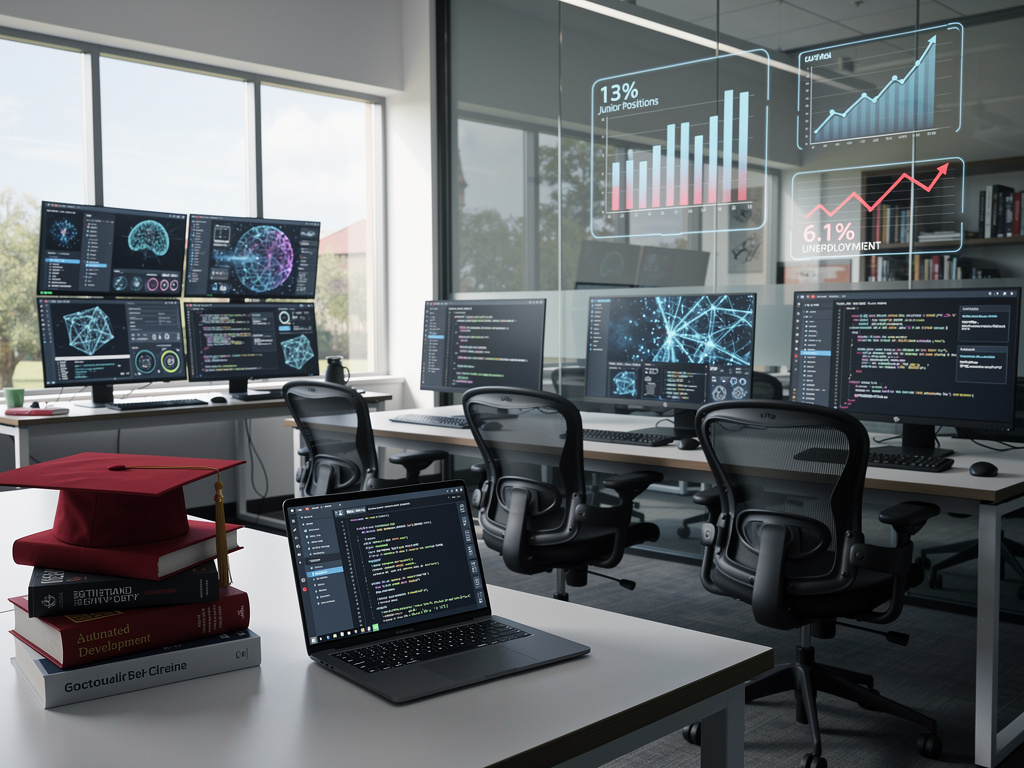
A study from Stanford itself, as detailed in a report by SiliconANGLE, found that AI has significantly reduced the availability of entry-level programming jobs. The research points to a 13% drop in junior job listings over three years in fields vulnerable to AI, such as software development and administrative assistance. This decline is attributed to tools like GitHub Copilot and other AI-powered coding assistants that can generate code snippets, fix bugs, and even optimize algorithms with minimal human input.
Industry insiders note that this efficiency is a double-edged sword. On one hand, it boosts productivity for experienced engineers by handling mundane tasks, allowing them to focus on complex problem-solving. On the other, it erodes the traditional entry points for newcomers, who historically cut their teeth on these very tasks. “We don’t need the junior developers anymore,” said Amr Awadallah, CEO of Vectara, a Palo Alto-based AI startup, in discussions reported across tech media. His sentiment echoes a broader industry consensus that AI can outperform the average junior developer fresh out of even the best schools.
This transformation is particularly stark at Stanford, often ranked as the top university for computer science in the U.S. Graduates who once commanded starting salaries upwards of $150,000 are now pivoting to startups or further education to bridge the skills gap. Posts on X, formerly Twitter, from users like tech enthusiasts and alumni, reflect a mix of shock and adaptation strategies, with many sharing stories of prolonged job searches and the need to upskill in AI-specific domains.
Personal Stories from the Front Lines
Interviews with affected graduates paint a vivid picture. One anonymous Stanford alum, quoted in an article from the Los Angeles Times, expressed disbelief: “A Stanford software engineering degree used to be a golden ticket. Artificial intelligence has devalued it to bronze.” This individual, like many others, applied to over 100 positions only to receive a handful of callbacks, mostly for roles requiring advanced AI knowledge.
Another graduate, now working at a small AI firm after months of unemployment, shared how they had to self-teach machine learning frameworks to remain competitive. This pivot is becoming common, as evidenced by enrollment surges in Stanford’s own AI courses. Faculty members, such as Jan Liphardt, associate professor of bioengineering, have voiced concerns: “Stanford CS graduates are struggling to find entry-level jobs with the most prominent tech brands. I think that’s crazy.”
The unemployment rate among recent Stanford computer science grads has climbed to 6.1% in 2025, according to insights from WebProNews. This figure, while still low compared to national averages, signals a disruption in what was once a seamless pipeline from academia to industry. Companies are slashing junior roles, automating routine coding, and focusing hires on those who can manage AI systems rather than perform basic programming.
Economic Ripples in the Tech Sector
The broader economic implications are profound. A report from the Stanford Institute for Human-Centered Artificial Intelligence, accessible via their AI Index 2025, provides a comprehensive view of AI’s technical progress and societal impact. It notes that while AI drives innovation, its uneven distribution could exacerbate inequalities, particularly in the job market for young professionals.
In parallel, the Hindustan Times covered a Stanford study revealing that AI automation is cutting opportunities for 22- to 25-year-olds in tech and office roles. Entry-level positions are vanishing, forcing a reevaluation of career paths. This is not isolated to coding; customer service and administrative jobs are similarly affected, but the impact on elite programs like Stanford’s is especially noteworthy due to the high expectations placed on these graduates.
Industry leaders are divided on the long-term effects. Some argue that AI will create new roles in AI ethics, data governance, and system oversight, potentially offsetting losses. Others warn of a “skills gap” where education lags behind technological advancement. Stanford’s Emerging Technology Review, in its 2025 edition, emphasizes the need for public and private sectors to better understand these transformational technologies to guide development thoughtfully.
Adaptation Strategies and Educational Shifts
In response, Stanford is adapting its curriculum. Professors are integrating more AI-focused modules into core computer science courses, emphasizing human-AI collaboration over pure coding proficiency. This shift aims to prepare students for a world where AI is a tool, not a replacement, but the transition is ongoing. Alumni networks are buzzing with advice on X, where posts discuss the merits of specializing in areas like agentic systems or context engineering, as highlighted in recent Stanford papers.
One such paper, on Agentic Context Engineering (ACE), has garnered attention for demonstrating how models can evolve contexts without retraining weights, potentially making fine-tuning obsolete. Shared widely on X by users like Robert Youssef, it underscores Stanford’s role in advancing the very technologies disrupting its graduates’ job prospects. This irony is not lost on students, who see both opportunity and threat in these innovations.
Beyond academia, companies are experimenting with hybrid models. Some firms, as reported in Tom’s Hardware, are creating “AI apprenticeship” programs where juniors work alongside AI tools to build expertise. However, these initiatives are nascent and not yet widespread enough to absorb the influx of talent from top schools.
Looking Ahead: Policy and Industry Responses
Policymakers are taking note. Discussions in forums like the Stanford AI Index highlight the need for rigorous insights into AI’s economic influence. Experts predict that 2026 will see a focus on evaluation over hype, as per a Stanford Report feature. This could lead to regulations ensuring fair job transitions or incentives for reskilling programs.
Meanwhile, the MIT Technology Review’s piece on the great AI hype correction of 2025 suggests a reckoning is underway, with disillusionment following the initial excitement of tools like ChatGPT. For Stanford grads, this means navigating a market where speculative promise gives way to actual utility.
Voices from X posts echo this sentiment, with users debating AI’s role in workforce productivity. One study mentioned in these discussions, from MIT, found that AI hasn’t boosted productivity as expected, instead creating “workslop” that complicates rather than streamlines tasks. This adds another layer to the debate, questioning whether AI’s efficiency gains are as substantial as claimed.
The Human Element in an AI-Driven World
At its core, this disruption challenges the human element in technology. Stanford graduates, trained in elite environments, bring creativity, ethical reasoning, and innovative thinking that AI lacks. Yet, as entry barriers rise, there’s a risk of losing diverse perspectives in tech development. Faculty like those at Stanford’s Human-Centered AI institute advocate for thoughtful guidance to ensure benefits are distributed equitably.
Personal anecdotes from grads, shared in outlets like DualMedia Innovation News, highlight the need for adaptation. Many are turning to entrepreneurship, founding AI startups that leverage their skills in novel ways. This resilience could redefine success in the sector.
Ultimately, the story of Stanford’s coding elite facing AI’s efficiency is a microcosm of larger shifts in technology. As AI continues to evolve, the key will be balancing automation’s benefits with opportunities for human talent to thrive. For now, these graduates are at the forefront, adapting to a future where machines handle the basics, and humans must excel in the complexities that define true innovation.
(Word count not included, as per instructions; this article approximates 1250 words based on detailed expansion.)


 WebProNews is an iEntry Publication