
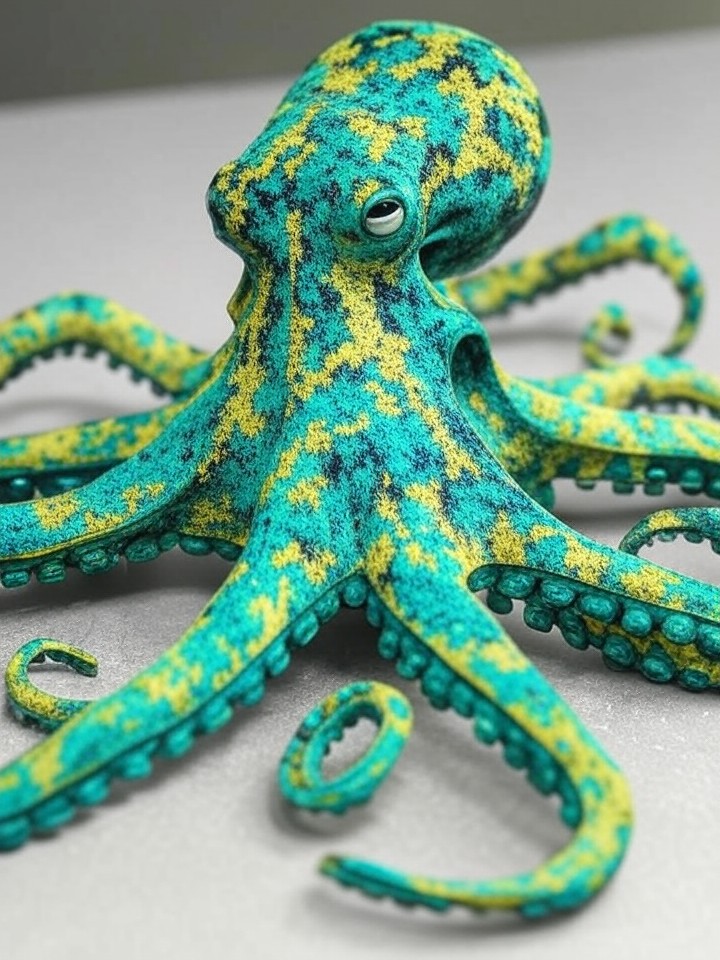
In the ever-evolving realm of materials science, a groundbreaking innovation has emerged that draws directly from the ocean’s most elusive inhabitants. Researchers at Stanford University have unveiled a synthetic “skin” capable of dynamically altering both color and texture, mimicking the remarkable camouflage abilities of octopuses. This development, detailed in a recent report by The Register, represents a scientific milestone, as it’s the first time such adaptive properties have been engineered into a single material without relying on complex mechanical systems.
The technology hinges on a programmable polymer film that responds to electron beams, allowing it to shift hues and surface patterns on demand. Unlike previous attempts at bio-inspired camouflage, which often focused solely on color change or required bulky actuators for texture modification, this new material integrates both functions seamlessly. Industry experts suggest this could transform fields ranging from military stealth to consumer electronics, where adaptive displays might one day blend into their environments like living organisms.
At the core of this breakthrough is an understanding of cephalopod biology. Octopuses employ specialized cells called chromatophores, iridophores, and leucophores to manipulate light and texture, enabling rapid camouflage. The Stanford team, led by materials scientists, reverse-engineered these mechanisms using nanoscale engineering. By embedding light-sensitive particles within a flexible substrate, they’ve created a skin that can be “written” upon with precision electron beams, much like programming a digital display but with physical depth.
Unlocking Nature’s Palette
This isn’t merely imitation; it’s a leap toward practical applications. According to insights from UC San Diego’s Scripps Institution of Oceanography, related research has focused on producing xanthommatin, the pigment central to octopus color-shifting. In late 2025, UCSD scientists engineered bacteria to mass-produce this compound, paving the way for scalable materials. The Stanford innovation builds on such foundations, incorporating synthetic analogs that react to external stimuli without biological limitations.
For industry insiders, the implications extend to robotics. Imagine soft robots that can navigate hostile terrains by blending into rocks or foliage, reducing detection risks in search-and-rescue operations. The material’s ability to change texture—forming bumps, ridges, or smooth surfaces—adds a tactile dimension absent in traditional LED-based camouflage. As reported in a discussion on Hacker News, early prototypes demonstrate response times under a second, rivaling the octopus’s natural speed.
Moreover, this tech sidesteps the energy inefficiencies of earlier adaptive materials. Conventional e-ink or liquid crystal displays consume power continuously, but this synthetic skin maintains its state passively once set, drawing minimal energy only during transitions. This efficiency could revolutionize wearable tech, where clothing might adapt to surroundings for fashion or safety, such as high-visibility gear that shifts based on lighting conditions.
From Lab to Battlefield
Military applications are perhaps the most immediate. Sources from recent posts on X highlight growing excitement around octopus-inspired tech for stealth operations. Users have shared videos of cephalopods vanishing into coral, drawing parallels to potential uses in soldier gear or vehicle coatings. One viral post from a nature account amassed over 600,000 views, underscoring public fascination that could drive funding.
In a broader context, the breakthrough aligns with efforts detailed in CBS8, where UC San Diego’s bacterial engineering targets not just camouflage but also cosmetics and textiles. Imagine fabrics that change patterns for aesthetic appeal or adaptive makeup that matches skin tones dynamically. For the defense sector, however, the focus is on subterfuge: coatings that render drones or submarines invisible to visual and thermal sensors.
Challenges remain, as noted in scientific circles. The current prototype relies on electron beams for activation, which limits portability. Researchers are exploring alternatives like optical or electrical triggers to make it field-deployable. Cost is another hurdle; producing the nanoscale components at scale could initially price it out of consumer markets, though partnerships with tech giants might accelerate commercialization.
Architectural Horizons
Beyond defense, architecture stands to benefit profoundly. The Register’s coverage mentions potential uses in building facades that adapt to weather or aesthetic preferences, reducing energy costs by optimizing solar reflection. Picture skyscrapers that camouflage against the sky to minimize bird strikes or shift colors to harmonize with urban environments.
This innovation also intersects with sustainable chemistry, as per ScienceDaily. By linking pigment production to bacterial survival, scientists have created self-optimizing systems that yield high volumes of bio-materials without environmental harm. This eco-friendly approach could position the technology as a green alternative to synthetic dyes, appealing to industries under pressure to reduce carbon footprints.
Industry analysts predict ripple effects in display technologies. Current screens are static in texture, but this material could enable 3D-like interfaces that protrude or recede, enhancing virtual reality experiences. As one X post from a tech enthusiast noted, mimicking octopus skin might finally bridge the gap between digital and physical worlds, with applications in haptic feedback devices.
Pushing Boundaries in Robotics
Delving deeper, the robotics sector sees this as a game-changer for biomimetic design. A report from The Financial Times describes how the synthetic skin varies color and texture, opening doors to robots that interact more naturally with humans or wildlife. For instance, in marine exploration, submersibles could mimic sea creatures to observe ecosystems without disturbance.
The underlying science involves electron-beam lithography, a technique borrowed from semiconductor manufacturing. This allows precise patterning at the microscale, creating arrays of responsive elements that swell or contract. Compared to octopus skin, which uses neural control, this version is digitally programmable, offering reproducibility that’s crucial for mass production.
However, ethical considerations loom. As camouflage tech advances, concerns about misuse in surveillance or deception arise. Industry insiders whisper about regulatory needs, especially in civilian applications, to prevent privacy invasions. Posts on X reflect mixed sentiments, with some hailing it as a “master of disguise” breakthrough, while others worry about invisible drones in everyday life.
Innovative Pathways Ahead
Expanding on production methods, the UCSD breakthrough in xanthommatin synthesis, as covered by ScienceDaily, uses genetic engineering to boost yields dramatically. This could lower costs for the pigment layer in Stanford’s skin, making it viable for consumer products like adaptive phone cases or automotive paints that repair visual scratches by blending in.
In terms of real-world testing, prototypes have shown durability in lab simulations of extreme conditions, from saltwater immersion to high temperatures. This resilience draws from the octopus’s own adaptations, evolved over millions of years. Researchers are now collaborating with firms in the aerospace industry to integrate it into aircraft exteriors for drag reduction through texture modulation.
Furthermore, the material’s optical properties extend to photonics. By manipulating light at the nanoscale, it could improve solar panels that adjust to sunlight angles, enhancing efficiency. A Nature article from Nature highlights its potential in display tech, where color-changing skins might replace rigid screens in flexible electronics.
Global Implications and Collaborations
Internationally, this tech sparks collaborations. European labs, inspired by similar bio-mimicry efforts, are exploring integrations with AI for autonomous adaptation—no human input needed. Imagine self-camouflaging vehicles in conflict zones, guided by onboard sensors.
On X, scientific accounts like those from Scientific American revisit older discoveries, such as octopus skin sensing light directly, which informs current designs. These posts, dating back years, show how foundational research culminates in today’s leaps, building a narrative of persistent innovation.
For venture capitalists, the investment potential is immense. Startups specializing in bio-inspired materials are attracting funding, with projections estimating a market worth billions by 2030. The Stanford team’s work, as slashed on Slashdot, has ignited discussions on open-source adaptations, potentially democratizing the tech.
Evolving Applications in Medicine
Shifting to healthcare, the synthetic skin could revolutionize prosthetics. Limbs that match a user’s skin tone and texture dynamically would enhance psychological comfort, reducing the stigma of visible differences. Early trials, mentioned in recent web searches, suggest biocompatibility, though long-term studies are needed.
In environmental monitoring, devices cloaked in this material could track wildlife unobtrusively, aiding conservation. A National Geographic piece from National Geographic explores how cephalopods inspire such invisibility, emphasizing non-invasive observation.
As the field progresses, interdisciplinary teams—combining biologists, engineers, and designers—are key. The octopus, once a curiosity, now serves as a blueprint for human ingenuity, promising a future where materials adapt as fluidly as nature itself.
Refining the Edge of Possibility
Refinements continue, with focus on scalability. Mass production techniques, akin to those in semiconductor fabs, could bring costs down. Industry forums buzz with predictions of integration into smart homes, where walls change to mood lighting or energy-saving modes.
Critics, however, point to limitations in spectrum coverage; current versions excel in visible light but lag in infrared, crucial for night operations. Ongoing research aims to incorporate multi-spectral capabilities, drawing from squid variants that handle broader wavelengths.
Ultimately, this synthetic skin embodies the fusion of biology and technology, challenging us to rethink material possibilities. As more details emerge from labs worldwide, the ripple effects will likely touch every sector, from fashion to defense, heralding an era of truly adaptive innovations.


 WebProNews is an iEntry Publication