
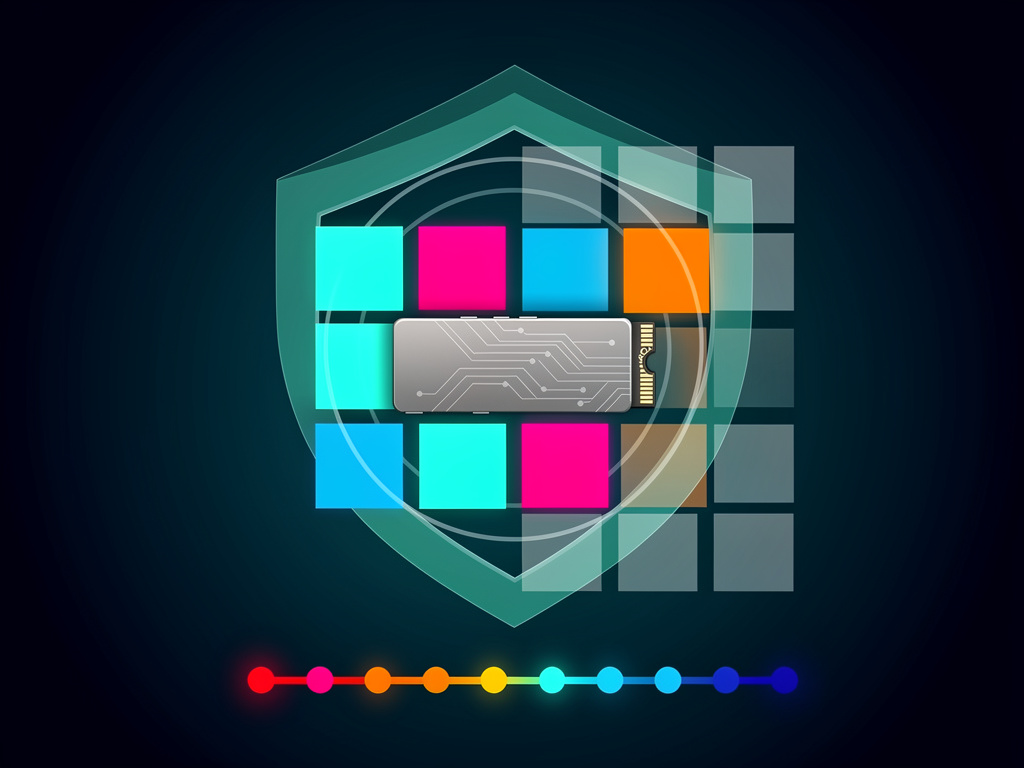
Ransomware operators move fast. They encrypt files. They wipe backups. Then they demand payment. Victims often discover the attack too late. The data they need has vanished from easy reach.
But a new approach from Florida International University changes the equation. It doesn’t stop the hackers at the perimeter. It doesn’t rely on separate backup systems that attackers can also target. Instead, it embeds protection directly in the solid-state drive. Even after infection, critical files stay recoverable far longer than before.
The work comes from assistant professor Weidong Zhu at FIU’s Knight Foundation School of Computing & Information Sciences. His system, detailed in research accepted for presentation at the 2025 ACM SIGSAC Conference on Computer and Communications Security, reorganizes how SSDs manage deleted data. Traditional drives scatter overwritten blocks randomly. Recovery windows shrink to hours or days. Zhu’s method sequences them by deletion time. Newer deletions, often the most valuable, linger. Older ones make way first.
Result? Recoverable data history stretches to 126 days. That’s according to Digital Trends, which first highlighted the breakthrough on June 2, 2026. Performance holds steady too. The approach improves data protection by at least 60 percent. Speed impact stays minimal. Drives don’t slow down noticeably.
Why does this matter? Ransomware groups have grown sophisticated. They don’t just encrypt live files. They hunt backups, delete volume shadow copies, and linger to maximize damage. Traditional recovery depends on clean copies stored elsewhere. Air-gapped tapes. Immutable cloud snapshots. Those work. But they add cost and complexity. And not every organization maintains them perfectly.
Zhu’s retention-aware versioning SSD offers something different. The storage hardware itself becomes an active participant in defense. “Our system extends recoverable data history up to 126 days,” Zhu said in the FIU announcement. “Even if your computer is infected, your data can survive on your drive.” The quote appears in both the university release and coverage by 1TechNation, published hours after the news broke.
Think about the mechanics. When a file gets deleted on an SSD, the drive marks the space as available for new writes. Garbage collection and wear-leveling eventually erase it. Attackers exploit that rapid churn. They trigger mass deletions or overwrites. Evidence disappears. Forensic teams and regular users lose their window.
This new design flips the priority. It tracks deletion order. It preserves recent versions longer in a structured way. The drive essentially keeps a smarter, time-aware buffer of what was overwritten. Recovery tools can reach back into that buffer with higher success rates. And because it’s inside the controller logic, it operates at hardware speed.
But. The system isn’t magic. It won’t decrypt locked files. It won’t prevent initial compromise. What it does is buy time. Massive amounts of it. In an era where mean time to detect ransomware often stretches to weeks, those extra days and months matter. Security teams gain breathing room to isolate, investigate, and restore from the drive itself.
Industry numbers paint a sobering picture. Only 28 percent of organizations fully restore operations after ransomware despite 90 percent claiming confidence, according to Veeam’s 2026 Data Trust and Resilience Report covered by Solutions Review in April 2026. The gap between perception and reality remains wide. AI-driven attacks add data sprawl and new vectors. Traditional perimeter tools fall short.
That’s where storage-layer innovations fit. Companies already push immutable backups. WORM object storage. Air-gapped vaults. Rubrik, Cohesity, and Pure Storage market rapid recovery from clean snapshots. Yet those solutions live outside the primary drive. Zhu’s contribution makes the primary storage more resilient on its own.
Collaborators from the University of Florida joined the project. The work ties into FIU’s Center for Integrated Security, Privacy, and Trustworthy AI. Earlier papers by Zhu explore storage semantics for ransomware defense and semantic gaps in flash systems. This latest builds on that foundation. It turns theory into a practical SSD modification.
Deployment questions remain. Will drive makers adopt the technique? Can it integrate into existing firmware without major redesign? Early signs suggest low overhead. That helps. Enterprises won’t sacrifice performance for security features they rarely use. Here the protection activates only when needed. The drive behaves normally until recovery becomes necessary.
Critics might argue it’s no substitute for strong prevention. True enough. Zero-trust architecture, endpoint detection, employee training, and patched systems still come first. But defense in depth demands multiple layers. This one sits close to the data. It survives even if other layers fail.
Recent attacks show the stakes. Ransomware variants target cloud buckets and make recovery impossible without payment. Statistics from Fortinet document rising enterprise exposure through 2025 and into 2026. Groups refine tactics. They combine encryption with data theft for double extortion. Recovery windows shrink.
Zhu’s approach counters one specific failure mode. The rapid erasure of deleted files. By making deletion history more predictable and persistent in useful ways, it gives responders a better chance. Forensic experts can carve data more effectively. Regular users might restore personal files without paying ransoms or losing months of work.
Expect more attention on storage as a security domain. Not just capacity and speed. But semantics. Retention policies. Versioning built into the flash translation layer. The paper title captures it: “Enabling Secure and Efficient Data Loss Prevention with a Retention-aware Versioning SSD.”
Implementation could start in enterprise drives first. Then trickle to consumer SSDs. Hardware changes take time. Yet the concept proves storage doesn’t have to be passive. It can observe patterns. Prioritize survival of recent data. Act as a last line of defense.
Organizations evaluating ransomware readiness should consider this research. It expands options beyond backup hygiene. Combine it with immutable storage and you create overlapping protections. Attackers must beat both the primary drive’s retention logic and the secondary backup systems.
The timing feels right. Ransomware shows no signs of slowing. AV-Test reported over 24,000 new samples in early 2026. AI assists in crafting variants and automating campaigns. Defenders need every advantage. Turning the SSD into a cybersecurity tool delivers one.
Zhu’s team didn’t set out to stop all attacks. They targeted a narrow but painful problem. The result offers hope for safer recovery. Data that would otherwise vanish can persist. For 126 days. Long enough, in many cases, to mount a proper response.


 WebProNews is an iEntry Publication