
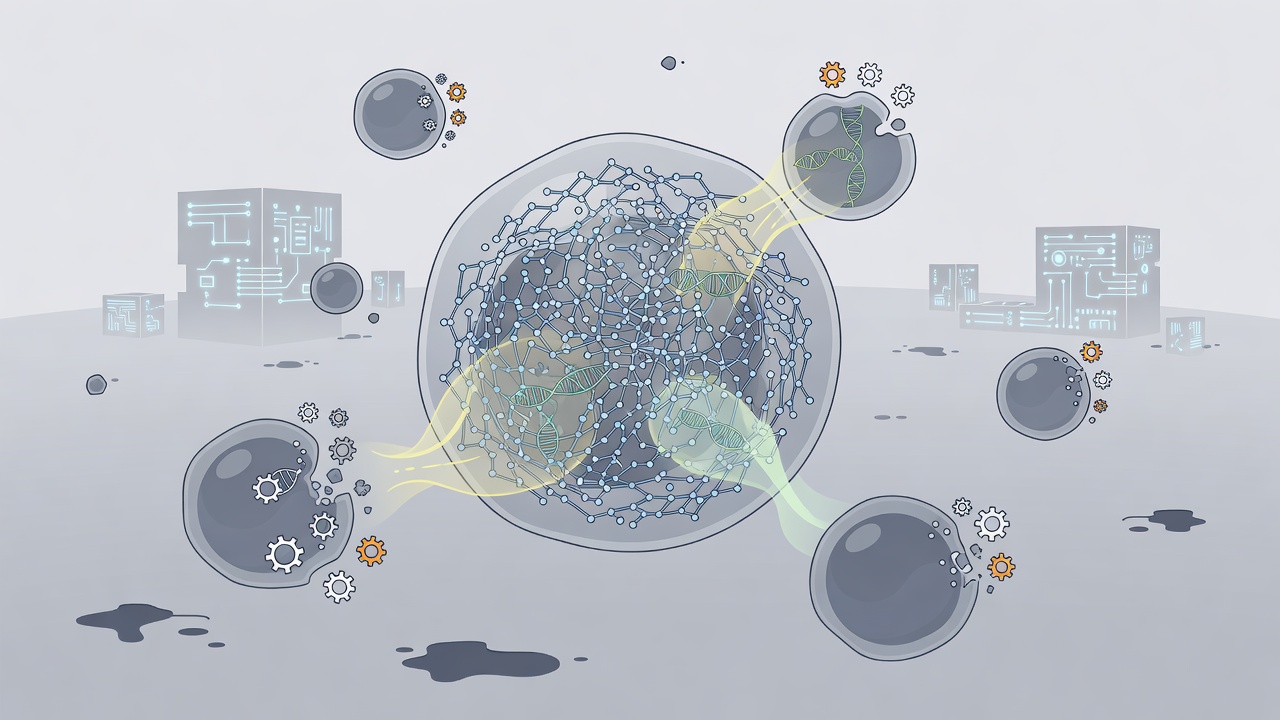
Scientists have crossed a long-sought threshold. They assembled a cell-like structure entirely from non-living chemicals. It feeds. It grows. It copies its genetic code. Then it splits into new generations that compete and evolve. No magic spark. Just molecules following instructions.
From Potato to Platform
The creation goes by SpudCell. The name nods to project leader Kate Adamala’s Polish roots. She and colleagues at the University of Minnesota built it from roughly 150 to 200 defined components. A 90-kilobase-pair genome split across seven DNA molecules sits at its core. That’s smaller than prior minimal-genome estimates of 113 kbp. Human cells carry about three million.
SpudCell performs what researchers call a full cell cycle. It acquires resources from its environment. It expands. It replicates its genome. It divides. And when variants arise that grow faster, they outcompete the originals. After five generations under nutrient stress, the quicker variant dominates. Selection at work. In a bag of chemicals.
Division happens without a cytoskeleton. That internal scaffold has bedeviled synthetic biologists for years because of its complexity. Here, proteins crowd the inner membrane surface until mechanical stress forces the structure to pinch apart. Simple. Effective. A workaround that sidesteps decades of frustration.
Yet SpudCell falls short of life. Its metabolism stays primitive. It cannot build its own ribosomes, the factories that produce proteins. Researchers must supply fresh liposomes packed with ribosomes, enzymes, lipids and other parts every few generations. Lineages last only five to 10 cycles before they falter. The cells die outside tightly controlled lab conditions. No escape. No apocalypse.
“SpudCell is not a ‘finished’ cell, and it is far simpler than anything in nature,” Adamala told The Register. “SpudCell is proof of what is possible. It proves that non-living, defined molecules can be assembled into a cell capable of functions that previously were exclusively reserved for natural life.”
She added in a statement to the University of Minnesota: “We’ve replicated in chemistry what only used to be possible in biology: the complete set of behaviors of a cell. It proves that the most fundamental functions of life, like growth and replication, do not need a mysterious magical spark.”
The work appears in a preprint manuscript available through Biotic. Peer review lies ahead. But the results already drew praise from leaders in the field.
John Glass, who directs synthetic-cell research at the J. Craig Venter Institute, said Adamala’s team produced a system “much closer to being ‘alive’ than anything else produced by the bottom-up synthetic cell field,” according to The New York Times.
Jack Szostak, Nobel laureate and synthetic-biology pioneer, told Quanta Magazine: “I don’t know of any other effort to put together an artificial cell from biological components that has progressed so far.”
Sijbren Otto, whose lab works on chemical self-replicators, called it “a big step forward to this holy grail of making a living thing out of dead components. It’s not completely there yet, but it’s definitely getting quite close.”
Previous efforts took different paths. Some stripped existing bacteria down to minimal genomes, as J. Craig Venter’s team did in 2010. Others mixed non-biological molecules to mimic certain behaviors. SpudCell stands apart because every piece comes from a known chemical inventory. Adamala can list every component. She holds a complete blueprint.
The genome replication system draws from earlier work by researchers including Hendrik Mutschler and Christophe Danelon. Thirty-six enzymes handle transcription and translation. Supply packets of lipids, tRNA and ribosomes keep the system running. A modified fusion protein tethers to the membrane and pulls in fresh lipids to allow growth. When crowding reaches a threshold, the membrane bends and splits. The mechanism takes inspiration from theoretical models proposed by Reinhard Lipowsky.
Adamala described her reaction in Quanta Magazine: “I wasn’t allowing myself to believe it for a while… ‘Holy shit, did I actually make a dividing cell?’… OK, now it’s real.”
She also offered a broader vision. “I’m a chemist, and ever since I started working on biology, I’ve been frustrated by our inability to fully describe and characterize any natural living cell. To understand and routinely use biology, we need engineerable and fully defined cells.”
That frustration fueled her next move. Adamala and colleagues launched Biotic, a public-benefit organization. Its goal is to turn scattered, one-off experiments into a genuine engineering discipline. Labs currently reinvent the same solutions. Knowledge rarely transfers. Biotic aims to provide shared, open foundations so synthetic biology does not remain the province of a few well-resourced groups.
“Every lab in this field is solving the same problems from scratch, and little of that institutional knowledge is carrying over to the next group,” Adamala explained. “That is the problem I want Biotic to solve: How to turn a field of one-off accomplishments into a real engineering discipline, built on shared, open foundations, so the ability to engineer biology is not something only a few private hands ever hold.”
Applications could reshape industries. Current manufacturing of medicines, materials and chemicals often hijacks living cells or burns massive energy in harsh reactors. Synthetic cells built from scratch might perform transformations that industrial chemistry cannot match. They could produce drugs with amino acids never seen in nature. They might grow materials at room temperature instead of forging them under extreme conditions.
“Cells built from scratch could perform molecular transformations industrial chemistry cannot,” Adamala told The Register. In her University of Minnesota interview she added that such platforms “could first transform molecular medicine, building precise therapeutic molecules including drugs incorporating amino acids evolution never used. We could see materials that are grown, rather than synthesized, and manufacturing approaches that operate at biological temperatures, not industrial ones.”
But hurdles remain. Ribosome regeneration tops Adamala’s immediate to-do list. Improved metabolism follows. More reliable division mechanisms come next. The current genome sits on seven separate plasmids; consolidating them into one stable molecule would mark real progress. Error-prone replication enzymes would allow true Darwinian evolution rather than the controlled variants tested so far.
Adamala knows the work is early. “This work is just the beginning. We are showing it’s possible to engineer the basic functions of the cell. To fully realize the promise of this technology – to make it robust and practical – we need combined international effort.”
She described scaling the project as exceptionally difficult. Techniques proved hard to transfer. Collaborators flew in for hands-on demonstrations. That model does not scale. Modularity and open infrastructure must replace it. “Any engineering discipline needs modularity. In our case, we believe those modules must be built in the open: an infrastructure foundation built privately just gives someone a toll booth.”
Other recent efforts provide context. In May 2024 a University of North Carolina lab created artificial cells with programmable cytoskeletons that change shape and respond to surroundings, reported by UNC News. A Spanish team last year built vesicles that navigate chemical gradients using only internal chemistry. Asian researchers in June 2026 released a 10-year roadmap for synthetic cells that includes self-sustaining ribosome production by year 10.
SpudCell sits ahead of many of those milestones on the cycle-completion front. It already grows, divides and selects. Yet it borrows from the collective progress. The field advances in fits. One lab solves membrane stability. Another cracks genome replication. Knowledge compounds slowly until open platforms arrive.
Biotic intends to accelerate that compounding. By publishing protocols, sharing reagents and standardizing parts, the organization hopes to let researchers focus on new functions rather than reinventing division or nutrient uptake.
Experts caution against overstatement. SpudCell is not alive. It lacks autonomy. It depends on human hands for continued existence. Still, it demonstrates that the behaviors long used to separate living from inert—feeding, growth, replication, division, selection—can emerge from a hand-assembled chemical inventory.
The project researchers captured it neatly in a statement to The New York Times: “SpudCell performs the behaviors often used to tell the living from the inert — it feeds, grows, replicates its genome, divides and undergoes selection — yet it is far simpler than any natural cell and was assembled, part by part, by hand.”
Adamala looks further. “My personal immediate to-do list includes ribogenesis, better metabolism, and more robust division. Those three things, with the support of the community built by Biotic, will go very far towards making it a viable platform for practical applications.”
So what else can biology do? That question, posed by Adamala in Quanta Magazine, now has a sharper answer. Quite a bit, it turns out. When the parts list is known, when every interaction can be modeled, when cells become programmable factories rather than black boxes, the possibilities expand. New drugs. Novel materials. Cleaner manufacturing. Deeper insight into life’s origins.
The Wright flyer to the Dreamliner. That’s how some compare today’s SpudCell to future engineered systems. Crude. Limited range. Yet it flew. And it proved the concept.
Biotic’s open approach could shorten the distance to more capable successors. If the field moves from solitary heroics to shared engineering, progress may accelerate. The next versions might synthesize their own ribosomes. They might run for hundreds of generations. They might produce compounds no natural cell ever made.
For now the achievement stands on its own. A synthetic cell completed its first full life cycle this summer in a Minnesota lab. It did so without borrowing from any living ancestor. That fact alone rewrites textbooks and roadmaps alike.
And the work has only started.


 WebProNews is an iEntry Publication