
Spotify’s High-Stakes Gambit: Why the Long-Promised HiFi Audio Is Now a Trojan Horse for a Pricier ‘Supremium’ Tier
NEW YORK – In the fast-moving world of digital media, three years can feel like a lifetime. For Spotify subscribers and investors, it has been precisely that long of a wait for a feature announced with considerable fanfare in February 2021: Spotify HiFi. The promise was simple and compelling—to deliver music in a lossless, CD-quality audio format that would allow listeners to “experience more depth and clarity.” Yet, as the calendar pages turned, the feature remained conspicuously absent, transforming from an exciting product launch into one of the industry’s most persistent and telling enigmas.
The delay is not a simple case of technical hurdles or missed deadlines. Instead, it reflects a seismic shift in the music streaming business, a strategic pivot forced upon the market leader by its deepest-pocketed rivals. When Apple and Amazon abruptly added lossless and spatial audio to their music services just months after Spotify’s announcement—at no additional cost—they effectively turned a premium, revenue-generating feature into a standard offering. This move left Spotify in a strategic bind: either absorb the significant costs of higher-quality streaming and licensing without a corresponding price increase, or risk launching a paid add-on that its chief competitors were giving away for free.
Recalibrating a Premium Product in a Commodity Market
The Stockholm-based audio giant chose a third, more patient path. It shelved the HiFi launch and went back to the drawing board, recognizing that lossless audio alone was no longer a sufficient lure to convince subscribers to pay more. The company’s focus, as articulated in numerous earnings calls, has been on growing its Average Revenue Per User (ARPU), a critical metric for profitability. This has been pursued through a combination of direct price hikes across its core plans and a strategic expansion into other audio formats, most notably podcasts and audiobooks.
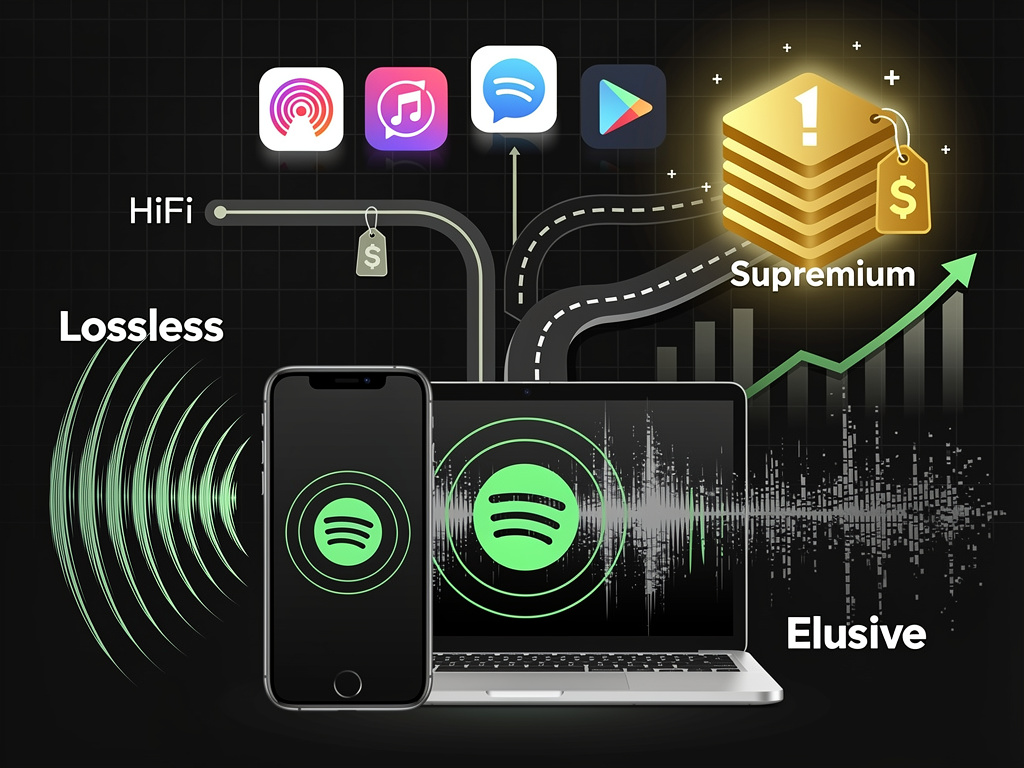
This broader strategy provides the crucial context for the future of high-fidelity audio on the platform. Rather than a standalone feature, HiFi is now poised to become a cornerstone of a new, more expensive subscription tier, reportedly codenamed “Supremium.” According to a report from Bloomberg, this top-tier plan will bundle lossless audio with a suite of other exclusive features, fundamentally changing the value proposition. The goal is no longer just to sell better sound, but to sell a comprehensive, premium audio experience that justifies a significant price jump.
The ‘Supremium’ Gambit: Bundling as the Path Forward
The rumored “Supremium” tier is Spotify’s answer to the commoditization of lossless audio. Leaks and code dissections suggest the package will include not only HiFi streaming but also expanded access to audiobooks, moving beyond the 15-hour monthly cap of the standard Premium plan. Furthermore, it is expected to incorporate advanced, AI-powered playlisting tools and other sound-mixing features, creating a robust offering that cannot be easily replicated by competitors. By bundling these disparate elements, Spotify aims to create a product that is defensible and, most importantly, profitable.
This strategy tacitly acknowledges a fundamental truth about the market for high-fidelity sound: it is, for the most part, a niche concern. The mass market that Spotify has so successfully captured is not composed of audiophiles with acoustically treated listening rooms. It is comprised of commuters, gym-goers, and office workers, the vast majority of whom listen on devices that are incapable of rendering the subtle differences between a high-bitrate compressed file and a true lossless stream.
Beyond the Codec: The Hardware Hurdle for Mass Adoption
The technical barrier to entry for enjoying true lossless audio remains substantial. As detailed in an analysis by MakeUseOf, the primary bottleneck for most listeners is their equipment. The overwhelming majority of consumers use Bluetooth headphones, such as Apple’s AirPods or Sony’s popular WH-1000XM series. Bluetooth technology itself relies on its own compression codecs (like SBC, AAC, or aptX) to transmit audio wirelessly. This means that even if Spotify delivers a pristine, 1,411 kbps lossless file to a smartphone, the data is compressed again before it reaches the listener’s ears, effectively negating the benefit of the high-quality source.
To genuinely appreciate the difference offered by CD-quality, 16-bit/44.1kHz audio, a user needs a specific hardware chain. This typically involves a pair of high-quality wired headphones connected to a device through a dedicated Digital-to-Analog Converter (DAC), an external component that processes the digital signal with greater fidelity than the standard chips found in phones and laptops. This is a setup reserved for dedicated audio enthusiasts, a small but valuable segment of the market, but hardly the basis for a platform-wide, revenue-driving feature.
Licensing Labyrinths and the Unseen Costs of Quality
Beyond the consumer-side hardware limitations are the significant back-end costs for Spotify. Lossless audio files are four to five times larger than the 320 kbps Ogg Vorbis files the platform currently uses for its highest-quality setting. This translates directly into higher data storage and bandwidth costs, which, at Spotify’s scale of over 600 million users, are non-trivial. These operational expenses are compounded by the complexities of music licensing.
Record labels and publishers often structure licensing deals with different royalty rates for different formats. A higher-fidelity stream is frequently considered a premium product for which rights holders expect a larger slice of the revenue. Without a dedicated, higher-priced tier to offset these increased payouts, offering lossless audio for free, as Apple and Amazon do, would have directly eroded Spotify’s already-thin margins. The “Supremium” bundle is a carefully constructed vehicle designed to absorb these costs while increasing overall ARPU.
The Competitive Chessboard and Spotify’s Final Move
While Spotify deliberated, the competitive environment solidified. Apple and Amazon continue to leverage lossless audio as an ecosystem benefit—a feature to enhance the value of their hardware and Prime memberships, rather than a standalone profit center. Meanwhile, smaller, audiophile-focused services like Tidal (which has long championed high-fidelity formats) and Qobuz have carved out a stable existence serving the high-end market. Spotify was left without a clear position in the high-quality audio segment.
The company’s forthcoming strategy appears to be a calculated response to this new reality. By waiting, Spotify has allowed the initial hype around lossless audio to subside, and it has gathered invaluable data on how to package and price a truly premium offering. The long-delayed HiFi feature, once envisioned as a simple product upgrade as originally announced, has evolved into the centerpiece of a much grander—and more expensive—vision. It is less an olive branch to audiophiles and more a strategic tool to segment its user base and extract more revenue from its most engaged subscribers, proving that in the streaming wars, sometimes the most patient player makes the most calculated move.


 WebProNews is an iEntry Publication