
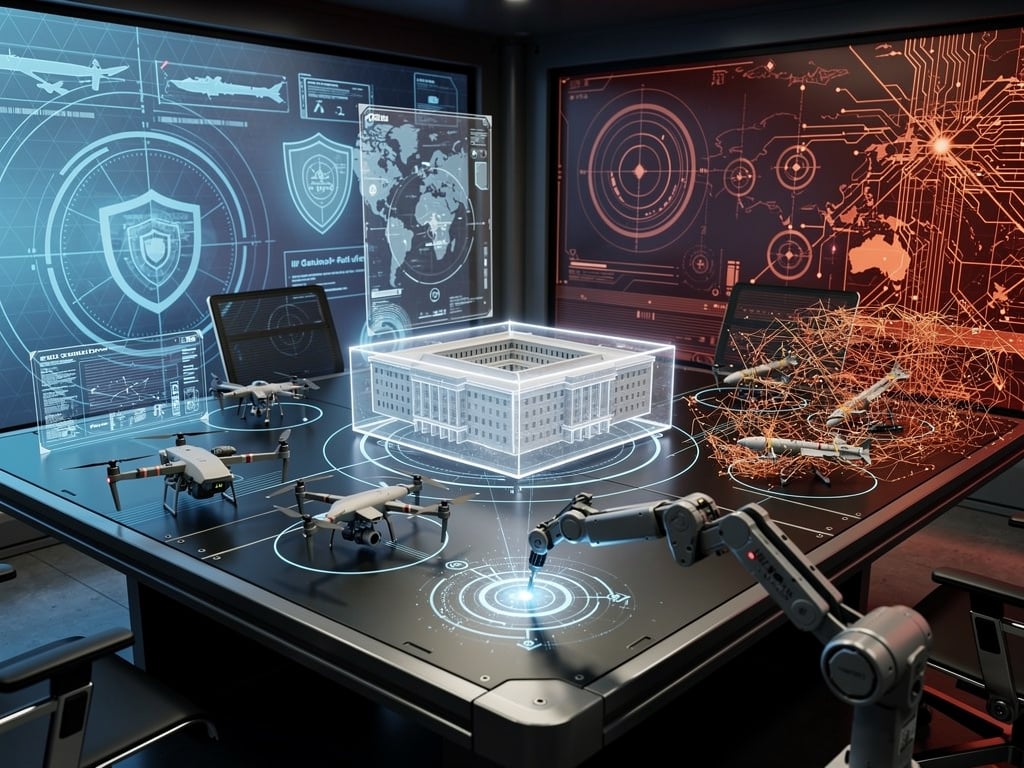
Adm. Frank Bradley delivered a measured warning last week in Tampa. The commander of U.S. Special Operations Command told an audience of special forces leaders that troops must exercise care in adopting artificial intelligence for combat decisions. His words landed amid a broader Pentagon drive to embed the technology across operations.
Bradley oversees the military’s most elite and secretive units. He spoke at the annual special forces conference. “Troops have to be very careful about how we come to AI’s employment and its inspiration into the delivery of lethality,” he said, according to reporting by The Associated Press. Bradley added that he envisions systems where AI picks targets. Yet humans must retain absolute assurance. “We, as humans, have to have the confidence that it’s going to deliver violence only where we intend it to be delivered.”
Short. Direct. Those sentences captured a tension running through the defense establishment. On one side sits Defense Secretary Pete Hegseth. He has moved aggressively to integrate AI without what he views as excessive limits. On the other stand some commanders and technology providers who insist on safeguards.
Hegseth’s approach crystallized earlier this year. He told SpaceX employees in January that he would reject any AI models “that won’t allow you to fight wars.” His stated goal involved systems operating “without ideological constraints that limit lawful military applications.” Those comments, also detailed in the AP report, set the stage for public friction.
The friction intensified with Anthropic. The San Francisco company, known for its Claude models, clashed with the Pentagon over usage terms. Hegseth demanded flexibility for all lawful military applications. Anthropic resisted on grounds that certain uses, such as fully autonomous lethal drones or mass surveillance, crossed ethical lines. The dispute escalated. The Pentagon labeled Anthropic a supply-chain risk to national security. It terminated a $200 million contract and barred other defense partners from engaging with the firm. Anthropic sued in response. The company argued the designation amounted to illegal retaliation.
But Bradley’s remarks introduced a different tone from within the uniformed ranks. His command specializes in high-risk missions where errors carry catastrophic costs. Confidence in targeting data matters. So does accountability when violence follows. Bradley did not reject AI. He conditioned its role on human oversight that leaves no doubt.
A Pentagon official, speaking anonymously to discuss internal views, responded to Bradley’s comments by stressing practical aims. The focus remains on “functional battlefield tools” that accelerate target identification and strikes. That perspective aligns with Hegseth’s broader agenda. The administration sees AI as an American edge against competitors, particularly China. President Donald Trump reinforced the point. He scrapped plans for a new AI executive order because he feared it might slow momentum. “We’re leading China, we’re leading everybody, and I don’t want to do anything that’s going to get in the way of that lead,” Trump told reporters.
Yet the military does not speak with one voice. At the same Tampa conference, other SOCOM leaders highlighted narrower applications. Sgt. Maj. Andrew Krogman, the command’s top enlisted official, described AI managing administrative burdens so operators could concentrate on core tasks. Melissa Johnson, SOCOM’s acquisition executive, called for technology that reduces “the cognitive workload on mundane tasks.” She added that the command applies AI “more and more, but it’s not to replace operator judgment, it’s to enhance it.” Those statements appeared in coverage from The Washington Post.
Helen Toner offered outside perspective. The interim executive director at Georgetown University’s Center for Security and Emerging Technology noted that both views hold truth. Bureaucratic and analytical uses of AI differ from lethal targeting. “There are a huge number of potential uses for AI in these kinds of bureaucratic settings, which the U.S. military is actively exploring,” Toner said. She pointed to past examples. Two years ago her center examined how the Army’s 18th Airborne Corps applied AI to artillery targeting. The system matched the efficiency of top historical units while operating with 2,000 fewer personnel. “Human operators are still the ones making crucial decisions, but AI is making it possible to operate with a new level of speed and scale,” she explained.
Real-world cases already demonstrate the dual nature. Lt. Gen. Michael Conley, who leads Air Force Special Operations Command, testified to Congress in May. He described AI tools that rapidly downgrade classified intelligence from top secret to secret level. The process took seconds instead of hours. Drone operators on the ground gained access during operations tied to Iran. Speed matters. So does the chain of responsibility when that speed produces mistakes.
The debate extends beyond one conference or one company. SOCOM has quietly explored AI for facility surveillance, agentic experimentation, and autonomous systems. Recent articles from DefenseScoop detail these efforts, including plans for a proving ground focused on autonomous warfare. Hegseth himself referenced a coming sub-unified command dedicated to the domain. The infrastructure is taking shape. Questions of control and confidence remain.
Bradley’s audience understood the stakes. Special operators execute missions where misidentification can mean dead allies, civilian deaths, or strategic failure. They train for environments where technology augments but does not supplant judgment. His call for confidence in AI’s lethal decisions reflects that culture. It does not oppose innovation. It demands that innovation preserve human accountability.
Hegseth, by contrast, frames constraints as obstacles. His January speech and subsequent actions against Anthropic signal a preference for speed over negotiated limits. The Pentagon has pivoted toward other providers, including OpenAI, Google, and SpaceX-linked efforts. Those firms appear more willing to accommodate military requirements. The market is adjusting. Whether the resulting systems earn the trust Bradley described will determine their battlefield value.
And the clock runs. Competitors advance their own programs. China’s military AI investments draw constant scrutiny in Washington. Every delay carries perceived risk. Every rushed deployment carries hidden costs. Bradley’s intervention highlights that the conversation inside the Pentagon includes voices urging deliberate integration rather than wholesale acceleration.
Recent coverage from Defense One captured SOCOM’s practical wishlist. Operators want compact, rugged AI tools that function offline. They seek systems that shrink cognitive load without introducing new vulnerabilities. Those requirements echo Johnson’s and Krogman’s comments. They also align with Bradley’s caution. Technology must earn confidence before it earns trust with violence.
The coming months will test these competing impulses. Contracts will be awarded. Experiments will scale. Commanders will assess whether AI truly delivers the precision Bradley requires. Hegseth will continue pressing for adoption at pace. The record of recent clashes with Anthropic shows the administration tolerates little pushback on its vision of unconstrained lawful use.
Bradley did not prescribe specific technical solutions. He stated a principle. Humans must know, with certainty, that AI-directed force hits only intended marks. In an era of proliferating sensors, vast data streams, and autonomous platforms, that principle grows harder to satisfy. Yet for special operations forces, it remains non-negotiable. Their missions permit no margin for algorithmic doubt.
The tension will persist. Military services experiment with target recognition software, intelligence summarization, logistics optimization, and more. Some applications carry low risk. Others sit at the edge of lethal autonomy. Bradley’s words serve as a reminder that the edge demands scrutiny. Confidence cannot be assumed. It must be earned through testing, transparency, and retained human authority.
So the Pentagon moves forward on two tracks. One accelerates capability. The other, voiced by a four-star special operations commander, insists on safeguards that preserve intent. How those tracks converge will shape American military power for the next decade. The conference in Tampa offered an early signal. Caution has its advocates even in an administration bent on speed.


 WebProNews is an iEntry Publication