
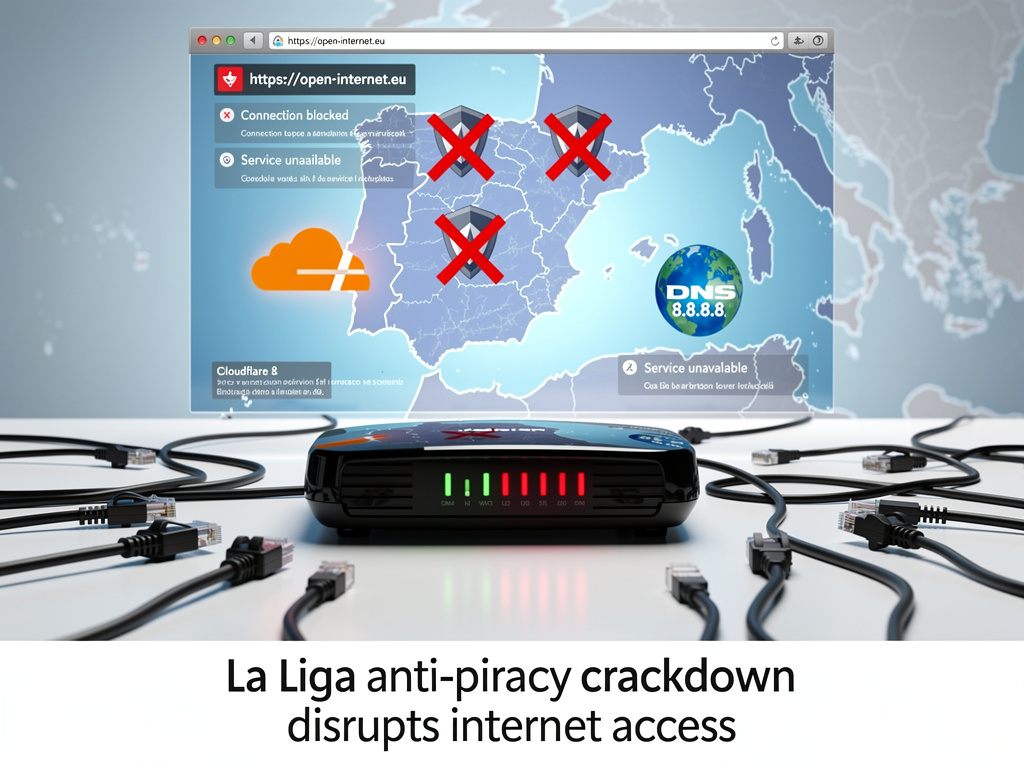
For years, La Liga, Spain’s premier football league, has waged an aggressive campaign against illegal streaming of its matches. But what began as a targeted effort to shut down pirate broadcasters has metastasized into something far more sweeping: a legal and technical apparatus that is now disrupting legitimate internet services, blocking VPN providers, and raising fundamental questions about the future of online freedom in one of Europe’s largest economies.
The collateral damage is mounting. Cloudflare, one of the world’s largest content delivery networks, has seen its services intermittently blocked in Spain. Google DNS and other public resolvers have been affected. And now, VPN services — tools used by millions of ordinary citizens, remote workers, and privacy-conscious individuals — are finding themselves in the crosshairs of court orders that critics say are breathtakingly broad.
How a Football League Gained the Power to Reshape Spain’s Internet
The legal foundation for La Liga’s anti-piracy operations dates back to a 2024 Spanish court order that granted the league extraordinary authority to compel internet service providers to block IP addresses and domains associated with unauthorized streams of its matches. The order, issued by a commercial court in Barcelona, was designed to be dynamic — meaning La Liga could add new targets in real time, during live matches, without returning to court for each individual block.
According to TechRadar, this mechanism has resulted in an ever-expanding blacklist that now includes not just pirate streaming sites, but also the infrastructure that legitimate services rely on. La Liga’s technical partner, Movistar (owned by Telefónica), implements the blocks at the ISP level, and the scope has grown to include Cloudflare IP addresses, public DNS resolvers, and — increasingly — VPN servers.
Cloudflare, Google DNS, and the Blocking of Core Internet Infrastructure
The most alarming aspect of Spain’s anti-piracy regime is its willingness to block shared internet infrastructure. Cloudflare, which provides DDoS protection and content delivery for millions of websites worldwide, uses IP addresses that are shared across thousands of domains. When La Liga’s system flags a Cloudflare IP because a single pirate stream is routed through it, the resulting block can knock out access to countless unrelated, perfectly legal websites.
This is not a theoretical concern. Spanish users have reported widespread outages affecting banking portals, e-commerce sites, news outlets, and government services — all because they happened to share infrastructure with a blocked pirate stream. Google’s public DNS service (8.8.8.8), used by millions globally as an alternative to ISP-provided DNS, has also been intermittently disrupted in Spain. The technical community has reacted with alarm, arguing that these blocks represent a fundamental misunderstanding of how the modern internet works.
VPN Providers Now Squarely in the Firing Line
The latest escalation involves VPN services. As TechRadar reported, La Liga’s blocking system has begun targeting VPN server IP addresses. The logic is straightforward from the league’s perspective: if users can circumvent ISP-level blocks by routing their traffic through a VPN, then the VPN itself becomes an obstacle to enforcement. But the implications are enormous.
VPNs are not niche tools for tech enthusiasts. They are standard security infrastructure for businesses, remote workers, journalists, activists, and ordinary citizens who want to protect their data on public Wi-Fi networks. The European Union has generally supported the right of citizens to use encryption and VPN technology. Spain’s approach — blocking VPN servers wholesale because some users might use them to access pirated football streams — represents a dramatic departure from that principle.
The Legal and Political Backlash Is Growing
Digital rights organizations across Europe have begun to push back. The Electronic Frontier Foundation and European Digital Rights (EDRi) have both raised concerns about the proportionality of Spain’s blocking regime. Under EU law, anti-piracy measures are supposed to be targeted and proportionate — they should not cause widespread collateral damage to legitimate services. Critics argue that La Liga’s system fails this test spectacularly.
Spanish internet users have also organized online, with forums and social media threads documenting the scope of the disruptions. Some have reported being unable to access their workplace VPNs during La Liga match times, effectively being locked out of work because a football league’s anti-piracy bot flagged their VPN provider’s IP address. Others have found that basic web browsing becomes unreliable on match days, as the blocking system casts an increasingly wide net.
La Liga Defends Its Approach as Necessary and Effective
La Liga has consistently defended its anti-piracy operations as essential to protecting the economic model of professional football. Broadcasting rights represent the single largest revenue stream for Spanish clubs, and piracy — particularly through illegal IPTV services — poses a genuine threat to that income. The league has argued that its blocking system is sophisticated, targeted, and subject to judicial oversight.
Javier Tebas, La Liga’s president, has been vocal about the league’s anti-piracy stance for years, framing it as a matter of economic survival for smaller clubs that depend on their share of broadcast revenue. The league points to statistics showing a reduction in piracy rates since the blocking system was implemented, and argues that the collateral damage reported by critics is exaggerated or temporary.
Technical Experts Say the Approach Is Fundamentally Flawed
But network engineers and internet policy experts say the problem is structural, not incidental. The modern internet relies on shared infrastructure — content delivery networks, cloud hosting platforms, and DNS resolvers that serve millions of users and websites simultaneously. Blocking at the IP level in this environment is, as one widely cited analogy puts it, like shutting down an entire apartment building because one tenant is running an illegal business.
Cloudflare itself has publicly objected to the blocking of its IP addresses, noting that a single IP can serve thousands of different websites. The company has argued that more targeted approaches — such as blocking specific domain names rather than IP addresses — would achieve the same anti-piracy goals without the massive collateral damage. DNS-level blocking, while imperfect, is generally considered less destructive than IP-level blocking because it can target individual domains rather than entire swaths of infrastructure.
A Precedent That Could Spread Across Europe
What happens in Spain may not stay in Spain. Other football leagues and content rights holders across Europe are watching La Liga’s experiment closely. The English Premier League, Serie A, and Ligue 1 all face similar piracy challenges and have their own anti-piracy operations. If Spain’s approach is seen as effective — even with its collateral damage — it could serve as a template for similar regimes in other EU member states.
This prospect has alarmed internet freedom advocates, who warn that the normalization of broad infrastructure blocking sets a dangerous precedent. Once the legal and technical mechanisms exist to block VPNs and CDNs in the name of copyright enforcement, the same tools can be repurposed for other forms of censorship. The slippery slope argument, often dismissed as hyperbolic, takes on a more concrete character when court orders are already being used to block Cloudflare and Google DNS.
What Spanish Internet Users Can Do — and What Remains Uncertain
For now, Spanish users affected by the blocks have limited options. Some have switched to lesser-known DNS resolvers that have not yet been targeted. Others have adopted VPN protocols that are more resistant to blocking, such as those that disguise VPN traffic as ordinary HTTPS browsing. But these are workarounds, not solutions, and they require a level of technical sophistication that most ordinary internet users do not possess.
The deeper question is whether Spain’s judiciary and legislature will rein in the blocking regime before it causes even more damage. A legal challenge to the court order’s scope is widely expected, and EU regulators may eventually weigh in on whether Spain’s approach complies with the bloc’s rules on proportionality and fundamental rights. Until then, every La Liga match day carries the risk of another round of internet disruptions — a surreal situation in which watching football illegally and browsing the web legally have become entangled in the same web of IP blocks and DNS blacklists.
The Spanish experiment is, at its core, a stress test for the open internet. It asks whether the economic interests of a sports league can justify the degradation of basic internet infrastructure for an entire country. The answer to that question will reverberate far beyond Spain’s borders — and far beyond the world of football.


 WebProNews is an iEntry Publication