
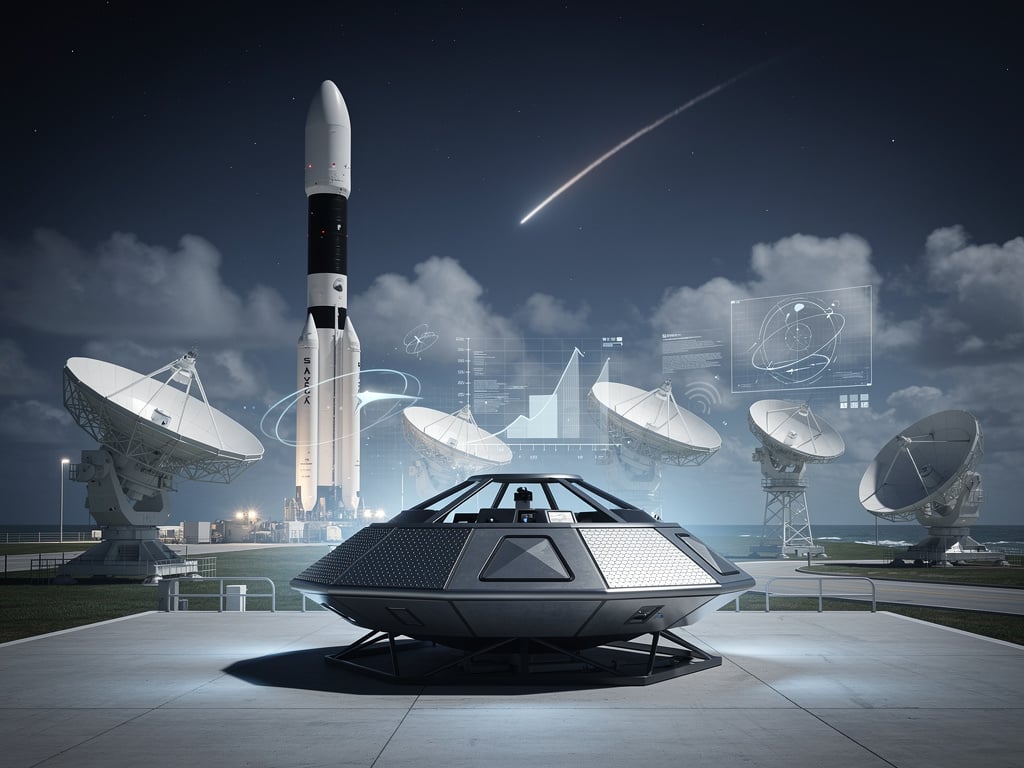
SpaceX pulled back the curtain just enough Tuesday to reveal Starfall. A Falcon 9 rocket roared off the pad at Cape Canaveral Space Force Station’s SLC-40 at 6:53 a.m. Eastern. The company called it the Starfall Demo mission. Little else was shared.
The webcast ended minutes after liftoff. No live views of deployment. No real-time telemetry on the capsule’s path through the atmosphere. Secrecy defined the entire effort. Yet the launch marked the public debut of a new uncrewed reentry vehicle shaped like a flying saucer.
At roughly 10 feet across and two feet tall, the squat puck weighs about 2,100 kilograms empty. It can carry up to 1,000 kilograms of payload. SpaceX describes it as a microgravity lab. Researchers and manufacturers gain routine, affordable access to orbit. They run experiments. They produce materials. Then the capsule brings results home.
“SpaceX has developed a new spacecraft called Starfall, which is, at its core, a microgravity lab that researchers and entrepreneurs can leverage to develop their products and innovations,” the company said during the brief broadcast, according to Futurism. “There is a huge opportunity to benefit life on Earth through microgravity research and in-space manufacturing.”
Deployment of Starfall was confirmed after the rocket’s second stage released its cargo. The capsule later plunged into the Pacific Ocean. No immediate word came on whether it survived the fiery descent or if recovery teams located it. That silence fits the pattern. The program stayed hidden until hours before launch.
But Starfall isn’t arriving in a vacuum. Other firms already chase similar goals. Varda Space Industries flies smaller reentry capsules for pharmaceutical manufacturing. Rocket Lab works on its own return systems. Starfall stands apart in size and ambition. Its design supports heavier loads. It could ride not only on Falcon 9 but also on future Starship flights.
The timing raises eyebrows. SpaceX filed with the FAA earlier this year for two test missions focused on reentry, splashdown and recovery. Agency approval came in May. The first flight happened within weeks. Observers note the unusual discretion for a commercial project. Post-IPO scrutiny usually pushes companies toward openness. Here the opposite occurred.
Military interest adds another layer. The Pentagon has long eyed rapid global cargo delivery via rocket. Point-to-point transport could move supplies or even weapons in under an hour. SpaceX holds multiple defense contracts already. The capsule’s saucer shape aids controlled flight during reentry. That feature matters as much for precision landing as for scientific return.
SpaceNews reported the launch treated like a classified mission. Webcast rules mirrored national security flights. No public details on secondary payloads, if any existed. The first-stage booster, on its 29th flight, landed successfully on the droneship A Shortfall of Gravitas. Routine success there. The real unknown remains the capsule itself. (SpaceNews)
Space.com offered more dimensions. The vehicle measures about 3.1 meters in diameter and 0.75 meters tall. It carries no propulsion of its own. Instead it relies on the launch vehicle to reach orbit, then deorbits through atmospheric drag and controlled maneuvering. This first test aimed to prove stable flight and heat shield performance. At least one more demo is planned. (Space.com)
Analysts see broader market forces at work. In-space manufacturing gains traction. Companies want to grow crystals, produce alloys or test biologics free of gravity’s pull. Bringing those products back intact and quickly matters. Traditional capsules like Dragon serve the International Space Station well. Starfall targets dedicated cargo runs from various orbits. Faster turnaround. Potentially lower costs per kilogram returned.
Yet questions linger. How does the heat shield hold up? Can the vehicle steer accurately enough for predictable splashdown? Will recovery prove economical? SpaceX offered no engineering papers or detailed schematics. The illustration released shows a disc-like craft glowing during reentry. Clean lines. Minimal protrusions. Hints at a blunt-body design that slows naturally while managing heat.
Payload Space noted the flight validates technology for a growing cohort of reentry startups. The sector bets that demand for returned microgravity products will rise sharply in coming years. Starfall’s success or failure will influence investment across that field. (Payload Space, published June 24, 2026)
Elon Musk stayed quiet on the topic before and after launch. His attention remains fixed on Starship development and Mars plans. Starfall appears a side project. One that could complement the bigger vehicle by giving customers an early way to test manufacturing concepts before Starship flies regularly.
The FAA license covers two tests. Regulators examined environmental impacts of splashdown and recovery operations. No major issues surfaced. That clearance cleared the path for this week’s flight. A second test could follow soon. Or the company might shift straight to operational missions if data looks good.
Industry watchers on X reacted with equal parts excitement and frustration. Many praised the rapid timeline from filing to flight. Others complained about the blackout after ascent. “No telemetry stream, no mission brief, no post-flight update,” one user posted. “Whatever they’re testing, they’re not showing the work yet.” The community has grown used to detailed Starship coverage. Starfall received the opposite treatment.
So what comes next? SpaceX could release recovery footage or sensor data in coming days. It might stay silent until the second test. Either approach fits past behavior on sensitive programs. The capsule’s design suggests versatility. Launch on Falcon today. Ride Starship tomorrow. Return 1,000 kilograms of high-value product anywhere on Earth within hours.
That last point fuels military speculation. A vehicle that delivers cargo globally in under an hour changes logistics. It also changes strategy. Defense planners have studied the concept for years. SpaceX’s existing work with the Space Force and NRO makes partnership plausible. The company neither confirms nor denies such angles.
For now the facts remain limited. One successful launch. One controlled reentry attempted. One saucer-shaped craft now sitting somewhere in the Pacific. Or perhaps not. Without confirmation, the mission’s full outcome stays hidden.
SpaceX has built its reputation on rapid iteration. Starship prototypes explode, then fly better. Falcon boosters return dozens of times. Starfall could follow the same script. This first flight gives engineers data. The next one builds on it. And somewhere in the background, plans for regular microgravity manufacturing flights take shape.
The flying-saucer silhouette might look whimsical. Its purpose does not. It targets a practical gap. Get experiments to orbit cheaply. Keep them there long enough to matter. Bring them back safely. Do it again and again. If the concept works, Starfall could become the workhorse for an emerging in-orbit economy. One measured not in passengers but in kilograms of product returned to waiting labs and factories.
That future remains years away. Tuesday’s launch offered the first tangible step. Quiet. Swift. And deliberately opaque. SpaceX rarely keeps secrets this well. When it does, attention follows. Starfall now sits squarely in that spotlight even as the company says little more.


 WebProNews is an iEntry Publication