
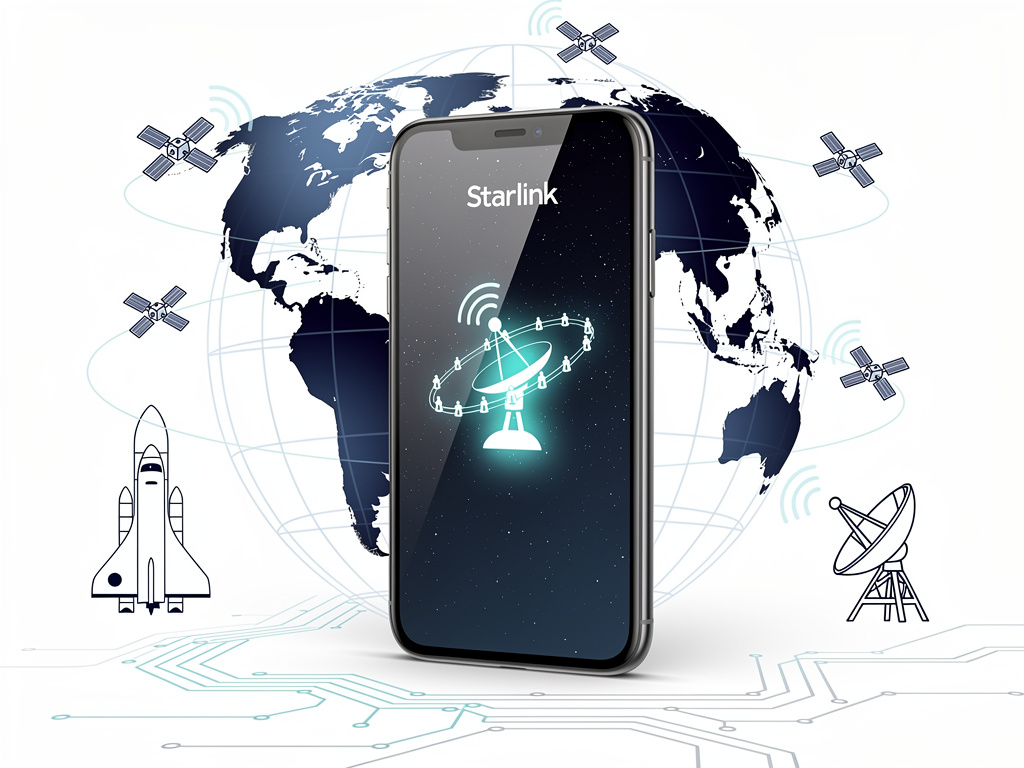
For years, the telecommunications industry has watched SpaceX’s Starlink satellite constellation evolve from a broadband internet service into something far more ambitious — a direct-to-cell platform capable of bypassing traditional carriers entirely. Now, a fresh wave of evidence suggests that SpaceX may be taking the next radical step: building its own smartphone. The revelation, buried in job postings and trademark filings, has set off a firestorm of speculation, even as CEO Elon Musk publicly distances himself from the idea.
The story began gaining traction when sharp-eyed observers noticed that SpaceX had filed a trademark application for the term “Starlink” in a category that explicitly covers mobile phones and smartphone devices. Simultaneously, job listings appeared on SpaceX’s careers page seeking engineers with expertise in mobile handset design, cellular modem integration, and consumer electronics hardware — skill sets that have nothing to do with launching rockets or managing satellite constellations, but everything to do with building a phone. As Digital Trends reported, these filings and postings represent the most concrete evidence yet that SpaceX is at least exploring the possibility of a Starlink-branded handset.
Trademark Filings and Job Postings Tell a Different Story Than Musk
What makes this development particularly intriguing is the stark contrast between the documentary evidence and Musk’s own public statements. When asked directly about the prospect of a Starlink phone, Musk took to X (formerly Twitter) to pour cold water on the rumors, stating that there is “no plan” for such a device. This is consistent with Musk’s long-standing public position that Starlink’s direct-to-cell service is designed to work with existing smartphones from manufacturers like Apple, Samsung, and Google — not to replace them. The whole selling point of Starlink’s cellular partnership with T-Mobile, announced with great fanfare in 2022, was that consumers wouldn’t need any special hardware to connect to satellites overhead.
Yet trademark filings are not casual undertakings. They require legal resources, strategic intent, and forward planning. Companies rarely file trademarks in product categories they have no intention of entering. The specific classification under which SpaceX filed — covering mobile phones and portable communication devices — leaves little room for ambiguity. As Digital Trends noted, even if SpaceX never brings a phone to market, the filing suggests that internal teams have at least studied the feasibility and commercial potential of such a product. In the world of corporate strategy, where actions often speak louder than executive tweets, these filings carry significant weight.
The Direct-to-Cell Revolution Sets the Stage
To understand why a Starlink phone would matter, one must first appreciate how dramatically SpaceX has already reshaped satellite communications. Starlink’s direct-to-cell technology, which began beta testing in early 2024 in partnership with T-Mobile, allows standard LTE-enabled smartphones to connect to specially equipped Starlink satellites in low Earth orbit. The service initially supported only text messaging, but SpaceX has been rapidly expanding capabilities to include voice calls and data connectivity. The Federal Communications Commission granted SpaceX supplemental coverage from space (SCS) authority, enabling the company to fill cellular dead zones across the United States — remote areas, national parks, disaster zones, and rural communities where traditional towers simply don’t reach.
The T-Mobile partnership was a masterstroke of market positioning. By piggybacking on an existing carrier’s spectrum and subscriber base, SpaceX avoided the regulatory and commercial headaches of becoming a full-fledged mobile network operator. But the arrangement also means that SpaceX remains dependent on carrier partnerships for its direct-to-cell revenue. A Starlink phone could fundamentally alter that dynamic, giving SpaceX a vertically integrated product — satellite constellation, ground infrastructure, and consumer hardware — that would allow the company to capture value at every layer of the telecommunications stack.
Why a Starlink Phone Could Upend the Wireless Industry
The strategic logic of a Starlink phone becomes even clearer when viewed through the lens of SpaceX’s broader business model. Starlink already has more than 4 million subscribers to its satellite internet service, a customer base that has demonstrated willingness to buy SpaceX hardware (the Starlink dish and router) and pay monthly subscription fees. A phone optimized for satellite connectivity — with an antenna designed specifically for Starlink’s frequency bands, a modem tuned for satellite-to-handset communication, and software deeply integrated with the Starlink network — could offer a meaningfully better experience than a generic smartphone relying on the same satellites through a carrier middleman.
Consider the potential market. There are billions of people worldwide who live outside the reach of reliable cellular infrastructure. In sub-Saharan Africa, Southeast Asia, rural South America, and remote regions of every continent, a phone that connects directly to a satellite network without requiring a local cell tower would be transformative. SpaceX has already demonstrated the ability to manufacture hardware at scale with its Starlink dishes, which are produced at a rate of thousands per week at the company’s facility in Austin, Texas. Applying that manufacturing expertise to a smartphone — even a ruggedized, satellite-first device rather than a flagship competitor to the iPhone — could open an enormous addressable market that Apple and Samsung have largely ignored.
Musk’s Denial May Be More Nuanced Than It Appears
Elon Musk’s public denials deserve scrutiny, but they also deserve context. Musk has a well-documented history of denying or downplaying projects that are in early exploratory stages, only to announce them later when the timing is right. He denied that Tesla was building a pickup truck before unveiling the Cybertruck. He suggested that Twitter’s transformation would be gradual before rebranding it to X almost overnight. In the SpaceX context, Musk initially described Starlink as a modest supplement to terrestrial broadband before it became one of the most disruptive forces in global internet access. A denial today does not preclude an announcement tomorrow.
There is also a diplomatic dimension to consider. SpaceX’s direct-to-cell business depends on partnerships with carriers like T-Mobile in the United States and other operators internationally. Announcing a Starlink phone — a device that could theoretically bypass carriers entirely — would alarm those partners and potentially jeopardize deals that are still being negotiated or expanded. It would be entirely rational for Musk to deny any phone plans publicly while SpaceX quietly explores the technology internally, waiting until carrier relationships are secure enough to withstand the competitive implications of a branded handset.
Technical Challenges and the Path Forward
Building a smartphone is no trivial undertaking, even for a company with SpaceX’s engineering prowess. The mobile phone industry is dominated by deeply entrenched players with decades of experience in supply chain management, software ecosystems, app store relationships, and carrier certification processes. Amazon’s Fire Phone, Facebook’s rumored handset, and Essential’s PH-1 all serve as cautionary tales of technology companies that underestimated the complexity of the smartphone market. A Starlink phone would need to run Android (or a fork of it) to have any hope of app compatibility, and it would need to pass rigorous certification from carriers and regulatory bodies worldwide.
However, SpaceX has several advantages that previous entrants lacked. First, it controls the network infrastructure — the satellites themselves — giving it a level of vertical integration that no phone manufacturer has ever possessed. Second, the company has a built-in customer base of millions of Starlink subscribers who already trust the brand. Third, SpaceX has demonstrated an extraordinary ability to iterate rapidly and drive down hardware costs, as evidenced by the evolution of the Starlink dish from a $3,000 unit to one that costs a fraction of that. If SpaceX approaches a phone the way it approached reusable rockets — with relentless iteration, vertical integration, and a willingness to absorb early losses for long-term market dominance — the results could be formidable.
What the Industry Should Be Watching
For now, the Starlink phone remains officially in the realm of speculation and circumstantial evidence. No prototype has been leaked, no launch date has been hinted at, and Musk’s denial remains on the record. But the convergence of trademark filings, targeted hiring, and strategic logic makes it impossible to dismiss. The telecommunications industry, already grappling with SpaceX’s direct-to-cell disruption, would be wise to take these signals seriously.
The coming months will be telling. If SpaceX continues to hire mobile hardware engineers, if additional trademark filings appear in international markets, or if supply chain reports surface from component manufacturers in Asia, the picture will become clearer. In the meantime, the wireless industry finds itself in an uncomfortable position: watching a rocket company — one that has already upended satellite broadband and is rapidly transforming cellular coverage — potentially set its sights on the most personal piece of technology in the world. Whether the Starlink phone arrives in 2025, 2027, or never, the mere possibility is already reshaping how carriers, handset makers, and regulators think about the future of mobile connectivity.


 WebProNews is an iEntry Publication