
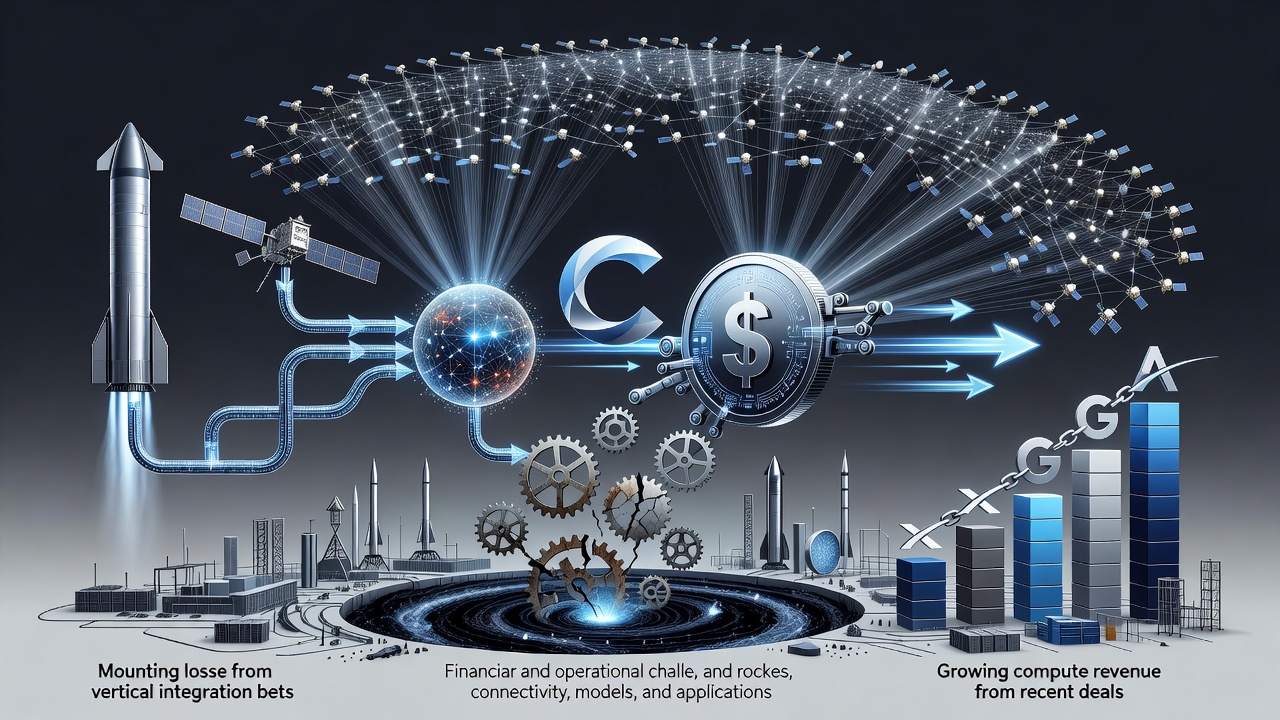
Elon Musk posted on X. SpaceX engineers from its most demanding programs had shifted focus. “The SpaceXAI cadence of model and harness improvement is speeding up tremendously, particularly due to a few dozen of the top Starlink/Starship engineers shifting much of their time to AI,” he wrote. Short sentence. Direct impact.
That move, revealed days ago, captures a company in transition. SpaceX no longer simply launches rockets or beams internet from orbit. It trains models. It builds supercomputers. And now it eyes data centers floating above Earth. The shift carries financial weight. Losses mount even as projections soar. Yet Musk and his team bet the combination of launch prowess, satellite networks and AI talent positions them unlike any rival.
Engineers Redirected, Models Accelerated
SpaceX pulled Starlink and Starship specialists onto Grok development. Business Insider reported the details (https://www.businessinsider.com/grok-4-5-starship-starlink-engineers-elon-musk-ai-cursor-2026-6). Musk confirmed new Grok 4.5 performance approaches or exceeds top benchmarks. Reinforcement learning refines it further. New foundation models arrive monthly.
And. The company acquired Cursor, the AI coding tool, in a deal valued at $60 billion. SpaceX exercised an earlier option. Joint training with Cursor data now feeds models released inside Grok Build and the Cursor product. Bloomberg noted an earlier Starlink executive now leads xAI’s human data team for Grok training (https://www.bloomberg.com/news/articles/2026-06-09/musk-s-xai-taps-starlink-staffer-to-run-grok-training-team). Talent flows. Priorities realign.
But financials tell a harder story. SpaceX posted a $4.3 billion net loss in Q1 2026. Capital spending topped $10 billion, much of it on AI infrastructure. Ars Technica examined the S-1 filing ahead of the IPO (https://arstechnica.com/ai/2026/05/as-grok-flounders-spacex-bets-future-on-beating-big-tech-at-ai/). The company values its addressable AI market at $26.5 trillion. Nearly the size of U.S. GDP. Launches and connectivity fill smaller slices. AI dominates the forecast.
Yahoo Finance captured the pivot. “Essentially, Musk and SpaceX are asking investors to value the company as a vertically integrated AI platform that happens to launch rockets,” the article stated (https://finance.yahoo.com/sectors/technology/article/spacex-musk-bets-heavily-on-ai-not-just-rockets-for-future-gains-140612946.html). Revenue hit $18.7 billion in 2025 after the xAI absorption. Losses reached $2.6 billion. The cost of two new businesses at once, analysts said.
SpaceX absorbed xAI in February. The deal, valued around $250 billion in some estimates, created what the company called the most ambitious vertically integrated innovation engine on and off Earth. Futurum Group outlined plans for up to one million satellites dedicated to orbital AI compute (https://futurumgroup.com/insights/spacex-acquires-xai-rockets-starlink-and-ai-under-one-roof/). Solar-powered. Laser-linked. Free from terrestrial power grids and cooling demands.
Musk explained the vision in a technical update. Each satellite could deliver 120 kW average power, 150 kW peak. Starship launches them at scale. A dedicated AI satellite production facility comes online next year. Space.com summarized the mechanics (https://www.space.com/space-exploration/satellites/elon-musk-wants-to-put-1-million-ai-satellites-in-space-heres-how-spacex-could-do-it). The video drew millions of views on X.
Terrestrial efforts continue. Colossus and Colossus II clusters in Memphis and Mississippi already reach gigawatt scale. SpaceX sells compute to outsiders. Deals with Anthropic and Google total billions annually. CNBC reported a pact with Reflection AI worth up to $6.3 billion (https://www.cnbc.com/2026/06/22/spacex-ai-colossus-data-center-reflection.html). In-house training stack written in C promises order-of-magnitude gains over existing frameworks. Musk shared progress on X last month.
So the infrastructure builds on the ground. Yet Musk insists Earth-bound limits will bind progress. Electricity demand for AI already strains grids. Orbital arrays sidestep that. Radiators handle heat in vacuum. Lasers move data at light speed between satellites and ground stations via Starlink-like tech.
Handset Dreams and Investor Scrutiny
Recent reports added another layer. The Wall Street Journal described a sleek, handset-like prototype shown to investors (https://www.wsj.com/tech/ai/spacex-showed-investors-prototype-of-elon-musks-new-ai-device-b445c57b). Designed to run a proprietary OS and tap xAI models. Musk quickly called the story “utterly false.” TechCrunch noted the denial even as shares in related suppliers moved (https://techcrunch.com/2026/07/01/spacex-has-an-ai-device-prototype-and-it-sure-sounds-phone-ish/). Forbes covered the pushback hours later (https://www.forbes.com/sites/zacharyfolk/2026/07/01/musk-denies-report-spacex-is-developing-handheld-ai-device/).
Whether or not a consumer device emerges, the intent seems clear. SpaceX wants control over the full stack. Compute. Models. Interfaces. Distribution through X, now tied to the combined entity. Hollywood Reporter highlighted media ambitions in the S-1. Advertising, subscriptions, image and video generation all tied to the AI segment (https://www.hollywoodreporter.com/business/business-news/elon-musk-spacex-media-ambitions-x-advertising-starlink-1236602996/).
Critics question the numbers. One trillion dollars in revenue by 2030? The Yahoo Finance piece called it bordering on science fiction. Losses persist. Regulatory hurdles around orbital constellations could arise. Power, spectrum, debris risks. Yet the S-1 filing projects AI as the dominant opportunity. Underwriters adjusted forecasts upward after AI contracts appeared.
Recent X posts from Musk and SpaceX reinforce the message. Monthly model releases. Hiring drives for engineers with or without AI backgrounds. “Smart humans figure it out fast,” Musk wrote. Partnerships expand. Compute sold at scale. The original Yahoo article that prompted this examination warned of bleeding that must stop if ambitions are to rewrite the company’s future (https://finance.yahoo.com/technology/ai/articles/spacex-ai-ambitions-could-rewrite-145215099.html).
That tension defines the moment. Short-term red ink funds long-term infrastructure no competitor can match easily. Starship’s flight rate keeps falling. Starlink grows subscribers. AI talent from across Musk’s companies converges. The merged entity, sometimes referred to as SpaceXAI in posts, pursues orbital data centers that could deliver compute unbound by earthly constraints.
Success hinges on execution. Models must improve. Satellites must reach orbit cheaply and reliably. Revenue from compute sales and applications must outpace the capital burn. Investors who bought into the June IPO at $135 per share now own a piece of that bet. Early trading valued the company above $1.75 trillion.
One thing seems certain. SpaceX no longer competes only with other rocket firms or satellite operators. It stands against hyperscalers and AI labs. The hardware that lifts payloads now lifts ambitions far beyond orbit. Whether the math closes remains the open question. But the direction? Clear. Fast. And increasingly expensive.


 WebProNews is an iEntry Publication