
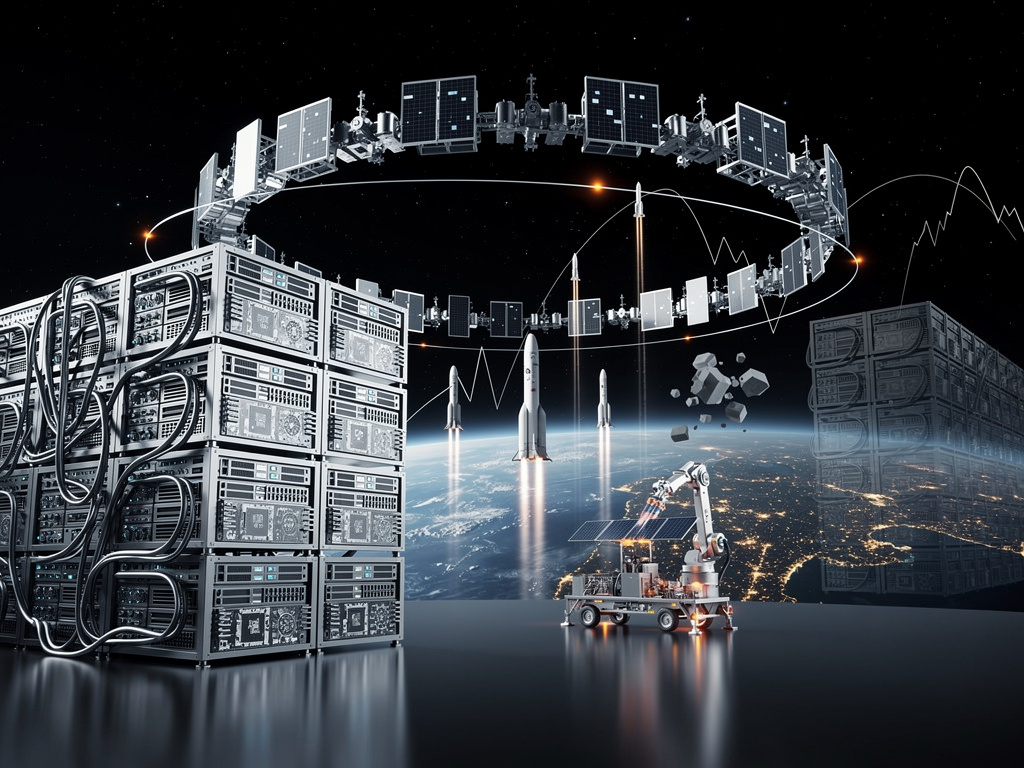
SpaceX has set its sights on lofting enormous computing power into orbit. The company sees sun-powered satellites as the answer to exploding demand for AI training and inference that already strains terrestrial power grids and cooling systems. Yet its latest disclosures paint a sobering picture. Success hinges on acquiring far more advanced processors than exist today.
The warning comes straight from SpaceX’s Form S-1 filing ahead of its anticipated IPO. Executives make no attempt to soften the message. “Our ability to achieve orbital AI at scale depends on our ability to access a sufficient number of AI chips, significantly more than are currently available to us,” the document states. And there it is. No hedging. No corporate spin. Just the blunt arithmetic of silicon scarcity.
Procurement practices compound the problem. SpaceX buys its GPUs through individual purchase orders rather than long-term contracts with suppliers. That leaves the company exposed to every shock that ripples through semiconductor manufacturing. Natural disasters. Trade tensions. Sudden surges in demand from hyperscalers who have already locked up capacity. Nvidia alone holds commitments worth $145 billion that push smaller buyers further down the priority list, TechRadar reported.
Manufacturing and supply of servers and network equipment for our technical infrastructure, particularly for GPUs and other specialized components, is limited to a small number of qualified suppliers. The filing repeats this point. It underscores how orbital ambitions rest on the same fragile foundation that constrains every other AI developer on the ground.
But SpaceX refuses to accept permanent dependence. Together with Tesla and xAI it plans to construct Terafab, a massive semiconductor factory in Texas. The project would use Intel’s 14A process technology and aim for production volumes that dwarf current global output of advanced AI chips. Elon Musk has described the effort as essential. “We either build the Terafab or we don’t have the chips, and we need the chips, so we’re going to build the Terafab,” he said at a March event in Austin, according to SpaceNews.
Even here the risks remain front and center. The S-1 explicitly cautions that Terafab may not succeed. “While we expect to construct Terafab to address such supply constraints, Terafab may not be successful, in which case we may not have other sources of sufficient AI chips to meet our orbital AI compute demands,” it reads. The partnership itself carries uncertainty. A framework agreement exists with Tesla. Neither Tesla nor Intel holds any legal obligation to stay committed. “While we have a framework agreement with Tesla, neither Tesla nor Intel are obligated to remain a part of the project, and we may not enter into any such definitive agreements,” the filing notes. Should either party walk away, the entire plan could unravel.
Analysts have piled on additional doubts. Costs for a network capable of meaningful AI workloads could run into the trillions. One research note from MoffettNathanson estimated that Musk’s vision of a million AI satellites would demand spending measured in trillions of dollars. Heat dissipation in vacuum poses physics problems that grow exponentially with compute density. Radiation hardens electronics over time. Hardware replacement becomes frequent and expensive. “These problems are likely to be more severe in space than under the sea,” Roy Chua, founder of AvidThink, told Reuters.
Still the momentum builds. SpaceX filed with the FCC in January 2026 for permission to launch up to one million data-center satellites between 500 and 2,000 kilometers altitude. The application projects annual launches of one million tonnes of hardware that could generate 100 gigawatts of AI compute capacity. Musk has predicted that within two to three years the lowest-cost way to generate AI compute will be in space. Gwynne Shotwell, SpaceX president, offered a more measured view. “I don’t know that we’ll get to a million, but it’s much easier to ask at the beginning and then march towards the goal,” she told Time, as reported by PCMag.
Other players have joined the race. Google pursues its Suncatcher project with plans for test constellations. Blue Origin filed for its own 51,600-satellite constellation. Startup Starcloud launched a satellite carrying an Nvidia H100 GPU and seeks regulatory approval for 88,000 satellites. Jeff Bezos has spoken publicly about moving large-scale computing off Earth. Even Anthropic signed an agreement with SpaceX that includes interest in partnering on multiple gigawatts of orbital AI capacity, SpaceNews reported in May.
The economic case rests on cheap solar energy in orbit and radiative cooling that requires no water. Proponents argue these advantages could drive costs per kilowatt-hour far below ground-based facilities burdened by grid constraints and evaporative cooling demands. Yet independent analyses question whether those savings survive the realities of launch expense, radiation shielding, and shortened hardware lifetimes. An IEEE Spectrum examination calculated that a 1-gigawatt orbital data center network might exceed $50 billion over five years, roughly three times the cost of an equivalent terrestrial installation.
Recent coverage highlights how quickly the discussion has shifted. What began as speculative talk now features concrete regulatory filings, IPO prospectuses that list orbital compute as central to a $28.5 trillion addressable market, and partnership announcements that tie frontier AI labs directly to space infrastructure. SpaceX’s own prospectus allocates 93 percent of that market figure to AI-related opportunities. The company acknowledges deployment might not begin until 2028 at the earliest, Newcomer noted in May.
Terafab itself represents a vertical integration bet of staggering scale. Musk aims for one terawatt of annual processor production, fifty times current combined output from all advanced chip makers. The factory would cost around $20 billion by his estimate. Success would solve the chip bottleneck for both orbital and terrestrial needs while reducing reliance on third-party foundries. Failure would leave SpaceX competing for the same constrained supply everyone else chases.
And so the tension persists. On one side sit the physics and economics of operating high-performance compute in vacuum. Radiation. Thermal management without convection. Launch costs that must fall dramatically for the numbers to work. On the other side stand the undeniable limits of terrestrial power generation and the accelerating appetite of reasoning models and agentic systems that consume compute at exponential rates.
SpaceX has demonstrated time and again its ability to drive down costs once thought immovable. Reusable rockets reshaped the launch market. Starlink scaled broadband from orbit in ways few believed possible. Whether the same discipline can overcome semiconductor scarcity and orbital operational challenges remains unproven. The company itself flags the risks in plain language. No one should mistake the ambition for certainty.
Recent reporting from late May underscores that the chip shortage conversation has only grown more urgent. As AI models demand ever-larger clusters, the gap between vision and wafer starts widens. Space-based solutions may one day provide relief. But first the silicon must exist. Without it, even the most powerful rockets remain grounded in aspiration.


 WebProNews is an iEntry Publication