
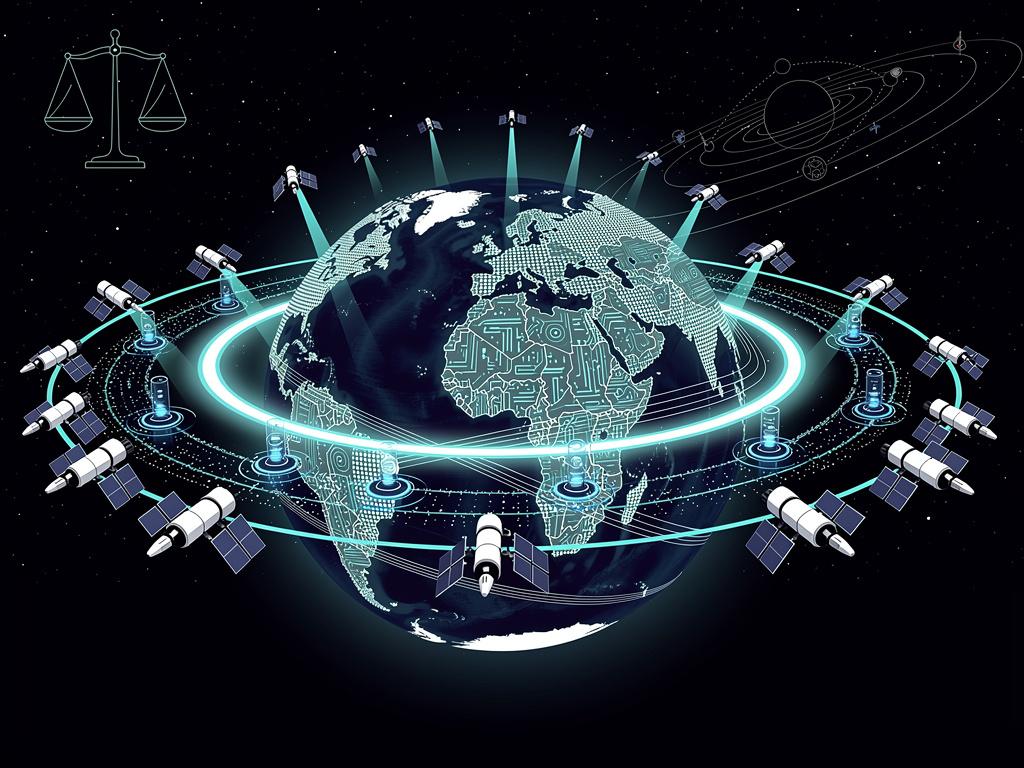
SpaceX has filed an application with the International Telecommunication Union to launch an additional one million satellites into orbit, a move that would dwarf the current Starlink constellation and fundamentally transform the company’s mission from providing global internet connectivity to powering artificial intelligence infrastructure on an unprecedented scale. The application, first reported by TechRadar, represents a quantum leap in satellite deployment ambitions, with the explicit purpose of supporting AI workloads that demand massive computational resources and ultra-low latency connections.
The current Starlink constellation consists of approximately 5,000 active satellites, already making it the largest satellite network in history. This new filing would increase that number by a factor of 200, creating an orbital infrastructure that could fundamentally alter how data processing occurs globally. Industry analysts suggest this expansion reflects SpaceX’s recognition that the next frontier in technology isn’t simply connecting people to the internet, but rather creating a distributed computing network in space that can handle the exponential growth in AI processing demands that terrestrial data centers are struggling to accommodate.
The Technical Architecture Behind Space-Based AI Processing
The proposed expansion would deploy satellites in multiple orbital shells, ranging from low Earth orbit at approximately 340 kilometers to higher altitudes approaching 614 kilometers. This multi-layered approach allows for optimized coverage patterns and reduced latency through shorter signal paths between satellites and ground stations. According to filings with the ITU, the satellites would operate in the E-band spectrum, utilizing frequencies between 71-76 GHz and 81-86 GHz, which offer significantly higher bandwidth capabilities than current Starlink satellites operating primarily in Ku and Ka bands.
The technical specifications suggest each satellite would function not merely as a relay station but as an active computing node capable of processing data in orbit. This distributed computing architecture would enable real-time AI inference at the edge of the network, eliminating the need to transmit raw data back to centralized data centers for processing. The implications for applications requiring instantaneous decision-making—from autonomous vehicles to financial trading algorithms—are profound, as the speed of light limitations that currently constrain terrestrial networks could be substantially mitigated through orbital processing.
Economic Drivers and the AI Infrastructure Crisis
The timing of SpaceX’s application coincides with a growing crisis in AI infrastructure capacity. Major technology companies are competing fiercely for limited data center space and electrical power capacity, with some projections suggesting that AI workloads could consume as much as 8% of U.S. electricity generation by 2030. The cost of building and operating terrestrial data centers has skyrocketed, with land acquisition, construction, and cooling systems representing billions in capital expenditure before a single server processes its first computation.
Space-based infrastructure offers a compelling alternative economic model. While the upfront costs of satellite deployment are substantial, the operational expenses are dramatically lower than terrestrial facilities. Satellites require no real estate, no property taxes, no cooling systems beyond passive radiation, and no human workforce for day-to-day operations. The solar panels that power these satellites provide essentially free energy after the initial manufacturing cost, creating an operational cost structure that could prove disruptive to the traditional data center industry. Furthermore, the global coverage inherent in a satellite constellation eliminates the need for redundant facilities in multiple geographic locations, consolidating infrastructure in a way that terrestrial networks cannot match.
Regulatory Challenges and International Implications
The path from application to deployment faces significant regulatory hurdles. The ITU filing is merely the first step in a complex international coordination process that requires spectrum allocation agreements with dozens of national telecommunications authorities. The sheer scale of the proposed constellation has already drawn criticism from astronomers and space sustainability advocates who argue that one million satellites would create unprecedented challenges for optical and radio astronomy, not to mention the increased risk of orbital collisions and space debris generation.
The Federal Communications Commission will play a crucial role in determining whether SpaceX can proceed with its plans for satellites serving U.S. markets. The FCC has historically been supportive of Starlink’s expansion but has also faced pressure from competing satellite operators and terrestrial telecommunications companies who argue that SpaceX receives preferential treatment. International regulators, particularly in Europe and Asia, may prove less accommodating, potentially fragmenting the global deployment and limiting the network’s effectiveness in certain regions.
Competitive Dynamics and Market Positioning
SpaceX’s move appears designed to establish a dominant position in space-based computing before competitors can mount effective challenges. Amazon’s Project Kuiper has announced plans for a constellation of 3,236 satellites, while OneWeb operates approximately 600 satellites focused primarily on connectivity rather than computing. China has also announced ambitious satellite internet plans, with state-backed companies proposing constellations numbering in the tens of thousands. However, none of these initiatives approach the scale of SpaceX’s latest application, suggesting the company is attempting to create a first-mover advantage so substantial that catching up becomes economically impractical for rivals.
The strategic implications extend beyond commercial competition into geopolitical territory. Control of space-based AI infrastructure could confer significant advantages in areas ranging from financial services to defense applications. The ability to process sensitive data entirely within a satellite network controlled by a single nation’s regulatory framework raises questions about data sovereignty, privacy, and the potential for information asymmetry between countries with access to such infrastructure and those without.
Technical Feasibility and Manufacturing Challenges
Deploying one million satellites requires solving manufacturing and launch challenges on a scale never before attempted. SpaceX currently produces Starlink satellites at a rate of approximately six per day at its facility in Redmond, Washington. Scaling to one million satellites would require either a dramatic acceleration of production rates or an extended deployment timeline spanning decades. The company’s Starship vehicle, currently in development, is designed to carry up to 400 Starlink satellites per launch, compared to the 20-60 satellites carried by Falcon 9 rockets. Even with Starship operational, launching one million satellites would require approximately 2,500 flights, representing a launch cadence that would need to exceed anything achieved in the history of spaceflight.
The satellites themselves would need to be substantially redesigned to incorporate AI processing capabilities while maintaining the cost targets that make the constellation economically viable. Current Starlink satellites cost approximately $250,000 to manufacture, suggesting that the full constellation could represent a quarter-trillion-dollar manufacturing undertaking before accounting for launch costs, ground infrastructure, and operational expenses. SpaceX’s vertical integration strategy, which includes in-house production of most satellite components and its own launch services, provides cost advantages that competitors cannot easily replicate, but the absolute scale of investment required raises questions about financing and return on investment timelines.
Environmental and Orbital Sustainability Concerns
The environmental impact of such a massive constellation extends beyond the immediate orbital environment to include the carbon footprint of manufacturing and launching one million satellites. Each Starship launch, while more efficient per satellite than smaller rockets, still burns hundreds of tons of propellant. The cumulative environmental impact of thousands of launches, combined with the energy-intensive manufacturing processes required to produce the satellites, represents a significant carbon expenditure that runs counter to the sustainability narratives often associated with space-based infrastructure.
Orbital debris presents perhaps the most serious long-term challenge. Even with a 95% success rate in controlled deorbiting at end-of-life, a million-satellite constellation would generate 50,000 defunct satellites over its operational lifetime. The probability of collisions increases exponentially with the number of objects in orbit, and a single collision between satellites traveling at orbital velocities generates thousands of debris fragments, each capable of destroying other satellites in a cascade effect known as Kessler Syndrome. SpaceX has implemented autonomous collision avoidance systems in current Starlink satellites, but the computational burden of tracking and avoiding collisions increases dramatically as the constellation grows, potentially requiring the very AI processing capabilities the network is designed to provide.
Market Applications and Revenue Models
The commercial applications for space-based AI processing extend across multiple industries. Financial services firms could leverage the ultra-low latency connections for high-frequency trading algorithms that operate faster than terrestrial networks allow. Autonomous vehicle manufacturers could offload complex decision-making processes to orbital processors, reducing the computational requirements for onboard systems. Scientific research institutions could access distributed computing resources for climate modeling, genomic analysis, and particle physics simulations without investing in dedicated supercomputing facilities.
The revenue model for such infrastructure remains somewhat speculative, but industry analysts suggest SpaceX could charge premium rates for AI processing services that offer latency advantages over terrestrial alternatives. If the company can achieve processing costs competitive with ground-based data centers while providing superior performance characteristics, the addressable market could reach into the hundreds of billions of dollars annually. However, customer adoption will depend heavily on the reliability and security of space-based processing, areas where SpaceX will need to demonstrate consistent performance before risk-averse enterprise customers commit critical workloads to orbital infrastructure.
The Road Ahead: Timeline and Milestones
The path from ITU application to operational constellation typically spans years, if not decades. SpaceX will need to secure spectrum allocations, obtain launch licenses, complete satellite design and testing, and scale manufacturing capacity before the first satellites optimized for AI processing reach orbit. Industry observers suggest that even under optimistic scenarios, meaningful deployment of AI-focused satellites is unlikely before 2027, with the full constellation potentially requiring until the 2040s to complete.
The success of this initiative will depend on numerous factors beyond SpaceX’s control, including regulatory approvals, technological breakthroughs in satellite manufacturing and AI processing, sustained access to capital markets, and the continued growth of AI workloads that justify such massive infrastructure investment. Nevertheless, the application signals SpaceX’s intention to position itself not merely as a launch services provider or internet connectivity company, but as a fundamental infrastructure provider for the AI era, with implications that could reshape the technology industry for generations to come.


 WebProNews is an iEntry Publication