
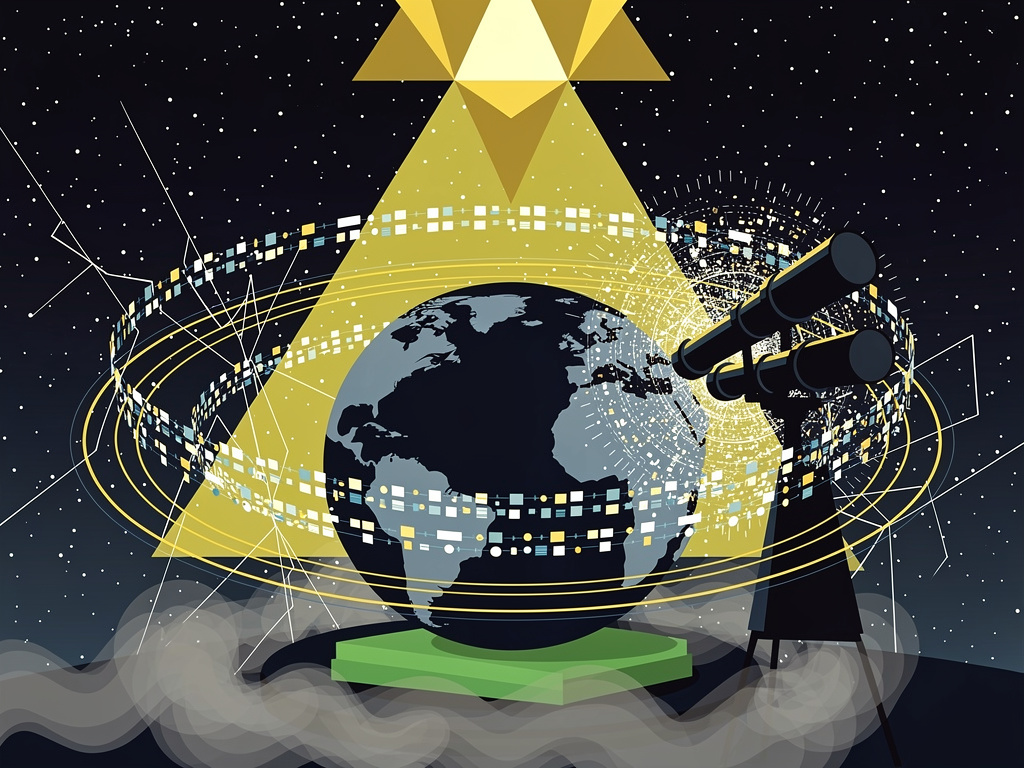
Elon Musk wants data centers in space. The idea sounds simple enough on paper. Put racks of processors on satellites. Power them with endless sunlight. Skip the water-guzzling cooling towers and grid constraints that hobble Earth-based facilities. Yet the scale he envisions has scientists warning of consequences that stretch far beyond launch costs.
SpaceX filed an application with the Federal Communications Commission in late January 2026 for permission to operate up to one million satellites dedicated to orbital data centers. The filing, first reported by Reuters, positions the constellation as a way to meet surging demand for artificial intelligence compute. “By directly harnessing near-constant solar power with little operating or maintenance costs, these satellites will achieve transformative cost and energy efficiency while significantly reducing the environmental impact associated with terrestrial data centers,” the company stated.
But astronomers see a different picture. One that fills the night sky with moving points of light. Tens of thousands of them, bright enough to see without aid. At any moment.
John Barentine, an astronomer and dark-sky consultant, ran simulations. They suggest the proposed fleet could produce that level of visibility. The satellites would sit in high-inclination orbits between 500 and 2,000 kilometers. Sun-synchronous paths that keep them lit even at local midnight. “The other constellations that we have dealt with so far are mostly at lower altitudes and in lower-inclination orbits,” he told Space.com. “That means the satellites spend most of their time in Earth’s shadow. We really don’t see them very much in the middle of the night, or they are not that bright.”
Contrast that with Starlink. The broadband network now numbers around 10,000 satellites. SpaceX worked with the International Astronomical Union to dim them. Less reflective materials. Adjusted solar panel angles. Brightness dropped. Progress, however imperfect, seemed possible. This new proposal feels like a reversal. Barentine described it as “undermining what we have achieved in the last few years.” He added that it represents “a challenge unlike any we have encountered thus far in this new era of commercial space.”
The satellites themselves would dwarf current designs. Musk revealed more details during a March event in Austin. He showed an illustration of the “AI Sat Mini.” Each unit generates 100 kilowatts for onboard AI processors. A radiator spans roughly 100 square meters to shed heat. Scaled against Starship, the craft stretches more than 170 meters long. Future versions could reach a megawatt. “For some reason there’s been a bizarre debate about radiators in space,” Musk said, according to SpaceNews. “It’s safe to say SpaceX knows how to do heat rejection in space with 10,000 satellites in orbit.”
Power forms the core appeal. On Earth, adding capacity grows harder and more expensive. Land. Electricity. Water. Regulations. In orbit, solar flux remains steady. No atmosphere to scatter light or trap heat inefficiently. Musk has argued that once launch costs fall far enough, space becomes the obvious choice. He tied the plan to a broader push with Tesla and xAI. Their Terafab project aims to produce one terawatt of specialized processors each year. Fifty times current global output for advanced chips. The D3 chip variant, hardened for radiation and built to run hotter, would anchor the effort.
Yet even Musk’s team shows caution. In April pre-IPO filings reviewed by Reuters, SpaceX warned investors that orbital AI compute efforts “involve significant technical complexity and unproven technologies, and may not achieve commercial viability.” The harsh space environment brings unique risks. Failures could cascade. SpaceX President Gwynne Shotwell told Time she doubts the full million will fly. “I don’t know that we’ll get to a million, but it’s much easier to ask at the beginning and then march towards the goal,” she said. A common regulatory tactic also used for Starlink’s original 42,000-satellite application.
Atmospheric scientists track another set of problems. Each launch injects soot and black carbon directly into the upper atmosphere. Reentries vaporize aluminum, lithium and other metals. With a million satellites, one burnout could occur every three minutes if spread across typical lifetimes. “It’s daunting because we’re doing this sort of experiment with the atmosphere when we don’t really know what the result will be,” Eloise Marais, professor of atmospheric chemistry at University College London, told the CBC.
Aaron Boley, co-director of the Outer Space Institute at the University of British Columbia, takes a broader view. Current satellite counts hover near 16,000, with more than half from SpaceX. Add a million more and the orbital environment changes fundamentally. “We saw this transition from thousands of satellites to 10,000 satellites largely done through SpaceX,” he said in the same CBC report. “And we were very worried about maintaining a healthy orbital environment with that. This just blows right past that. And by almost all metrics that we can think of, this is just a bad idea in terms of our long-term use and access to space.”
More than 1,000 public comments flooded the FCC docket before it closed. Most opposed the plan. Concerns range from increased collision risks to electromagnetic interference that could jam radio astronomy. The Vera C. Rubin Observatory and other next-generation telescopes stand to lose observing time. Shutters might stay closed longer than they remain open. Barentine worries the presumption of approval puts the burden on opponents to prove harm. He calls for a full environmental review.
SpaceX counters that the satellites avoid terrestrial water use and draw clean solar energy. Starship’s reusability would slash launch expenses. The company has minimized deorbit impacts before and suggests some units could shift to heliocentric orbits. Musk has spoken of building data centers on the moon eventually, flinging processors outward with electromagnetic mass drivers. Visions of petawatt-scale compute. Kardashev-level energy capture. Yet those steps remain distant.
Interest from AI firms has surfaced. Anthropic agreed to study use of the orbital capacity, according to a May 7 report in SpaceNews. The company will first buy all output from SpaceX’s terrestrial Colossus 1 data center, which exceeds 300 megawatts. Other players, including Starcloud and Blue Origin, explore similar concepts. China’s efforts add pressure. The race for orbital compute has begun even as questions multiply.
Technical hurdles persist. Latency for data transfer back to Earth. Radiation hardening at scale. Maintenance without human access. Heat rejection at megawatt levels. Musk insists experience with thousands of Starlink satellites proves the basics work. Others remain unconvinced. A recent Wall Street Journal video analysis highlighted the engineering barriers that remain.
The proposal arrives as terrestrial data center construction strains power grids and local resources. Hyperscalers hunt for gigawatts. Space offers an alternative that sidesteps some constraints. But it creates others. Light pollution that affects every observer on the planet. Atmospheric loading whose cumulative effects stay uncertain. Orbital crowding that could limit future missions.
No one disputes the demand for AI compute will keep rising. How society meets that demand matters. Musk bets on the sun and reusable rockets. Scientists ask for slower, measured steps and better data on side effects. The FCC must now weigh those arguments against innovation pressures. Decisions made in the coming months could shape the sky for decades. And the view from below may never look quite the same.


 WebProNews is an iEntry Publication