
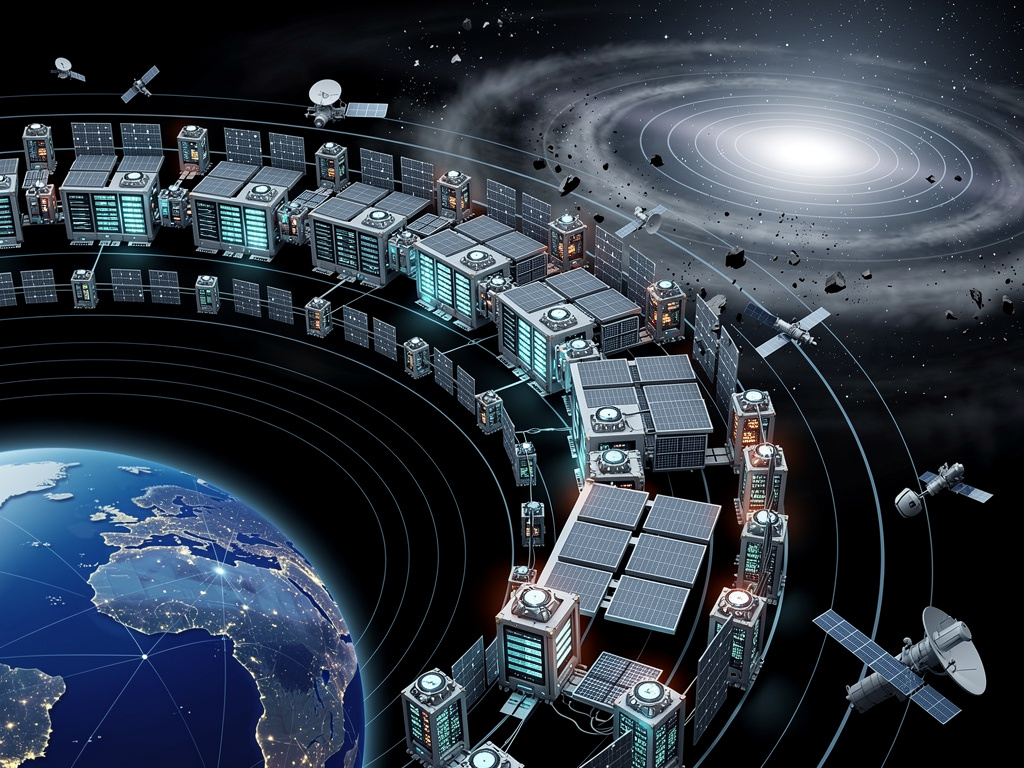
Elon Musk wants a million satellites circling Earth. Not for internet this time. These would house data centers. They would run artificial intelligence far above the clouds. The plan surfaced in a filing with regulators earlier this year. It has scientists warning of an orbital junkyard that could choke low-Earth orbit for generations.
SpaceX filed with the Federal Communications Commission in late January 2026 for permission to launch up to one million satellites dedicated to orbital data centers. BBC News reported the application seeks solar-powered platforms to handle surging AI workloads. Current Starlink numbers roughly 10,400 active satellites as of June 2026, according to astronomer Jonathan McDowell’s tracking. One million more would dwarf that figure by a factor of 100.
The satellites would sit in low-Earth orbit. They would tap constant sunlight for power. Deep space cold would radiate away heat from dense computing clusters. No need for massive terrestrial power plants or water-hungry cooling towers. SpaceX argues this approach sidesteps Earth’s grid constraints as data-center electricity demand doubles by 2035.
But the scale alarms astronomers and orbital-safety experts. Each new satellite adds mass, brightness and eventual debris. “There’s a lot of space up there,” Musk said in a recent video clip highlighted by Space.com. “Even when you’re talking thousands, or even — you know — up to a million satellites, yeah, you got plenty of room to move around up there. Space is really big, so it’s not like space is going to get crowded.”
Critics disagree. They point to existing problems. Starlink satellites already trigger one collision-avoidance maneuver every two minutes on average. The fleet performed some 300,000 such maneuvers in 2025 alone, New Scientist reported. Add a million larger platforms and the risk of Kessler syndrome — a runaway cascade of collisions — grows sharply.
Twelve times larger. That’s how much bigger the proposed AI satellites would be compared with today’s common Starlink models, according to CNET. One million of them would create a physical presence difficult to grasp. Their greater surface area means more potential for impacts from micrometeoroids or other debris. Their brighter profiles could further spoil ground-based telescope views.
Astronomers already track thousands of Starlink streaks across their images. The new constellation would multiply that interference. A study detailed in The Conversation predicts the million-satellite fleet would increase atmospheric pollution from reentries and heighten risks of falling debris. Satellites don’t vanish cleanly. Many leave metallic vapors in the upper atmosphere. Others drop fragments that reach the ground.
SpaceX counters with technology. Its automated collision-avoidance system uses low-latency risk assessment and electric propulsion for quick maneuvers. The company has lowered parts of the Starlink shell from 550 kilometers to 480 kilometers during 2026 to speed natural decay of failed units. Satellites carry propellant budgets for hundreds of avoidance actions over five-year design lives. Yet even conservative thresholds — maneuvering at a one-in-a-million collision probability — strain resources at this scale.
Timelines remain fluid. Musk has referenced launches beginning as soon as 2028 using Starship, the fully reusable vehicle still in testing. Starship’s projected capacity to deliver millions of tons to orbit annually underpins the economics. Launching one million tons of satellites per year, each generating 100 kilowatts of compute per ton, would yield 100 gigawatts of AI capacity with minimal ongoing costs. That math appears in SpaceX’s own updates.
The proposal ties into broader ambitions. It follows SpaceX’s merger with xAI. It precedes what could become the largest initial public offering in history. Forbes examined the financial stakes. Its May 31, 2026, article warned the plan carries high risk of financial catastrophe if technical or regulatory hurdles mount. North American space scholars cited in the piece question whether Starship can achieve the required cadence and whether markets will pay for orbital compute at scale.
Legal pushback has arrived. Amazon has mounted challenges over spectrum and orbital slots. Other operators eye similar ideas but at smaller scales. Blue Origin and Starcloud have filed for their own constellations measured in tens of thousands rather than millions. The FCC must weigh interference, orbital congestion and scientific impacts before granting approval.
Proponents highlight sustainability arguments. Radiative cooling in vacuum eliminates water consumption that terrestrial data centers burn through by the billions of gallons yearly. Solar power arrives uninterrupted. Maintenance happens through replacement rather than repair. Failed satellites deorbit or move to disposal orbits farther out, sometimes even heliocentric paths to reduce crowding.
Yet disposal itself creates new headaches. Reentries deposit aluminum oxides and other compounds into the mesosphere. Researchers still map the long-term atmospheric consequences. A single large satellite breakup can generate thousands of trackable fragments. At million-unit scale, even a low failure rate produces substantial debris.
Room to move. Musk’s refrain. But physics sets hard limits. Orbital velocities exceed 7 kilometers per second. Impacts at those speeds vaporize material and spray fragments in all directions. Current catalogs already list more than 36,000 debris pieces larger than 10 centimeters. Smaller untracked objects number in the hundreds of thousands. Each new satellite must thread this needle for years.
SpaceX’s SEC filing for its potential IPO acknowledges the danger explicitly. Orbital debris could render licensed shells unusable for considerable durations if a cascade begins. The company’s own business depends on safe access to these altitudes. That admission underscores the tension. Commercial success and orbital stewardship now collide in the same domain.
Engineers at SpaceX speak of redundant swarms. Lose a few satellites? Launch replacements cheaply. The design emphasizes simplicity — no complex user-facing antennas, just compute, radiators, solar arrays and laser links between satellites. Optical inter-satellite links would handle most data transfer, limiting radio-frequency demands.
Still, power density targets remain aggressive. Achieving 100 kilowatts of compute per ton demands advanced chips, efficient cooling and sturdy structures. Radiation hardening adds mass. Thermal management in vacuum relies on large deployable radiators that could increase collision cross-sections.
Recent coverage adds nuance. SatNews noted the February 2026 FCC application followed the xAI merger and signaled a strategic pivot from broadband toward space-based computing. Sky & Telescope reported in February 2026 that experts worry the plan could ruin dark skies, pollute the atmosphere and worsen debris problems.
Conversations on X reflect public division. Some users decry another layer of orbital clutter ruining astronomy. Others trust SpaceX’s track record of innovation and rapid iteration. The company has lowered satellite brightness through design changes after early complaints. It shares tracking data and coordinates with NASA and other operators.
Whether those practices scale remains unproven. A constellation one hundred times larger than today’s Starlink would test every assumption. Collision probability models, deorbit reliability, spectrum sharing, astronomical mitigation — each piece must hold.
The prize tempts. AI training runs consume ever more electricity. Hyperscalers hunt locations with cheap power and permissive regulations. Placing compute next to the sun’s output and nature’s best heat sink offers theoretical advantages. If launch costs drop as projected, orbital data centers could undercut ground-based rivals within years.
Regulators face a balancing act. Approve too readily and risk irreversible orbital damage. Move too slowly and cede leadership in a strategic technology. International coordination lags. Other nations watch closely. Many may resist American dominance of critical orbits.
So far the dialogue stays technical. Musk frames the effort as a step toward Kardashev Type II status — a civilization harnessing its star’s full energy. Scientists counter that humanity must first master stewardship of the narrow band around its home planet.
The coming months will test both visions. FCC review will invite public comment. Astronomy groups plan formal input. Debris-modeling teams will run new simulations. Starship’s flight cadence will determine feasibility.
One outcome looks certain. The debate over a million AI satellites will force fresh thinking about who owns orbit, how to keep it usable and what price society pays for compute at unprecedented scale. The junkyard scenario is no longer science fiction. It is a risk calculation with numbers that start at one million and climb from there.


 WebProNews is an iEntry Publication