
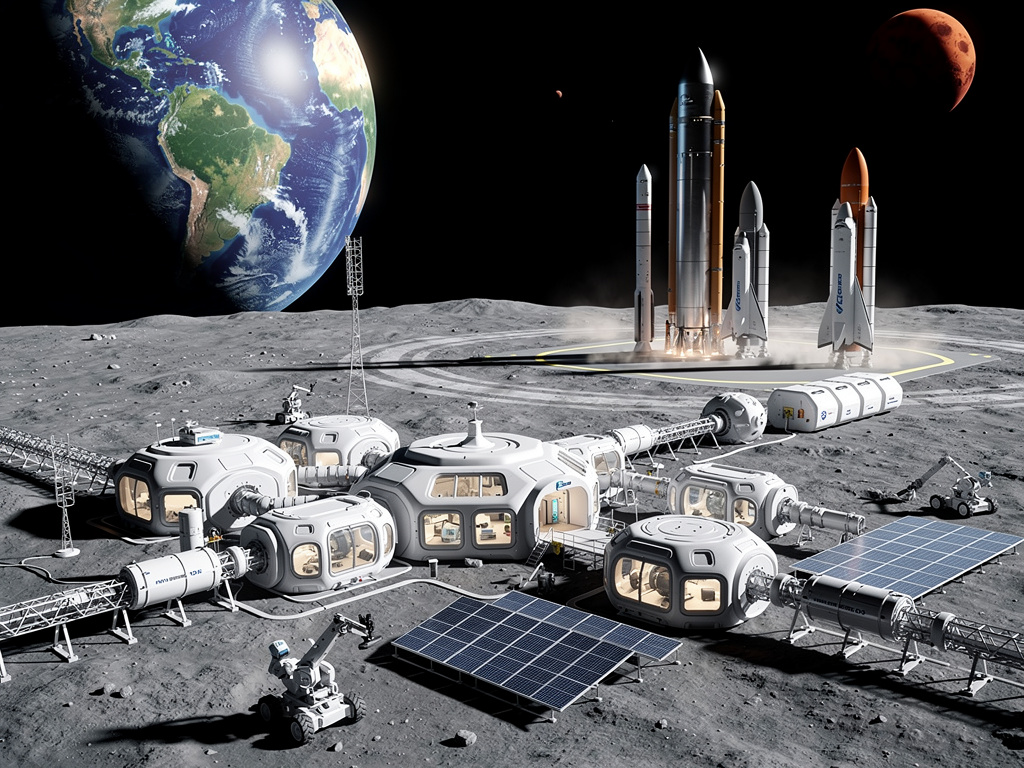
For more than two decades, Elon Musk has been synonymous with one audacious goal: making humanity a multi-planetary species by colonizing Mars. That vision drove the founding of SpaceX in 2002, fueled the development of the Starship mega-rocket, and inspired countless presentations featuring computer-generated renderings of gleaming Martian habitats. But in a striking strategic shift that has sent ripples through the aerospace community, Musk has indicated that SpaceX is now prioritizing the construction of a self-sustaining, self-growing city on the Moon before turning its full attention to the Red Planet.
The revelation came in early February 2025, when Musk posted on his social media platform X that the lunar project had moved ahead of Mars in SpaceX’s near-term planning. As reported by Slashdot, Musk described the concept as a “self-growing city” on the Moon — one that would leverage autonomous construction, in-situ resource utilization, and iterative expansion to establish a permanent human presence on the lunar surface. The phrasing was deliberate: not merely a base or an outpost, but a city designed to expand on its own with minimal resupply from Earth.
A Dramatic Reordering of Interplanetary Ambitions
The decision to prioritize the Moon over Mars represents a profound reordering of SpaceX’s publicly stated ambitions. For years, Musk dismissed lunar settlement as a distraction, famously quipping that the Moon was too close and too small to serve as a meaningful backup for human civilization. Mars, with its 24.6-hour day, polar ice caps, and thin atmosphere of carbon dioxide, was always framed as the more viable candidate for terraforming and long-term habitation. Yet the practical realities of deep-space logistics, life-support systems, and political momentum appear to have shifted the calculus.
Several factors likely contributed to this pivot. First, NASA’s Artemis program — which has contracted SpaceX to develop a lunar variant of Starship as the Human Landing System (HLS) — has placed enormous financial and engineering resources at the company’s disposal for Moon-focused missions. The HLS contract, worth nearly $3 billion in its initial phase and subsequently expanded, has effectively subsidized the development of lunar-capable Starship variants. Second, the Moon’s proximity to Earth — roughly three days of travel versus six to nine months for Mars — makes it an infinitely more practical testing ground for the technologies required for any off-world settlement, including closed-loop life support, radiation shielding, regolith-based construction, and autonomous robotics.
The Self-Growing City Concept: Engineering Autonomy at Scale
The notion of a “self-growing” city is perhaps the most technically ambitious element of Musk’s announcement. In traditional space architecture concepts, every habitat module, every piece of equipment, and every consumable must be launched from Earth at staggering cost. A self-growing city, by contrast, would be designed to harvest lunar resources — primarily regolith, water ice from permanently shadowed craters near the poles, and metals extractable through various processing techniques — and use them to manufacture building materials, propellant, and eventually even electronic components on-site.
This approach draws on decades of research into in-situ resource utilization (ISRU), a field that has gained significant traction in recent years. NASA’s MOXIE experiment aboard the Perseverance rover demonstrated oxygen extraction from the Martian atmosphere, and multiple research groups have shown that lunar regolith can be sintered or 3D-printed into structural elements using concentrated solar energy or microwave heating. SpaceX’s contribution would be the transportation infrastructure — the Starship system capable of delivering massive payloads to the lunar surface — while the autonomous construction systems would likely be developed in partnership with robotics firms and potentially through contracts with NASA and the Defense Department.
Political and Commercial Currents Driving the Shift
The timing of Musk’s announcement is not incidental. The geopolitical competition for lunar resources has intensified dramatically. China’s Chang’e program has achieved a series of firsts, including the first landing on the far side of the Moon and the return of lunar samples from previously unexplored regions. Beijing has announced plans for a joint International Lunar Research Station with Russia and other partners, with construction phases extending through the 2030s. The United States, under both the Biden and now the second Trump administration, has responded by accelerating Artemis timelines and expanding the scope of commercial lunar partnerships through programs like the Commercial Lunar Payload Services (CLPS) initiative.
Musk’s relationship with the federal government has also evolved in ways that make lunar prioritization strategically advantageous. His role leading the Department of Government Efficiency (DOGE) under the Trump administration has given him unprecedented access to federal spending decisions and policy direction. While Musk has insisted on a firewall between his government advisory role and SpaceX’s commercial interests, critics have noted that the alignment between federal lunar priorities and SpaceX’s newly announced focus raises questions about potential conflicts of interest. Regardless of the political dynamics, the practical effect is clear: the Moon is where the money, the contracts, and the near-term political will are concentrated.
Technical Challenges That Could Define the Decade
Building a self-sustaining lunar city presents engineering challenges that dwarf anything humanity has attempted in space. The lunar environment is extraordinarily hostile: surface temperatures swing from roughly 127°C (260°F) in direct sunlight to minus 173°C (minus 280°F) in shadow. Lunar dust — fine, abrasive, and electrostatically charged — infiltrates mechanical systems and poses severe health risks if inhaled. The absence of a magnetic field or substantial atmosphere means that solar radiation and micrometeorite impacts are constant threats. And unlike the International Space Station, which orbits within Earth’s protective magnetosphere, a lunar surface settlement would be exposed to galactic cosmic rays and periodic solar particle events that can deliver dangerous radiation doses in hours.
Water ice, believed to exist in significant quantities in permanently shadowed craters at the lunar south pole, is the linchpin of most ISRU strategies. It can be split into hydrogen and oxygen for rocket propellant, used for drinking water and agriculture, and employed as radiation shielding. But extracting it from craters that have not seen sunlight in billions of years — where temperatures hover near minus 240°C — will require novel mining and processing technologies that have never been tested in the field. SpaceX would need to develop or integrate robotic systems capable of operating in these extreme conditions, transporting extracted ice to processing facilities, and doing so with minimal human oversight.
What This Means for the Mars Timeline
For Mars enthusiasts, the lunar pivot raises an uncomfortable question: does prioritizing the Moon mean Mars is being shelved? Musk has been careful to frame the shift as a sequencing decision rather than an abandonment. The technologies developed for lunar settlement — heavy-lift transportation, ISRU, autonomous construction, closed-loop life support — are directly transferable to Mars. In this framing, the Moon serves as a proving ground where systems can be tested, iterated, and refined at a fraction of the cost and risk of deploying them 140 million miles from Earth.
There is also a compelling economic argument. A functioning lunar economy — one that produces propellant, construction materials, and eventually exports resources to Earth orbit — could generate the revenue streams needed to fund the far more expensive Mars campaign. Lunar-produced propellant, for instance, could dramatically reduce the cost of deep-space missions by enabling spacecraft to refuel in lunar orbit rather than hauling all their propellant from Earth’s deep gravity well. This “gas station in the sky” concept has been championed by space economists for years, and SpaceX’s lunar city could be the first serious attempt to make it a reality.
Industry Reaction and the Road Ahead
The aerospace industry’s response has been a mixture of enthusiasm and skepticism. Blue Origin, which is developing its own lunar lander under a separate NASA contract, stands to benefit from increased federal investment in lunar infrastructure. Smaller companies in the CLPS pipeline — firms like Intuitive Machines, Astrobotic, and Firefly Aerospace — could see expanded opportunities as demand for lunar surface delivery grows. But some veteran space engineers have cautioned that Musk’s timelines, historically optimistic, may not account for the full complexity of autonomous lunar construction.
SpaceX has not yet released a detailed roadmap or timeline for the lunar city project, and many critical questions remain unanswered. How many Starship flights would be required to deliver the initial infrastructure? What level of autonomy would the construction systems possess? How would the city be governed, and under what legal framework would lunar resources be extracted and utilized? The Outer Space Treaty of 1967 prohibits national sovereignty claims on celestial bodies, but the U.S. Commercial Space Launch Competitiveness Act of 2015 and the Artemis Accords have begun to establish frameworks for resource extraction rights — frameworks that remain contested by some nations.
A New Chapter in the Human Story Beyond Earth
What is clear is that SpaceX’s lunar pivot marks a new chapter in the commercialization of space. By targeting a self-growing city rather than a traditional government-run base, Musk is signaling that the private sector intends to lead the next phase of human expansion beyond Earth — not as a contractor executing government designs, but as a principal architect of off-world civilization. Whether this vision materializes on the timeline Musk envisions, or whether it encounters the delays and setbacks that have characterized so many ambitious space programs, the strategic direction is unmistakable. The Moon, long regarded as a stepping stone, may now become the foundation upon which humanity’s interplanetary future is built.


 WebProNews is an iEntry Publication