
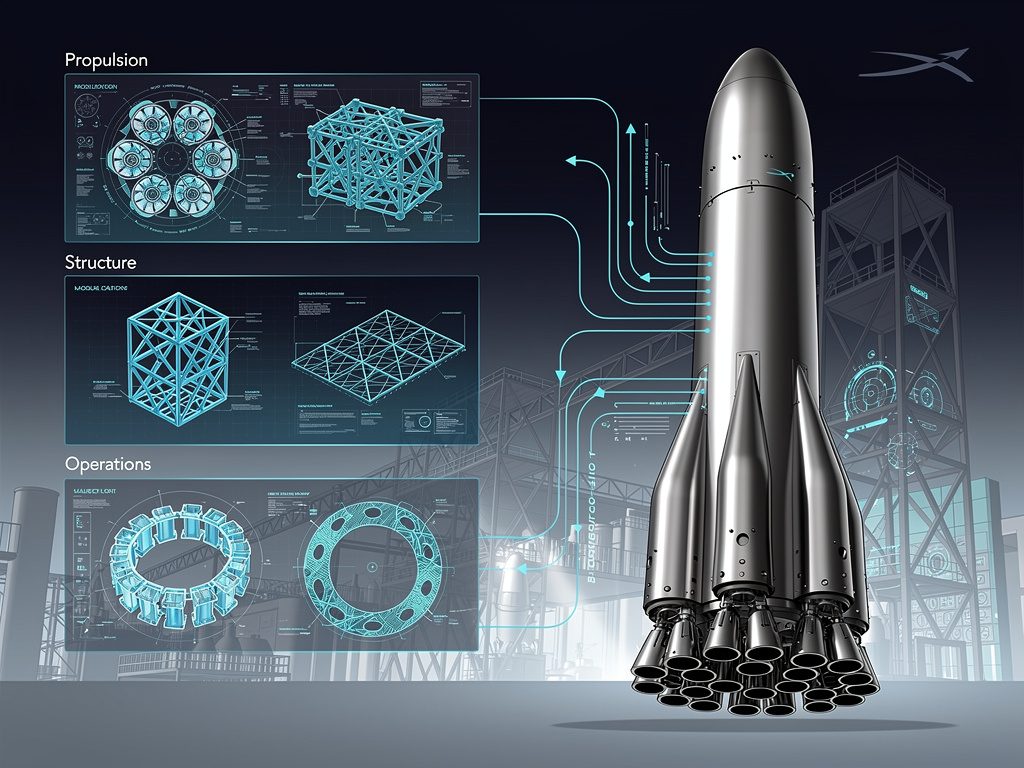
SpaceX has unveiled its most ambitious hardware evolution yet: the Block 2 iteration of its Super Heavy booster, a radical redesign that promises to fundamentally alter the economics of space transportation. Through a meticulously produced video released on social media, the company offered industry insiders their first detailed look at engineering modifications that could determine whether Elon Musk’s Mars colonization timeline remains feasible or becomes another Silicon Valley moonshot that never materializes.
The footage, dissected frame-by-frame by aerospace engineers across the industry, reveals a booster that shares little beyond basic geometry with its predecessor. According to Digital Trends, the most striking modification involves a complete reconfiguration of the engine bay, now housing an expanded array of Raptor engines arranged in a denser configuration that maximizes thrust while minimizing structural mass. This isn’t incremental improvement—it’s a wholesale reimagining of how reusable rockets should function in an era where launch cadence matters as much as payload capacity.
The Block 2 booster represents SpaceX’s response to hard-won lessons from eighteen test flights, each providing data that traditional aerospace development programs would have taken decades to accumulate. The company’s iterative approach, once dismissed as reckless by established contractors, has compressed what NASA’s Space Launch System required fifteen years to achieve into a development timeline measured in months rather than fiscal cycles. Industry observers note that this velocity of iteration creates competitive moats that traditional defense contractors, bound by cost-plus contracts and risk-averse procurement processes, cannot replicate regardless of budget allocation.
Engineering Philosophy Meets Manufacturing Reality
The video documentation reveals engineering choices that reflect SpaceX’s unique position as a vertically integrated manufacturer. Unlike legacy aerospace firms that outsource major subsystems to congressional-district-optimized supply chains, SpaceX’s control over component production enables design modifications that would trigger years of renegotiation in traditional programs. The Block 2’s revised heat shield mounting system, visible in close-up shots of the booster’s exterior, demonstrates this advantage: tiles now integrate directly into structural elements rather than being retrofitted onto surfaces designed without thermal protection in mind.
Manufacturing efficiency improvements embedded in the Block 2 design suggest SpaceX is preparing for production rates that would have seemed fantastical even five years ago. The simplified grid fin attachment points, redesigned propellant feed systems, and modular avionics bays all point toward a booster optimized not just for performance but for the kind of assembly-line production more commonly associated with commercial aircraft than orbital rockets. This focus on manufacturability reflects hard economic reality: reusability only matters if you can build enough vehicles to maintain flight rates that justify the infrastructure investment.
The propulsion system modifications represent perhaps the most significant technical leap. The Block 2 booster’s engine arrangement allows for more granular thrust vectoring control, critical for the precision required in SpaceX’s ambitious catch-and-relaunch concept. Each Raptor engine, itself a marvel of full-flow staged combustion technology that no other operational rocket employs, can now be individually throttled with greater range and faster response times. This capability directly addresses the challenge that has plagued previous landing attempts: the difficulty of precisely controlling a vehicle the size of a skyscraper moving at supersonic speeds through turbulent atmospheric conditions.
The Catch Mechanism’s Hidden Complexity
SpaceX’s decision to catch returning boosters with mechanical arms rather than landing them on legs represents either inspired genius or engineering hubris, depending on which industry veteran you consult. The Block 2 design incorporates hardpoints and structural reinforcements specifically engineered to withstand the concentrated loads imposed by the catch mechanism—loads that traditional rocket structures, designed to distribute forces across wide areas, were never intended to handle. These modifications required fundamental rethinking of load paths through the vehicle’s primary structure, changes that ripple through every major subsystem.
The economic logic behind the catch system becomes clearer when examining the Block 2’s mass budget. By eliminating heavy landing legs and their associated deployment mechanisms, SpaceX freed up thousands of kilograms that can be reallocated to payload capacity or propellant reserves. More importantly, the catch system enables turnaround times measured in hours rather than days or weeks. A booster that lands on legs requires extensive ground support equipment, transportation back to the launch site, and time-consuming inspections of landing gear systems. A caught booster, in theory, can be refueled and reflown with minimal processing—the holy grail of aircraft-like operations that has eluded every previous reusable rocket program.
However, this approach concentrates enormous risk into the catch mechanism itself. A single failure could destroy not just the returning booster but the launch tower infrastructure required for all future flights. This all-or-nothing proposition reflects SpaceX’s willingness to accept concentrated risk in exchange for transformative capability improvements—a calculation that traditional aerospace risk management frameworks would categorically reject. The Block 2’s structural modifications suggest SpaceX has confidence, backed by extensive simulation and testing, that the catch system’s reliability can reach levels that make this trade-off worthwhile.
Raptor Evolution Drives System Performance
The Raptor engines powering the Block 2 booster represent the third major iteration of SpaceX’s methane-fueled propulsion system, each generation incorporating lessons from hundreds of test firings and flight operations. Full-flow staged combustion, the cycle that makes Raptor possible, operates every component at extreme temperatures and pressures that leave no margin for manufacturing imperfection. The fact that SpaceX can now produce these engines in sufficient quantity to outfit multiple boosters simultaneously represents a manufacturing achievement that rivals the design accomplishment.
Methane fuel selection, once questioned by industry traditionalists who favored proven kerosene or hydrogen propellants, now appears prescient. Methane’s cleaner combustion characteristics reduce the coking and residue buildup that plagued earlier reusable engines, enabling the rapid reuse cycles that SpaceX’s business model requires. More importantly for Mars ambitions, methane can theoretically be produced on the Martian surface using local resources—a capability that kerosene or hydrogen cannot match without prohibitive infrastructure investment.
The Block 2’s engine arrangement also addresses thermal management challenges that limited earlier iterations. By spacing engines to optimize both thrust efficiency and cooling airflow, SpaceX has created a propulsion bay that can operate at higher duty cycles without exceeding thermal limits. This seemingly minor modification has profound implications for mission profiles: a booster that can sustain full thrust longer can place heavier payloads into higher orbits or enable trajectories that were previously propellant-prohibitive.
Production Scale Signals Market Ambitions
The existence of a Block 2 design, emerging while Block 1 vehicles are still undergoing flight testing, reveals SpaceX’s confidence in its fundamental architecture and its intention to scale production dramatically. Traditional aerospace development follows sequential phases: design, test, qualify, then manufacture. SpaceX’s overlapping approach—designing the next generation while testing the current one—compresses timelines but requires organizational capabilities that few companies possess. It demands engineering teams that can simultaneously support operational vehicles while developing replacements, manufacturing facilities that can retool without halting production, and supply chains flexible enough to accommodate rapid specification changes.
This production philosophy reflects lessons learned from Tesla’s manufacturing evolution, where early production hell experiences taught the value of designing for manufacturability from the outset. The Block 2 booster incorporates simplified welding sequences, reduced part counts, and standardized interfaces that collectively slash the labor hours required for assembly. These changes may seem prosaic compared to engine performance metrics, but they determine whether SpaceX can achieve the launch cadence required to make Starship economically viable. A rocket that costs $100 million to build but flies once is far less valuable than one costing $200 million that flies fifty times.
The implications extend beyond SpaceX’s own operations. If Block 2 achieves its design objectives, the resulting cost-per-kilogram to orbit could drop below thresholds that enable entirely new categories of space activity. Satellite constellations currently constrained by launch costs become economically feasible. Space-based manufacturing, long relegated to science fiction, enters the realm of plausible business cases. Even Mars colonization, Musk’s stated ultimate objective, transitions from aspirational vision to engineering challenge with defined parameters and calculable costs.
Regulatory Hurdles and Flight Test Realities
For all its technical sophistication, the Block 2 booster faces challenges that engineering alone cannot solve. The Federal Aviation Administration’s environmental review processes, designed for an era of handful of annual launches, struggle to accommodate SpaceX’s vision of multiple daily flights from Starbase. Each design modification triggers new reviews, each flight test requires updated licenses, and each incident generates documentation requirements that consume months of calendar time. The regulatory framework, built around assumptions of scarcity and infrequent operations, has become a binding constraint on development velocity.
SpaceX’s relationship with regulators has grown increasingly contentious as the company’s ambitions have scaled. What began as cooperative partnership has evolved into bureaucratic friction, with SpaceX publicly criticizing approval timelines while regulators express concern about safety culture and environmental impacts. The Block 2 booster, regardless of its technical merits, must navigate this regulatory environment before it can demonstrate its capabilities in flight. This reality check tempers enthusiasm among industry observers who recognize that revolutionary hardware means little if it cannot secure permission to fly.
Flight testing itself presents risks that no amount of simulation can fully mitigate. The Block 2’s more aggressive design pushes boundaries in areas where operational experience remains limited. Higher thrust levels, denser engine packing, and structural modifications optimized for the catch mechanism all introduce failure modes that may not manifest until vehicles operate under real-world conditions. SpaceX’s iterative philosophy accepts that some test vehicles will fail—indeed, expects it—but each failure consumes hardware that represents months of manufacturing effort and millions of dollars in sunk costs. The question isn’t whether Block 2 will experience setbacks, but whether those setbacks occur at a rate that permits continued progress toward operational capability.
Market Disruption and Competitive Response
The Block 2 booster arrives as global competition in launch services intensifies. China’s reusable rocket programs, though years behind SpaceX in demonstrated capability, benefit from state backing that insulates them from market pressures. European efforts, coordinated through the European Space Agency, pursue more conservative technical approaches but enjoy stable government funding. Even within the United States, competitors ranging from Blue Origin to Rocket Lab are developing systems that challenge SpaceX’s dominance in specific market segments. The Block 2 represents SpaceX’s effort to extend its technological lead before competitors can close the gap.
However, technical superiority guarantees nothing in markets shaped by geopolitics and national security concerns. Government customers, particularly in defense and intelligence sectors, increasingly express concern about dependence on a single launch provider, even one as capable as SpaceX. This dynamic creates opportunities for competitors who offer inferior performance at higher prices but provide diversification that risk-averse procurement officials value. The Block 2’s capabilities may prove irrelevant if policy decisions allocate contracts based on industrial base preservation rather than cost-effectiveness or performance metrics.
The commercial satellite market, once expected to drive demand for frequent launches, has proven more volatile than early projections suggested. Consolidation among constellation operators, financial struggles at several high-profile ventures, and slower-than-expected revenue growth in satellite services have all dampened launch demand. SpaceX’s own Starlink constellation generates much of the company’s launch activity, creating a vertically integrated ecosystem that supports development costs but raises questions about market depth beyond internal needs. The Block 2 booster, designed for high flight rates, requires robust external demand to justify its existence—demand that remains uncertain despite optimistic projections.
The Path Forward Requires Execution Excellence
SpaceX’s Block 2 booster represents the kind of bold technical bet that has defined the company’s trajectory since its founding. The design incorporates lessons from nearly two decades of rocket development, billions of dollars in investment, and operational experience that no competitor can match. Yet hardware excellence alone has never guaranteed success in aerospace, an industry littered with technically superior systems that failed due to cost overruns, schedule delays, or market timing miscalculations. The Block 2’s ultimate significance will be determined not by its specifications but by SpaceX’s ability to manufacture it economically, fly it reliably, and operate it at cadences that transform space access from rare event to routine operation.
The coming months will reveal whether SpaceX’s confidence in this design is justified or misplaced. Initial flight tests will stress systems in ways that ground testing cannot replicate. Manufacturing ramp-up will expose whether production processes can deliver quality at scale. Regulatory interactions will determine if approval timelines permit the rapid iteration that SpaceX’s development model requires. Each of these challenges has derailed ambitious aerospace programs in the past, and the Block 2 faces all of them simultaneously while operating under intense public scrutiny and competitive pressure.
What remains undeniable is that SpaceX has fundamentally altered the terms of debate in space transportation. The Block 2 booster, whether it succeeds or fails, represents a vision of space access that prioritizes operational tempo and economic efficiency over traditional aerospace values of maximum performance and absolute reliability. This philosophical shift, as much as any specific technical innovation, may prove to be SpaceX’s most enduring contribution to the industry. The Block 2 is not merely a new rocket—it is a statement about what space transportation could become if freed from legacy assumptions and institutional constraints. Whether that vision proves achievable remains the most consequential question facing the space industry today.


 WebProNews is an iEntry Publication