
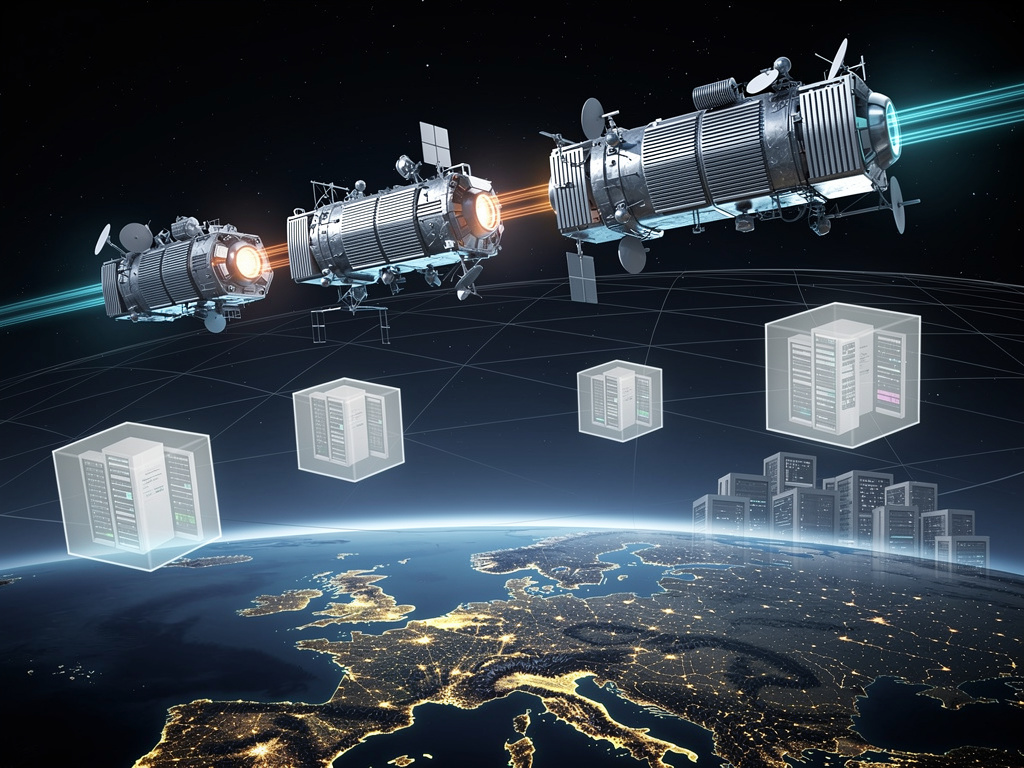
In a move that could fundamentally alter the economics of cloud computing and data processing, SpaceX has disclosed plans to the Federal Communications Commission to deploy satellites capable of functioning as orbiting data centers, according to GeekWire. The revelation, buried within technical filings submitted to the FCC, suggests Elon Musk’s aerospace venture is positioning itself not merely as a telecommunications provider but as a direct competitor to terrestrial cloud infrastructure giants like Amazon Web Services, Microsoft Azure, and Google Cloud.
The filings indicate that SpaceX is seeking authorization to operate satellites equipped with advanced computing capabilities that would process data in orbit rather than simply relaying it to ground stations. This architectural shift represents a departure from traditional satellite communications, where spacecraft serve primarily as relay stations bouncing signals between terrestrial points. Instead, SpaceX envisions a distributed computing infrastructure that leverages the unique advantages of space-based processing, including reduced latency for certain applications and the ability to serve remote or maritime customers without requiring data to traverse multiple network hops.
Industry analysts suggest the implications extend far beyond SpaceX’s existing Starlink broadband business. By combining connectivity with computational power, the company could offer integrated services that eliminate the need for separate internet service providers and cloud computing vendors. This vertical integration could prove particularly attractive to enterprise customers operating in remote locations, maritime vessels, or regions with limited terrestrial infrastructure. According to data from Satellite Today, the edge computing in space market is projected to reach $2.8 billion by 2030, representing a compound annual growth rate of 24.3%.
The technical challenges associated with operating data centers in low Earth orbit are formidable. Thermal management in the vacuum of space requires sophisticated cooling systems, as traditional air-cooling methods are ineffective. Radiation hardening of processors and memory systems adds significant cost and complexity, as cosmic rays and solar radiation can corrupt data and damage semiconductor components. Power generation and storage must be robust enough to maintain operations during eclipse periods when solar panels generate no electricity. Despite these obstacles, SpaceX’s track record of rapid iteration and cost reduction in launch services suggests the company may be uniquely positioned to overcome these barriers.
The Regulatory Minefield and Spectrum Allocation Battle
SpaceX’s FCC filings reveal a complex regulatory strategy that seeks to maximize operational flexibility while minimizing interference with existing satellite operators. The company is requesting authority to use multiple frequency bands for both user uplinks and downlinks, as well as inter-satellite links that would enable data to flow between orbiting processors without touching ground infrastructure. This mesh network approach could dramatically reduce latency for global applications by allowing data to remain in orbit until it reaches the satellite closest to its final destination.
However, spectrum allocation remains a contentious issue. Competing satellite operators, including OneWeb and Amazon’s Project Kuiper, have raised concerns about potential interference with their own constellations. The International Telecommunication Union, which coordinates global spectrum use, has established frameworks for managing these conflicts, but the unprecedented nature of space-based data centers creates regulatory ambiguity. According to SpaceNews, the FCC is developing new rules specifically designed to address mega-constellations and their evolving use cases, though these regulations may not be finalized for several years.
The economic implications of regulatory approval extend beyond SpaceX. If the FCC grants the requested authorizations, it could establish precedents that enable other companies to deploy similar space-based computing infrastructure. This could accelerate the development of what some industry observers are calling the “orbital cloud” – a distributed computing environment that spans both terrestrial and space-based resources. Conversely, regulatory delays or restrictions could provide traditional cloud providers with additional time to develop their own space-based capabilities or alternative solutions that maintain their competitive positions.
Technical Architecture and Performance Characteristics
The satellites SpaceX proposes to deploy would likely incorporate specialized processors optimized for specific workloads. Machine learning inference, video processing, and financial modeling represent potential applications where space-based processing could offer advantages over terrestrial alternatives. For maritime and aviation customers, the ability to process sensitive data without transmitting it to ground stations could address security and compliance requirements while reducing bandwidth consumption.
Latency characteristics present both opportunities and limitations. While satellites in low Earth orbit orbit at altitudes of approximately 550 kilometers, significantly closer than geostationary satellites at 36,000 kilometers, the speed of light still imposes physical constraints. Round-trip latency to a Starlink satellite and back to Earth ranges from approximately 20 to 40 milliseconds, depending on satellite elevation angle. For applications requiring real-time processing, such as autonomous vehicle coordination or high-frequency trading, this latency may prove prohibitive. However, for batch processing, content delivery, and applications serving remote users, the latency penalty may be acceptable or even advantageous compared to routing data through distant terrestrial data centers.
Power efficiency emerges as a critical design parameter. According to research from IEEE, space-based computing systems must achieve performance-per-watt ratios significantly higher than terrestrial counterparts to justify the cost of launching and maintaining orbital infrastructure. Solar panel efficiency, battery energy density, and processor thermal design power all factor into the economic viability equation. SpaceX’s experience with power systems on Dragon spacecraft and Starlink satellites provides a foundation, but data center workloads impose substantially different requirements than communications relay functions.
Market Disruption and Competitive Response
The terrestrial cloud computing market, dominated by Amazon Web Services, Microsoft Azure, and Google Cloud, generated approximately $270 billion in revenue in 2024, according to Gartner. Even capturing a small percentage of this market could generate substantial revenue for SpaceX while diversifying the company beyond launch services and broadband connectivity. The potential for disruption extends beyond pure-play cloud providers to telecommunications companies, content delivery networks, and edge computing specialists.
Amazon, which operates both AWS and the Project Kuiper satellite constellation, finds itself in a particularly complex competitive position. The company has invested billions in Kuiper, primarily positioning it as a broadband competitor to Starlink. If SpaceX successfully integrates computing capabilities into its satellites, Amazon may need to accelerate its own space-based computing initiatives or risk ceding first-mover advantages in the orbital cloud market. Microsoft and Google, lacking their own satellite constellations, may need to pursue partnerships or acquisitions to access space-based infrastructure.
The defense and intelligence sectors represent another significant market opportunity. According to Defense News, the Pentagon is actively exploring space-based computing for tactical edge applications where terrestrial infrastructure may be unavailable or vulnerable to attack. SpaceX’s existing relationships with the Department of Defense and National Reconnaissance Office through launch services and Starshield contracts could facilitate entry into this market segment. However, security clearances, supply chain requirements, and geopolitical considerations may necessitate separate satellite designs or dedicated orbital infrastructure.
Financial Implications and Investment Requirements
The capital requirements for deploying thousands of satellites equipped with advanced computing capabilities dwarf even SpaceX’s substantial existing investments in Starlink. Each satellite’s cost increases significantly when incorporating processors, memory, and thermal management systems beyond basic communications payloads. Industry estimates suggest traditional data center satellites cost $50 million to $100 million each, though SpaceX’s vertical integration and manufacturing scale could substantially reduce per-unit costs. Even at aggressive cost targets of $5 million to $10 million per satellite, a constellation of several thousand units would require tens of billions of dollars in capital investment.
Launch costs, while substantially reduced by SpaceX’s reusable Falcon 9 and Starship vehicles, still represent a significant expense. Each Starship launch could potentially deploy hundreds of satellites simultaneously, dramatically reducing per-satellite launch costs compared to traditional expendable rockets. However, the total number of launches required to establish a global computing constellation would number in the hundreds, consuming substantial internal launch capacity that might otherwise serve external customers or Starlink broadband expansion.
Revenue models for space-based computing services remain largely speculative. SpaceX could pursue usage-based pricing similar to terrestrial cloud providers, charging for compute cycles, storage, and data transfer. Alternatively, the company might bundle computing capabilities with Starlink connectivity, offering integrated packages that simplify procurement for enterprise customers. Specialized applications serving maritime, aviation, or remote industrial customers could command premium pricing that justifies the infrastructure investment. According to Morgan Stanley, the global space economy could reach $1 trillion by 2040, with satellite-based services representing a substantial portion of that growth.
Environmental and Sustainability Considerations
The proliferation of satellites in low Earth orbit has generated increasing concern among astronomers, environmental advocates, and space sustainability experts. Each additional satellite contributes to orbital congestion and increases collision risks, potentially generating debris that threatens other spacecraft. SpaceX has implemented measures to reduce Starlink satellites’ visibility from Earth and incorporated autonomous collision avoidance systems, but the addition of computing capabilities increases satellite mass and complexity, potentially complicating end-of-life disposal.
Energy consumption represents another sustainability consideration. While space-based solar panels generate electricity without combustion emissions, the manufacturing processes for satellites, processors, and launch vehicles involve substantial carbon footprints. A comprehensive lifecycle analysis would need to compare the total environmental impact of space-based computing against equivalent terrestrial data centers, accounting for construction materials, operational energy sources, cooling requirements, and disposal methods. According to Nature, the carbon footprint of rocket launches is growing as launch rates increase, though SpaceX’s methane-fueled Starship could potentially use carbon-neutral synthetic fuel in the future.
Regulatory frameworks for space sustainability remain underdeveloped. The FCC has implemented five-year deorbit requirements for new satellites in low Earth orbit, but enforcement mechanisms and penalties for non-compliance remain unclear. International coordination through bodies like the United Nations Committee on the Peaceful Uses of Outer Space proceeds slowly, often lagging behind technological developments. SpaceX’s ability to demonstrate responsible orbital operations and end-of-life disposal could influence regulatory approaches that affect all satellite operators.
The Path Forward and Industry Transformation
SpaceX’s timeline for deploying data center satellites remains uncertain, as the company has not publicly disclosed launch schedules or service availability targets. The FCC filing process typically requires months or years to complete, particularly for novel applications that lack established regulatory frameworks. Technical development, testing, and validation of space-based computing systems could extend timelines further, especially given the harsh operating environment and limited opportunities for maintenance or repair.
The success or failure of SpaceX’s orbital data center initiative will likely depend on factors beyond pure technical capability. Customer adoption requires not only functional services but also competitive pricing, reliability guarantees, and integration with existing enterprise IT infrastructure. Software development kits, application programming interfaces, and management tools must achieve parity with mature terrestrial cloud platforms. Security certifications, compliance frameworks, and audit capabilities must satisfy enterprise and government requirements. Building this ecosystem requires sustained investment and partnership development that extends well beyond satellite deployment.
Regardless of SpaceX’s ultimate success, the company’s ambitions signal a fundamental shift in how industry leaders conceptualize space-based infrastructure. The evolution from passive relay stations to active computing nodes represents a paradigm shift comparable to the transition from mainframes to distributed cloud computing that transformed the technology sector over the past two decades. Whether SpaceX dominates this emerging market or merely catalyzes broader industry transformation, the integration of orbital and terrestrial computing resources appears increasingly inevitable, with profound implications for how humanity processes, stores, and accesses information in the coming decades.


 WebProNews is an iEntry Publication