
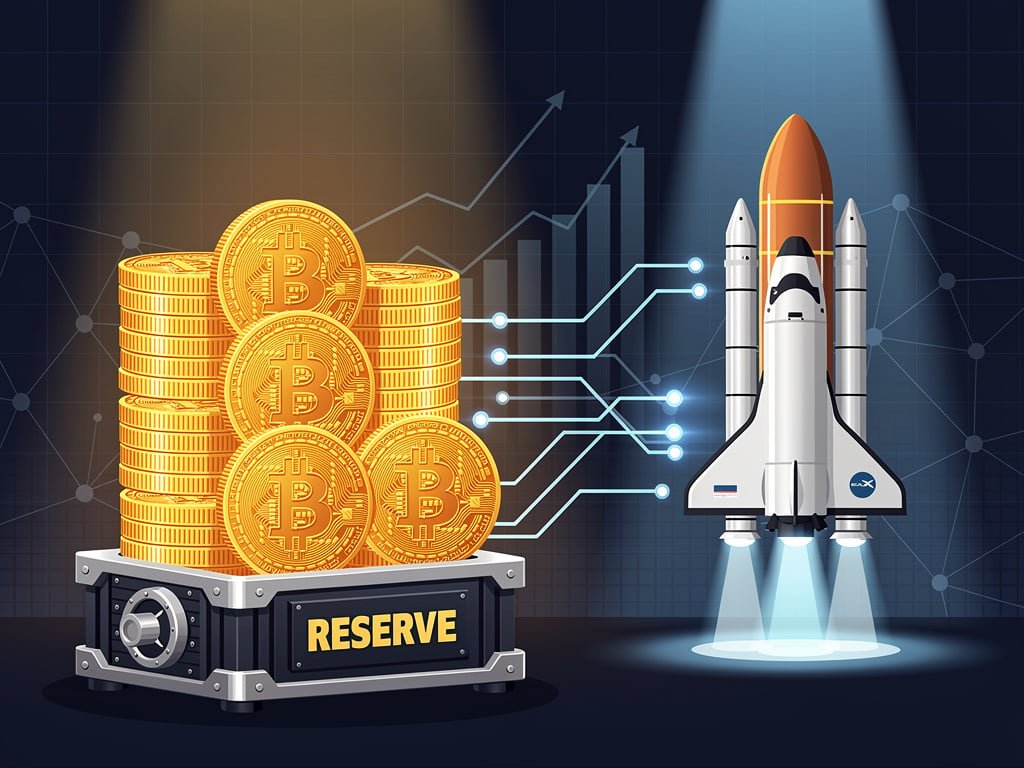
SpaceX holds 18,712 bitcoin. The stake, revealed in the company’s S-1 filing ahead of a planned Nasdaq listing, sits at roughly $1.4 billion today. Purchased at a total cost of $661 million, or about $35,000 per coin, the position has delivered nearly $800 million in unrealized gains. But the disclosure does more than highlight a smart trade. It frames bitcoin as a deliberate reserve for excess cash in one of the most ambitious companies on Earth.
The numbers surprised many. On-chain trackers from Arkham Intelligence had pegged SpaceX’s visible holdings around 8,285 bitcoin as recently as last year. The filing showed more than double that amount. Some of those coins were bought back in 2021. Others accumulated later. The company trimmed its position at points. Records indicate it held as few as 6,095 bitcoin in 2025 before rebuilding. Yet it stopped selling after late 2024. That decision now looks intentional.
And the rationale feels clear. SpaceX treats the bitcoin as a hedge against inflation and a long-term store for cash not immediately needed for rocket development or Starlink expansion. Edward Ludlow, co-host of Bloomberg Technology, put it plainly on Bloomberg Crypto. The language in the filing suggests they view it as “a hedge against inflation, long-term asset, but most likely this sort of strategic reserve for its excess cash.”
Short sentence. Simple logic. Cash sits. Bitcoin compounds. Volatility remains the cost of admission.
Compare that approach to Tesla, another Musk-led operation. Tesla holds 11,509 bitcoin. SpaceX’s pile exceeds it. A hypothetical merger of the two would create a combined treasury of more than 30,000 bitcoin worth some $3.3 billion, enough to rank fifth among public corporate holders globally, according to CoinDesk analysis. No such deal has been confirmed. The possibility alone fuels talk of coordinated strategy across Musk’s empire.
Yet the bitcoin position represents just 1.8 percent of SpaceX’s total assets. The company reported $15.8 billion in cash and securities alongside it. Revenue reached $18.7 billion in 2025, with Starlink contributing $11.39 billion. In that context the crypto stake looks modest. Still, its presence on the balance sheet marks a shift. Public companies increasingly accept bitcoin’s place in treasury management. MicroStrategy built an empire on the idea. Others watch and learn.
But acceptance brings headaches. Accounting rules require quarterly mark-to-market adjustments. Bitcoin’s price swings will flow straight into reported earnings. Those swings have nothing to do with launch cadence or satellite deployments. David Krause, finance professor emeritus at Marquette University, spelled out the risk in Fortune. “Marking $1.45 billion in Bitcoin to market each quarter can produce wild swings into reported earnings that have nothing to do with rocket launches or satellite performance.”
The volatility cuts both ways. Gains boost profits on paper. Losses drag them down. Investors must separate operational performance from treasury noise. SpaceX’s upcoming IPO will test whether Wall Street has grown comfortable with that distinction. The filing already values the bitcoin at $1.29 billion on a fair-value basis as of March 31. Future quarterly reports will update that figure in real time.
Elon Musk’s own history with crypto adds color. He championed dogecoin in 2021, even joking about putting “a literal Dogecoin on the literal moon.” Tesla once accepted bitcoin for vehicle purchases before reversing course. Musk later described most cryptocurrencies as scams while granting that some hold merit. His public enthusiasm has cooled. The holdings at both his flagship companies suggest conviction remains in private. James Seyffart, Bloomberg analyst, captured the surprise. “It’s a lot more than I thought they had (like everyone else),” he texted Fortune. “He and/or someone higher up in his close circle are obviously strong believers in bitcoin to buy and hold through all this volatility.”
Post-IPO, SpaceX would rank as the seventh-largest public company by bitcoin ownership. The distinction matters less than the signal it sends. Corporate treasurers study these moves. When a firm with SpaceX’s cash flow and growth profile commits capital to bitcoin and holds through cycles, others take notice. Grayscale Research noted the development in late May. The firm projected SpaceX could emerge as the largest publicly traded diversified company holding bitcoin after its expected listing.
Recent coverage reinforces the momentum. A May 27 report from CoinDesk examined the merger scenario in detail, highlighting how the combined treasury would immediately elevate Musk’s influence in bitcoin markets. Bitcoin Magazine emphasized the historic nature of the IPO filing itself, calling the $1.45 billion treasury one of the most significant corporate disclosures of 2026. Even as bitcoin trades near $77,000, the conversation has moved beyond price speculation toward structural adoption.
SpaceX faces no immediate pressure to sell. Krause told Fortune that any disposal would likely require “a major strategic shift or a genuine liquidity crisis, not routine treasury management.” Like Tesla before it, SpaceX appears to see bitcoin as a reserve asset rather than a trading instrument. The accounting friction exists. So does the upside. For an enterprise betting on Mars colonies and global internet coverage, a bitcoin buffer may simply represent prudent diversification.
Public markets will soon price that judgment. Shares could command a valuation north of $2 trillion at listing. Buyers will inherit indirect bitcoin exposure whether they seek it or not. Some will cheer the hedge. Others will discount the earnings noise. Either reaction underscores a larger truth. Bitcoin has graduated from fringe experiment to balance-sheet line item for elite technology companies. SpaceX just made that transition official.


 WebProNews is an iEntry Publication