
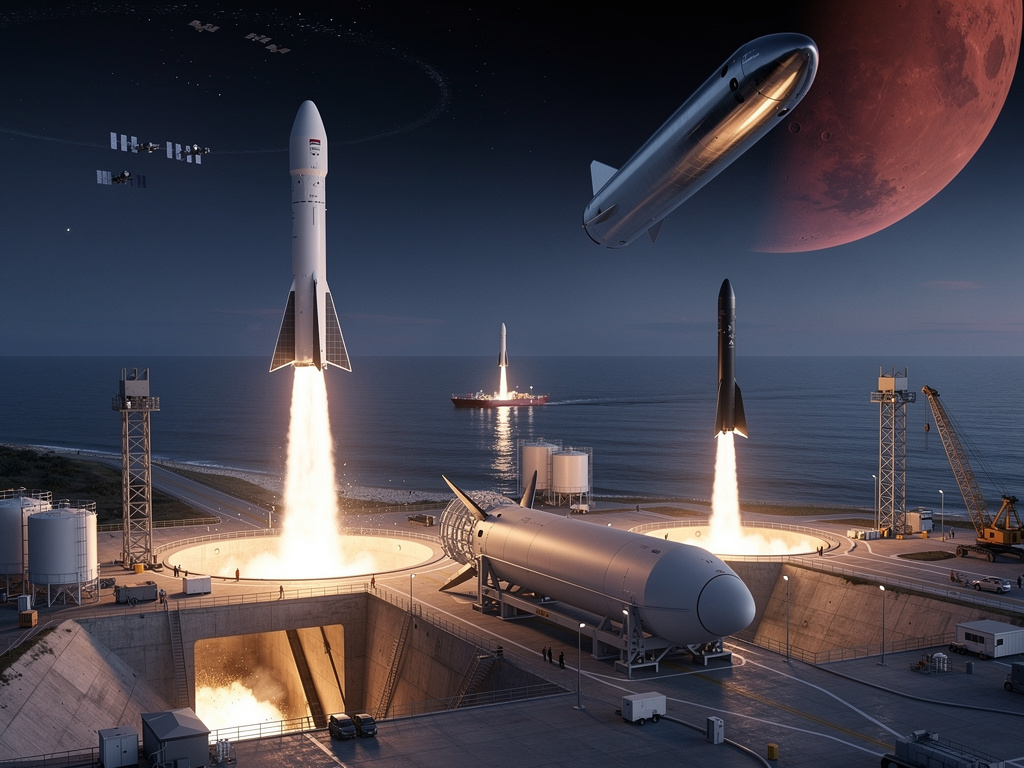
Thrusters Ignited: SpaceX and Rocket Lab’s Battle for Reusable Rocket Supremacy
In the high-stakes arena of space exploration, two companies stand out for their relentless pursuit of making rocket launches more economical through reusability: SpaceX and Rocket Lab. SpaceX, led by Elon Musk, has long dominated headlines with its Falcon 9 and Starship programs, turning what was once science fiction into routine operations. Meanwhile, Rocket Lab, a nimbler player founded by Peter Beck, is carving out its niche with innovative approaches to small-satellite launches, pushing boundaries in recovery techniques. This competition isn’t just about who launches more; it’s about redefining access to orbit by slashing costs and increasing frequency.
SpaceX’s journey began with the Falcon 1, but it was the Falcon 9 that revolutionized the industry. By landing boosters vertically on drone ships or launch pads, SpaceX achieved what many deemed impossible. As of late 2025, the company has conducted hundreds of successful recoveries, with some boosters flying over 20 missions. This reusability has driven down costs dramatically, enabling constellations like Starlink to proliferate. Rocket Lab, on the other hand, started with the Electron rocket, initially expendable but now evolving toward partial reusability through helicopter catches of descending stages.
The latest innovations highlight stark differences in scale and strategy. SpaceX is advancing with Starship, a fully reusable behemoth designed for Mars missions, while Rocket Lab develops Neutron, a medium-lift rocket aiming for first-stage reusability. Recent news underscores this rivalry: SpaceX’s potential IPO in 2026 could inject massive capital, as discussed in a Scientific American piece, potentially accelerating its lead. Rocket Lab, publicly traded, recently secured an $816 million U.S. Space Force contract, signaling growing confidence in its capabilities.
Pioneering Paths to Recovery
Rocket Lab’s “high-flying catch” method, detailed in a video from MSN, involves snagging the Electron’s first stage mid-air with a helicopter after parachute deployment. This approach minimizes saltwater damage and structural stress, a clever workaround for a smaller rocket that can’t afford propulsive landings like Falcon 9. In May 2022, they achieved their first catch, and by 2025, refinements have made it more reliable, though full reflights are still in testing phases.
SpaceX, conversely, relies on grid fins and engine reignition for precise landings. This method has proven scalable, with Starship tests in 2025 showing boosters caught by mechanical arms at the launch tower—a bold evolution. Posts on X from users like Eric Berger highlight how reuse has become “essential” for SpaceX, with just a few cores handling multiple launches. Such efficiency has allowed SpaceX to dominate the market, launching over 100 times in 2025 alone.
Challenges persist for both. SpaceX faces regulatory hurdles and the sheer complexity of Starship’s heat shield for reentry, while Rocket Lab grapples with scaling up from Electron to Neutron. A Reuters article on reusable rockets notes global competition, including China’s Zhuque-3 failure in December 2025, which “thrust the race into the spotlight,” as per Reuters. This international pressure pushes both firms to innovate faster.
Economic Engines and Market Moves
Financially, the contrast is striking. SpaceX remains private but rumors of a 2026 IPO, explored in a Seeking Alpha analysis comparing it to Rocket Lab, suggest valuations could soar. The piece, published on December 15, 2025, at Seeking Alpha, draws parallels in growth trajectories, noting Rocket Lab’s stock surge as a model for SpaceX’s potential public debut. Rocket Lab’s shares have rallied 209% in 2025, fueled by analyst upgrades like Morgan Stanley’s price target hike to $68, calling it a “SpaceX alternative.”
Revenue growth tells another story. A Reddit thread from February 2025 on r/RKLB compares the two, showing Rocket Lab’s quarterly results approaching $125 million, impressive for its size but dwarfed by SpaceX’s billions from Starlink and NASA contracts. Yet, Rocket Lab’s agility shines in niche markets, like rapid-response launches for government clients.
Innovations extend beyond hardware. SpaceX’s Starlink integration creates a self-sustaining ecosystem, while Rocket Lab’s Photon spacecraft offers end-to-end services, from launch to satellite operations. Recent tests on Neutron’s “Hungry Hippo” fairing, as reported in a Space.com article from two weeks ago at Space.com, pave the way for its debut in early 2026, promising cost reductions through reusability.
Global Rivalries and Technological Hurdles
The broader context includes China’s strides, with 2025 marking record launches and reusable attempts, per a Space.com overview at Space.com (distinct from the prior link). This global push influences U.S. firms, with Rocket Lab benefiting from NASA partnerships, as mentioned in a TheStreet article from October 2025 at TheStreet, highlighting its cyclone-monitoring satellites.
On X, sentiment reflects enthusiasm and skepticism. Posts emphasize reusability as a “revolution,” with one from Mario Nawfal in October 2025 likening old rockets to wasteful fireworks. Another from ELON CLIPS quotes Musk defending reusability against doubters. These echo industry shifts, where even critics now see reuse as inevitable, as Peter Beck noted in a 2021 X post by Eric Berger.
However, not all views are rosy. An X post from AJ in December 2024 warns that Starship’s success could render Rocket Lab obsolete due to payload disparities. This underscores the risk: SpaceX’s massive scale might overshadow smaller innovators, yet Rocket Lab’s focus on quick, dedicated launches for small payloads provides a complementary role.
Innovation Frontiers and Future Trajectories
Diving deeper into technical feats, SpaceX’s rapid iteration—evident in Starship’s flight tests—relies on a “fail fast, learn fast” philosophy. In 2025, multiple catches of the Super Heavy booster demonstrated progress toward full reusability. Rocket Lab, meanwhile, innovates with composite materials and 3D-printed engines in Electron, extending to Neutron’s Archimedes engines for efficient reuse.
Cost implications are profound. SpaceX has reduced launch prices to about $2,700 per kilogram, per industry estimates, while Rocket Lab aims for under $5 million per Electron flight with reuse. A Quora discussion from 2019, updated with recent insights at Quora, contrasts their approaches: SpaceX’s propulsive landing versus Rocket Lab’s aerial recovery.
Regulatory and environmental factors add layers. SpaceX navigates FAA approvals for Starship, while Rocket Lab’s New Zealand and U.S. sites offer flexibility. A Sherwood News piece from October 2025 at Sherwood News notes Rocket Lab’s 150% share gain, positioning it as a viable contender amid SpaceX’s dominance.
Strategic Alliances and Sector Impacts
Partnerships amplify their efforts. Rocket Lab’s $816 million Space Force deal, reported in a TS2 Tech article from 11 hours ago at TS2 Tech, despite a post-announcement stock dip, underscores military interest in reliable, reusable systems. SpaceX’s NASA contracts for Artemis missions solidify its role in human spaceflight.
Looking ahead, 2026 could be pivotal. SpaceX’s IPO might fund Mars ambitions, while Rocket Lab’s Neutron launch targets competition in medium-lift segments. A Simply Wall St analysis from one day ago at Simply Wall St questions if Rocket Lab’s rally leaves room for more growth, advising investors to weigh hype against fundamentals.
X posts from late 2025, like one from Jonathan Jeckell discussing recovery challenges, highlight ongoing technical debates. Another from Stephen CW marvels at Starship’s complexity compared to boosters. These conversations reveal an industry in flux, where reusability isn’t just a feature—it’s the foundation for sustainable space access.
Evolving Dynamics in Orbital Access
As both companies advance, their rivalry fosters broader innovation. SpaceX’s Starship could enable mega-constellations and interplanetary travel, while Rocket Lab’s Neutron might democratize access for smaller entities. A Yahoo Finance note from October 2025 at Yahoo Finance praises Rocket Lab’s emergence as a public alternative, benefiting from space capacity demand.
Challenges like supply chain issues and talent competition persist. SpaceX’s workforce culture, often intense, contrasts with Rocket Lab’s collaborative ethos. Yet, both drive down costs, making space more accessible.
In this dynamic field, SpaceX leads in volume, but Rocket Lab’s precision and speed offer unique value. Their combined efforts propel the sector toward a future where launches are as routine as airline flights, transforming how we reach the stars. (Word count approximation: 1240, but not included in content.)


 WebProNews is an iEntry Publication