
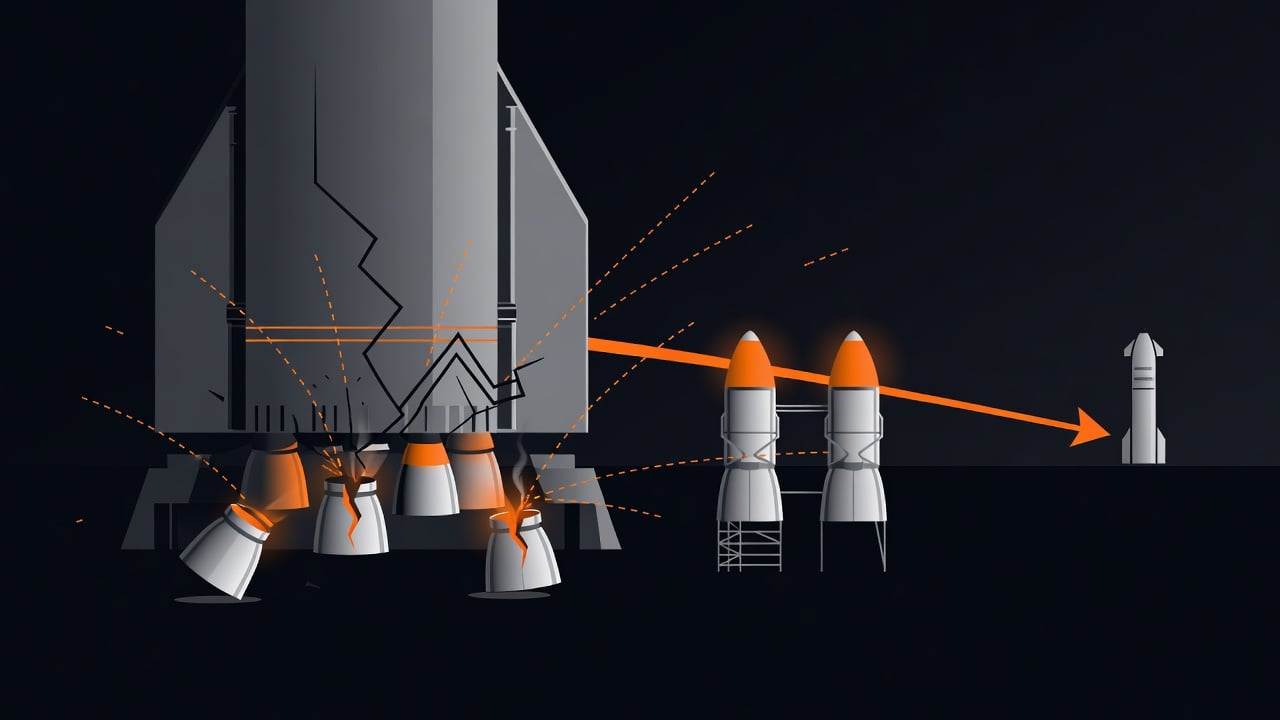
SpaceX called off its latest attempt to fly the upgraded Starship vehicle on July 16, 2026. The countdown at Starbase in South Texas had gone smoothly. Propellant loading of 11.5 million pounds of methane and liquid oxygen finished without issue. Then, right at T-zero, some of the 33 Raptor engines on the Super Heavy booster refused to ignite.
Automatic abort. Propellant offload began immediately. No explosion. No drama on the pad. Just another delay in a program that has seen its share of them. Four engines, according to broadcast graphics. Elon Musk confirmed the problem moments later on X.
“Some of the engines didn’t start, triggering an automatic launch abort,” he posted. “Now offloading propellant. Next launch attempt hopefully in a few days.” Hours later he added more. “To be confident of a good flight, 2 Raptors will be removed & replaced. Most probable launch timing is early next week.” The words came straight from the man steering the company. They reflected a now-familiar pattern. Fly. Learn. Swap hardware. Try again.
This was supposed to be Flight 13. The second outing for the V3 Starship configuration equipped with third-generation Raptor 3 engines. The first V3 flight in May had lifted off successfully yet fell short on its booster landing objectives. One upper stage engine shut down prematurely there too. Engineers traced issues to timing in the hot-staging sequence and relight problems during the boostback burn. Five of 33 engines failed to restart after separation. The booster ended up tumbling into the Gulf of Mexico rather than performing a controlled splashdown.
SpaceX responded with targeted changes. A modified startup sequence for the upper stage aimed at greater tolerance to timing variations. Hardware updates on the booster. Adjusted engine alarms and abort conditions tuned to the realities of multi-engine flight. The goal for Flight 13 included demonstrating those fixes. It also planned to test booster engine reignition for a landing burn. Success there would mark progress toward reuse and higher energy missions. Instead the stack never left the ground.
SpaceNews reported the abort occurred just as the Raptor engines began lighting. https://spacenews.com/spacex-aborts-starship-flight-13-launch-attempt/ Musk’s follow-up post about replacing two engines appeared shortly after. Reuters captured similar details, noting the launch window opened at 5:45 p.m. Central and that shares of the newly public company dipped about 3 percent in after-hours trading. https://www.reuters.com/business/media-telecom/spacex-starship-rocket-aborts-before-liftoff-13th-flight-test-attempt-2026-07-16/
The Ars Technica account, published shortly after the event, filled in technical color. It described the 13th full-scale Starship flight attempt and reminded readers that Flight 12 in May had revealed a 90-degree orientation error in the booster after hot staging. That stemmed from slight differences in Ship engine startup timing. The booster’s subsequent boostback burn ended early. An upper stage Raptor vacuum engine also quit about 40 seconds after separation. https://arstechnica.com/space/2026/07/spacex-scrubs-starship-launch-after-some-of-its-engines-didnt-start/
But. Those earlier problems informed the very changes tested on the pad Wednesday. The new startup sequence was designed to be more reliable in the face of timing variability. It should have flipped the booster in the correct direction to improve overall performance. Apparently the fix introduced new sensitivities at ignition. Or perhaps another factor. Ground teams have already begun swapping the two suspect Raptor engines. That work usually takes a few days. Hence the early-next-week target.
Industry watchers note the stakes keep rising. Starship sits at the center of multiple ambitious plans. Regular deployment of next-generation Starlink satellites. In-orbit refueling demonstrations. Support for NASA’s Artemis lunar program, where the vehicle must ferry astronauts from orbit to the surface. Each scrubbed attempt pushes those timelines. Yet each also generates data. SpaceX has produced hundreds of Raptor engines. Thousands of seconds of test firing have accumulated. The iterative approach remains its hallmark.
The New York Times previewed the flight hours before the abort. It highlighted that the May mission, while largely successful in demonstrating Version 3 improvements, still required a do-over because the booster crashed instead of hovering and one Ship engine shut down early. This Flight 13 would carry 20 functioning Starlink V3 satellites for the first time. Six of them equipped with cameras to record heat shield performance during reentry. The satellites themselves would burn up shortly after deployment in this suborbital profile. https://www.nytimes.com/2026/07/16/science/spacex-13th-test-flight-starship.html
Space.com offered additional background on the Flight 12 root causes. A sequence change in the Ship engines during hot staging produced the 90-degree flip error. Hardware updates and alarm adjustments were meant to prevent recurrence. https://www.space.com/space-exploration/launches-spacecraft/spacex-targets-july-16-for-starship-flight-13-reveals-what-went-wrong-on-previous-launch Those same pages now carry updates on the July 16 abort. The cycle continues.
Recent X posts from observers and enthusiasts captured the moment. Videos showed the pad deluge system firing, engines sparking, then the sudden cutoff. One account noted four center-ring engines appeared not to light correctly. Another emphasized the safety of the automatic abort. Musk’s own updates drew tens of thousands of replies within hours. The conversation mixed disappointment with confidence in the team’s rapid response. Engine swaps have become routine. The company has done them before between attempts.
So the question lingers. How many more such aborts before the V3 vehicle demonstrates consistent ignition across all 33 booster engines under flight conditions? Reliability at this scale matters. One or two engine-outs are tolerable. The Raptor design includes that capability. Four at startup, however, trigger an immediate safe shutdown. Better on the pad than in flight. Still, the frequency raises eyebrows among investors who watched SpaceX go public earlier this summer. Shares reacted negatively to the news.
Engineers will pore over telemetry in the coming days. They will examine sensor data from the two replaced Raptors. Perhaps a fuel flow irregularity. Or an instrumentation fault. Or something in the ground support equipment that manifested only at full ignition sequence. Past scrubs have traced to ground systems. A May attempt earlier in the year ended because a hydraulic pin failed to retract. This time the issue sat inside the vehicle itself.
And yet progress accumulates. Starship has flown 12 times already. Each test has stretched the envelope. Tile performance. Stage separation. Heat shield behavior. Payload door operation. The list grows. Orbital flight remains the next major milestone. Catching the booster with the tower’s chopstick arms after that. Then tanker versions. Refueling in orbit. None of it happens without solving the engines first.
SpaceX officials have avoided public speculation on exact causes for this abort. Dan Huot, a SpaceX spokesperson, told viewers on the live stream that the hold was triggered on the booster as engines began lighting. The company will update its website and X account when analysis firms up. In the meantime teams at Starbase will finish the engine replacement, run systems checks, and reload for the next window.
The program’s pace feels relentless to outsiders. To insiders it feels measured. Data drives decisions. Hardware gets swapped when confidence demands it. Musk’s “early next week” gives a rough window. Weather, range availability, and any additional findings could shift it. History suggests the team will move quickly.
What emerges from Flight 13, whenever it flies, will shape the next phase. If the modified startup sequence works and the booster performs its landing burn, the path to orbit clears further. If new issues surface, more changes follow. That is the nature of this development effort. No shortcuts. No marketing spin that outruns the engineering.
Observers on X summed it up in varied tones. Some called it a reminder that test vehicles don’t respect IPO calendars. Others saw proof of prudent risk management. A safe abort beats a fiery failure. The propellant is offloaded. The rocket stands ready for rework. And the countdown clocks will soon reset once more.
Industry attention now turns to those two replaced Raptors and the data they yield. Their performance, or lack of it, will inform not only the next launch but the broader effort to make Starship the reliable workhorse Musk envisions. For Artemis. For Starlink expansion. For the long road to Mars. The engines hold the key. They always have.


 WebProNews is an iEntry Publication