
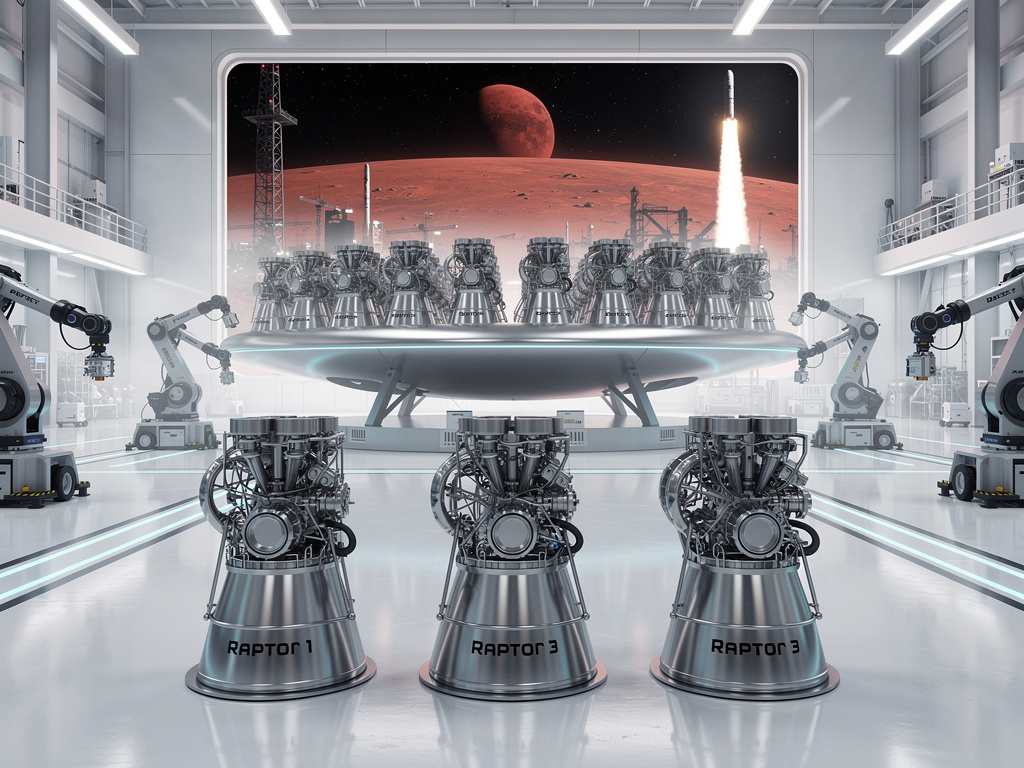
Propelling Humanity: Inside SpaceX’s Game-Changing Raptor Engine Evolution
In the high-stakes world of aerospace engineering, few innovations have captured the imagination quite like SpaceX’s Raptor engine series. As the backbone of the Starship program, these engines represent a bold leap forward in propulsion technology, promising to make interplanetary travel not just feasible but routine. Drawing from recent developments, including the unveiling of the Raptor 3, this deep dive explores how SpaceX is rewriting the rules of rocket science through iterative design, advanced manufacturing, and relentless optimization.
The Raptor engine’s journey began with a fundamental shift in fuel choice: methane and liquid oxygen, or methalox, which offers advantages in reusability and performance over traditional kerosene-based systems. This full-flow staged combustion cycle engine is designed to operate under extreme conditions, pushing the boundaries of thrust and efficiency. According to insights from Orbital Today, the iterative process behind Raptor has involved numerous failures and refinements, each contributing to the engine’s role in enabling reusable Mars missions.
SpaceX’s approach emphasizes rapid prototyping and testing, a methodology that has accelerated development cycles dramatically. Unlike legacy aerospace firms that might spend years perfecting a single design, SpaceX iterates quickly, learning from real-world data. This philosophy is evident in the progression from Raptor 1 to Raptor 3, where each version builds on the last, incorporating lessons from flight tests and ground firings.
Efficiency Through Iteration
The Raptor 3, debuted in late 2025, showcases remarkable advancements, including nearly double the thrust of its predecessor at a fraction of the cost. As detailed in a report from Blockchain News, the engine achieves this through AI-driven manufacturing techniques that streamline production and reduce weight. By eliminating the need for a traditional heat shield, engineers have simplified the design, allowing small fuel leaks to burn off safely in open plasma, enhancing reliability.
Metal additive manufacturing plays a pivotal role here, enabling complex geometries that were previously impossible with conventional methods. Metal AM highlights how this technology has been extensively used in Raptor 3, contributing to its lighter structure and improved performance metrics. The result is an engine that not only produces more power but does so with greater efficiency, crucial for the heavy-lift demands of Starship.
Beyond hardware, SpaceX’s development methodology fosters innovation across the board. A Substack analysis from The Cogitating Ceviche describes this as a five-step process involving first principles thinking, rapid iteration, and intelligent risk-taking. This framework has implications far beyond rocketry, offering a blueprint for other industries seeking to accelerate progress.
Thrust and Cost Breakthroughs
Quantifying the leaps: Raptor 3 delivers approximately 280 tons of thrust, a 51% increase over Raptor 1, while slashing production costs by a factor of four. Posts on X from industry observers echo this, noting the engine’s sublime engineering that eliminates unnecessary components for mass savings. Such optimizations are vital for Starship’s goal of full reusability, where every kilogram counts toward payload capacity.
Integration with Starship’s Super Heavy booster amplifies these benefits. The system requires dozens of Raptors working in concert, and recent updates from SpaceX’s official updates page detail enhancements like increased propellant volume and redesigned feedlines. These changes support longer missions and higher reliability, key for ambitious targets like lunar landings and Mars colonization.
Challenges remain, however. High-pressure environments in the full-flow cycle demand materials that withstand 600 bar pressures and extreme temperatures. As shared in X discussions by propulsion experts, mastering this cycle required novel approaches to turbopump design and thermal management, pushing the envelope of what’s possible in engine architecture.
Manufacturing Revolution
AI and additive manufacturing aren’t just buzzwords; they’re transforming how SpaceX builds engines. The Raptor 3’s production leverages these tools to create parts with optimized geometries, reducing assembly complexity. Tesla Mag reports on how this has led to a engine that’s lighter by 42.9 tons per launch configuration, directly translating to greater efficiency and lower operational costs.
Looking at the broader ecosystem, competitors like ISRO are ramping up with their own heavy-lift vehicles, as noted in Hindustan Times, aiming to challenge SpaceX in satellite deployment. Yet, SpaceX’s edge lies in its integrated approach, combining engine innovation with rapid infrastructure upgrades at Starbase.
Interviews with pioneers like Tom Mueller, a key figure in SpaceX’s early engine development, provide insider perspectives. In a feature from Interesting Engineering, Mueller recounts the journey from Merlin to Raptor, emphasizing the shift to methalox for its clean-burning properties and potential for in-situ resource utilization on Mars.
From Failure to Triumph
Historical context enriches the narrative. A decade ago, SpaceX achieved its first Falcon 9 landing, a milestone recounted in Ars Technica, which turned tragedy into triumph after launch failures. This resilience is mirrored in Raptor’s evolution, where explosive tests have informed safer, more robust designs.
Current preparations for Starship Flight 12, as covered by NASASpaceFlight, show vehicles readying for a 2026 opener, with Booster 19 assembly underway. These efforts include propulsion avionics upgrades that enhance valve control and sensor readings, ensuring precise engine performance during ascent and reentry.
X posts from users like Dima Zeniuk highlight community excitement, describing Raptor 3 as the most advanced engine ever, with first flights targeted for Q1 2026 on Starship V3. This sentiment underscores the engine’s role in not just technical achievement but in inspiring a new generation of space enthusiasts.
Infrastructure and Future Missions
Starbase’s ongoing upgrades, detailed in another NASASpaceFlight article, support this engine revolution. Demolition and construction work is expanding capabilities, allowing for more frequent tests and launches, which in turn accelerate Raptor refinements.
The video deep dive from MSN illustrates these concepts visually, breaking down the engine’s internal workings and the physics of staged combustion. It emphasizes how methane’s properties enable regenerative cooling, a critical feature for sustained burns.
Comparisons with other innovations, such as Stoke Space’s aerospike engines mentioned in X threads, highlight the diversity of approaches in the field. While Raptor focuses on clustered power, others explore novel shapes like actively cooled metallic heat shields for reentry.
Broader Implications for Space Exploration
Economically, Raptor’s cost reductions could democratize access to space. By lowering launch expenses, SpaceX aims to enable constellations like Starlink and private missions, reshaping global communications and research.
Environmentally, methalox’s cleaner combustion reduces soot buildup, aiding reusability. This aligns with SpaceX’s vision of sustainable space travel, where engines like Raptor facilitate resource harvesting on other worlds.
Geopolitically, advancements position the U.S. as a leader in space, with partnerships and competitions driving further innovation. As Orbital Today notes, the engine’s evolution is key to Mars ambitions, potentially realizing human settlement within decades.
Pushing Boundaries Further
Looking ahead, SpaceX plans continued enhancements, possibly integrating vacuum-optimized variants for deep-space maneuvers. X discussions speculate on even higher thrust versions, building on Raptor 3’s foundation.
Challenges like regulatory hurdles and supply chain issues persist, but SpaceX’s track record suggests they’ll be overcome through ingenuity. Tesla Mag’s coverage reinforces that Raptor 3 represents the pinnacle, yet it’s just a stepping stone.
Ultimately, the Raptor series embodies a paradigm shift, where propulsion isn’t a bottleneck but a catalyst for exploration. As SpaceX forges ahead, the engine’s legacy will be measured not in thrust alone, but in the horizons it opens for humanity.


 WebProNews is an iEntry Publication