
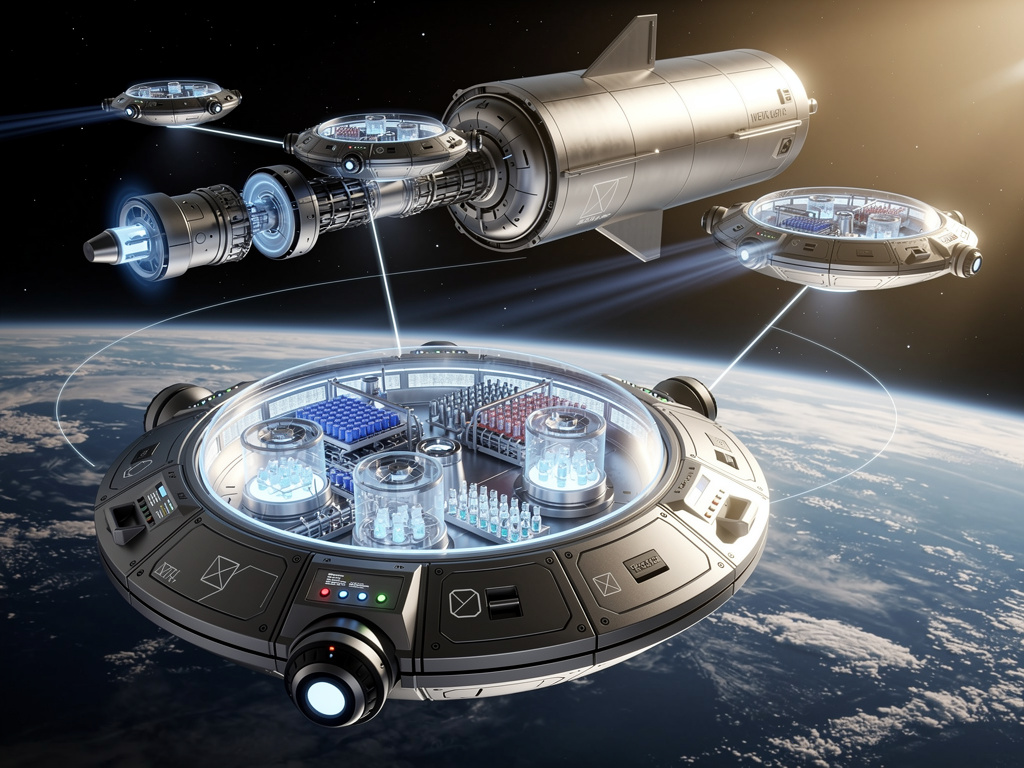
SpaceX stands on the verge of a major expansion. The company best known for reusable rockets and satellite internet now eyes manufacturing products where gravity barely registers. Its Starfall program, revealed in recent reports, centers on small uncrewed capsules that ride to orbit, linger in microgravity, and return with goods refined in ways impossible on Earth.
Details emerged last year. Bloomberg first described plans to send pharmaceutical components and similar items aboard Starship, leave them in capsules for processing, then bring the finished material back through atmospheric reentry. The Los Angeles Times covered the same effort, noting Starship would deploy these capsules for time in space before recovery. Los Angeles Times laid out the anonymous sourcing that pointed to an internal project name and uncrewed operations.
But Starfall isn’t limited to one launcher. Gizmodo examined the hardware in depth. The capsule measures 10.2 feet across and 2.5 feet tall. An aluminum top plate pairs with a carbon-fiber heat shield. Inside sits volume for up to 2,205 pounds of payload across dimensions of 8.2 by 4.9 by 1.6 feet. Gizmodo reported the Federal Aviation Administration has cleared test flights. Recovery involves a main parachute plus pilot and drogue chutes. The heat shield jettisons before splashdown in the Pacific off California. SpaceX aims to declare the system operational before the decade closes.
This marks more than a side project. It builds directly on years of work that lowered launch prices. Starship’s reusability promises costs low enough to make frequent orbital access routine. Once that happens, leaving hardware in space for weeks stops looking exotic. It starts looking like standard procedure. And the payoff could stretch across pharmaceuticals, advanced materials, and fiber optics grown without convection currents or container walls.
Varda Space Industries already proved the concept on a smaller scale. The California startup flew its own reentry capsules and struck deals with pharmaceutical partners. Yet Varda depends on rides from outside providers. SpaceX carries no such handicap. It owns the rockets, controls the cadence, and can scale experiments faster than any rival. That integration gives it a structural edge few others match.
NASA has watched the trend. The agency published its latest ISAM State of Play report tracking in-space servicing, assembly, and manufacturing across government, industry, and academia. The document catalogs hardware demonstrations, software for autonomous construction, and studies on large radio-frequency apertures. NASA also formed a consortium to make these capabilities routine rather than experimental. Its work underscores that microgravity processing no longer sits in the distant future. Multiple players now invest real money.
Recent coverage adds texture. Chris Prophet’s Substack analysis connected Starfall to broader plans for returning lunar or manufactured goods. The author noted the same capsules could one day ferry materials from the Moon. Chris Prophet on Substack placed the effort inside a larger push that includes orbital propellant depots and eventual Mars missions. Tanay J’s breakdown of SpaceX’s S-1 filing highlighted how the company lists space manufacturing among future markets alongside lunar energy and asteroid resources. Tanay J observed that Starship’s payload capacity opens doors for orbital data centers and compute clusters cooled by the vacuum of space.
Starship itself supplies the foundation. SpaceX’s May 2026 prospectus, covered by SpaceNews, disclosed more than $15 billion spent on the program. The company expects payload delivery to orbit in the second half of 2026. That timeline aligns with early Starfall tests. SpaceNews reported the filing also detailed massive manufacturing facilities under construction in Texas, Florida, and California. Those sites will support production rates that dwarf anything attempted before.
Yet challenges remain. Precise propellant transfer in orbit must succeed before large-scale assembly becomes practical. Heat shield durability on high-speed returns still demands repeated testing. Regulatory approvals for frequent reentries will grow more complex as cadence increases. None of these barriers look insurmountable given the company’s track record. But they require flawless execution across hundreds of variables.
Investors sense the shift. SpaceX’s planned IPO, discussed in Barron’s coverage of a scrubbed Starship test flight, carries a roughly $2 trillion valuation. That figure rests partly on launch dominance and Starlink subscriptions. It also prices in the possibility that manufacturing and infrastructure in orbit become material revenue lines. Barron’s tied the timing of flight tests to the public offering process.
Conversations on X reflect the excitement and skepticism that always surround ambitious timelines. Recent posts mention orbital shipyards, data centers powered by constant sunlight, and the idea of building entire satellites in space rather than launching them intact. Some users point to Starship’s payload bay as the logical place to integrate components on orbit. Others question whether supply chains for raw materials can ever close in vacuum. The platform captures raw sentiment better than any analyst note.
So what does success look like? A Starfall capsule returns pristine ZBLAN optical fiber or protein crystals with market value measured in millions per kilogram. Production scales. Competitors license the ride or buy their own capsules. Orbital depots store propellant. Robotic arms assemble truss structures that dwarf anything sent up whole. The cost curve bends until space-based industry stops being a curiosity and starts being infrastructure.
SpaceX never claimed it would do all of this alone. The company positioned itself as the trucker hauling cargo and people at prices that make other businesses viable. Starfall fits that model exactly. It turns excess capacity into a new service. It tests hardware that could evolve into larger platforms. And it keeps the focus on rapid iteration rather than perfect paper studies.
Critics once dismissed reusable rockets as fantasy. Then Falcon 9 landings became routine. They questioned whether Starship could survive reentry. Flight tests continue to close the gap. The pattern suggests that skepticism about orbital manufacturing will face similar pressure once the first commercial products land in the Pacific.
The next few years will clarify the pace. Early Starfall missions will carry simple payloads. Later ones may host more sophisticated experiments. Parallel work on in-orbit refueling and autonomous docking will determine how quickly assembly can follow. Each milestone feeds the next.
One fact stands clear. Access to space no longer limits ambition the way it once did. The constraint now sits in imagination, capital allocation, and regulatory agility. SpaceX has bet heavily that those barriers will fall in sequence. Its move into manufacturing shows the wager extends beyond transportation. It reaches into what humanity actually builds once it gets there.


 WebProNews is an iEntry Publication