
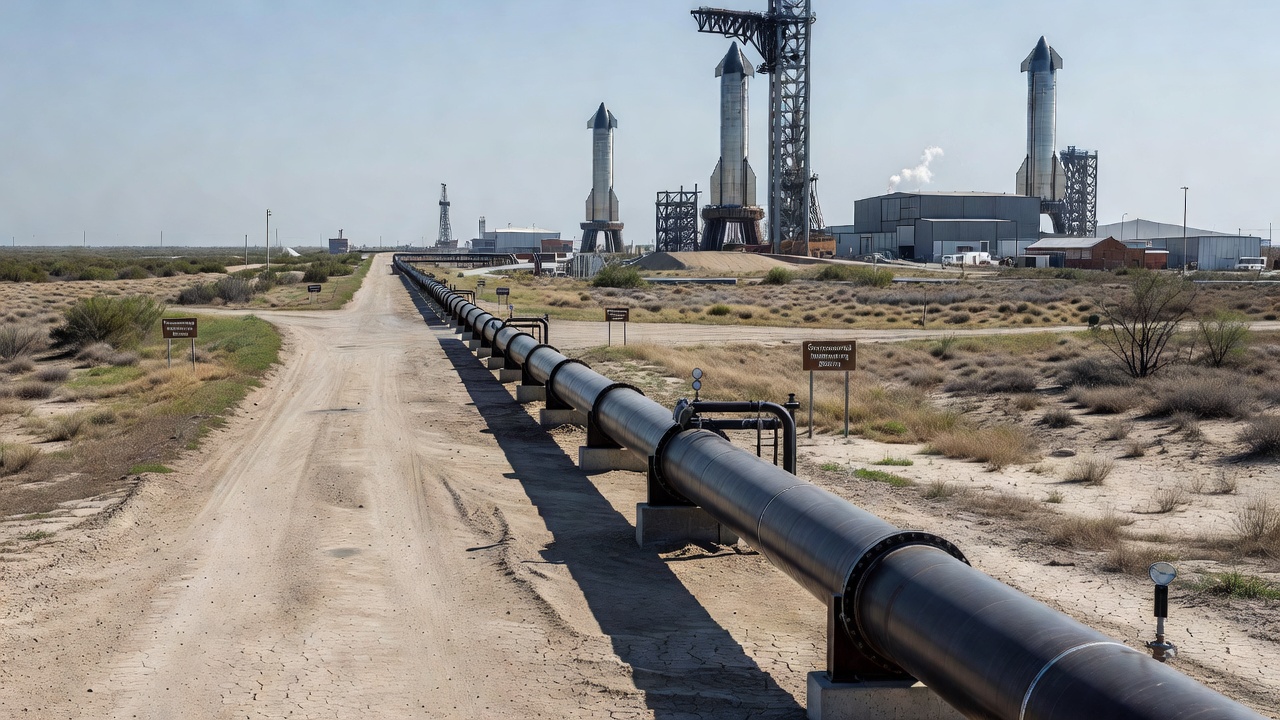
SpaceX continues to expand its infrastructure footprint in Texas with plans to construct a dedicated natural gas pipeline to support operations at its Starbase facility near Boca Chica. According to a report from Engadget, the company has filed applications with state regulators to build and operate the line, marking another step in its effort to control more aspects of the energy supply needed for rocket manufacturing, testing, and launch activities.
The proposed pipeline would stretch approximately 20 miles from a connection point in the nearby town of Port Isabel to the Starbase complex. This infrastructure project reflects the growing scale of SpaceX’s ambitions along the Gulf Coast, where the company has transformed a former fishing village into a hub for Starship development. By building its own pipeline, SpaceX aims to secure a direct and reliable supply of natural gas, which powers essential equipment including industrial furnaces, cryogenic systems, and ground support machinery at the site.
Natural gas plays a central role in modern rocket production facilities. At Starbase, the fuel heats metals for vehicle components, supports various manufacturing processes, and helps maintain the extreme temperature controls required for handling liquid oxygen and methane propellants. The Starship vehicle itself uses methane as fuel, and while the pipeline would not directly supply flight propellant, it would ensure stable energy for the massive infrastructure required to build, test, and launch these vehicles. SpaceX has already invested heavily in on-site power generation, including a large solar farm and battery storage, but natural gas remains a critical baseload resource that complements those renewable installations.
Regulatory filings submitted to the Texas Railroad Commission outline the project’s technical specifications. The pipeline would consist of steel piping designed to transport processed natural gas at standard distribution pressures. SpaceX intends to work with local utility providers for the initial hookup but will maintain ownership and operational control over the new segment. This approach allows the company to bypass some limitations of existing municipal infrastructure, which was never designed to support an operation of this magnitude.
The move comes as Starbase undergoes rapid physical expansion. New production bays, test stands, and launch pads continue to rise across the coastal site. Each addition increases energy demand, and reliance on third-party utilities has occasionally created bottlenecks. During peak testing periods, when multiple Raptor engines fire simultaneously on test stands, the facility can draw substantial power and gas volumes. A dedicated pipeline reduces the risk of supply interruptions that could delay critical engine firings or cryogenic tank validation tests.
Local reactions to the proposal remain mixed. Some residents near Port Isabel and Boca Chica welcome the economic activity that SpaceX has brought to the region, including jobs and increased tax revenue. Others express concern about further industrialization of sensitive coastal habitats. Environmental groups have monitored the company’s activities closely since construction began in earnest several years ago. The pipeline route would cross areas that include wetlands and protected zones, requiring additional environmental assessments and mitigation measures before approval.
SpaceX has developed a track record of working through these regulatory processes. Previous projects, including the construction of massive propellant tanks and the expansion of launch infrastructure, have followed similar patterns of application, public comment, and eventual permitting. The company typically emphasizes the strategic importance of its Texas operations to national space goals, highlighting how Starship could eventually support lunar missions, Mars exploration, and large-scale satellite deployment for its Starlink network.
The pipeline project also highlights a broader pattern in SpaceX’s approach to infrastructure. Rather than depending entirely on established utility companies, the firm often prefers vertical integration. This philosophy appears across multiple sites. At its California headquarters, the company generates much of its own power. In Florida, it has developed dedicated facilities at Kennedy Space Center. In Texas, the strategy extends to energy, water, and transportation. The company operates a fleet of specialized vehicles and has even explored building its own power plant in the past.
From an engineering perspective, a private natural gas pipeline offers several advantages. First, it allows precise pressure and quality control tailored to the specific needs of aerospace manufacturing. Contaminants in commercial gas supplies can sometimes affect sensitive processes, particularly those involving high-precision welding or heat treatment of stainless steel Starship components. Second, the pipeline can be routed directly to priority facilities, minimizing distribution losses and improving response time during high-demand operations. Third, ownership gives SpaceX greater flexibility to expand capacity as Starship production rates increase toward the company’s goal of rapid reusability.
The timing of the application also aligns with significant milestones in the Starship program. Following several high-profile test flights, including successful catches of the Super Heavy booster by the launch tower’s mechanical arms, SpaceX is accelerating toward more ambitious orbital attempts. These operations require extensive ground support systems that consume large quantities of electricity and gas. A stable natural gas supply would help maintain the pace of both vehicle fabrication and launch cadence.
Critics sometimes point to the environmental impact of increased fossil fuel use at the site. While SpaceX incorporates solar arrays and energy storage, natural gas still represents a substantial portion of the energy mix. The company has stated that its long-term vision includes more sustainable practices, including potential use of renewable natural gas or hydrogen in the future. For now, however, conventional natural gas offers the most practical solution for the energy-intensive work underway.
Construction of the pipeline, if approved, would likely involve standard trenching methods across much of the route. In sensitive areas, directional boring might be employed to reduce surface disruption. The project would create temporary construction jobs while requiring a smaller team for ongoing maintenance and monitoring. Pipeline integrity sensors and automated shutoff systems would form part of the safety design, consistent with industry standards.
The broader context of this development reveals how SpaceX is evolving from a spacecraft manufacturer into a more comprehensive aerospace and infrastructure organization. The Starbase facility now includes not only launch pads but also a dedicated port for cargo ships, extensive road networks, employee housing concepts, and various support buildings. Each element requires corresponding utility support, and the natural gas pipeline represents one piece of that larger puzzle.
Observers expect the Texas Railroad Commission to review the application through its standard process, which includes public notice and opportunity for comment. Given the economic significance of SpaceX to Cameron County, local leaders have generally supported the company’s initiatives, though they continue to balance growth against environmental protection and community impacts.
For SpaceX, securing energy independence at Starbase supports its aggressive timeline for Starship development. The vehicle represents the cornerstone of future plans, from providing heavy-lift capability for NASA’s Artemis program to enabling the company’s vision of making humanity multi-planetary. Every component of the ground infrastructure, including reliable natural gas delivery, contributes to achieving the rapid iteration and high flight rates that define the program’s objectives.
As the application moves forward, it will likely generate additional coverage from both technology publications and local Texas news outlets. The project illustrates the practical realities behind ambitious space exploration goals. While orbital mechanics and propulsion physics capture public attention, the supporting infrastructure often determines whether those technical achievements can happen on schedule and at scale.
SpaceX has shown willingness to invest in such foundational elements. Previous expenditures on concrete, steel, and specialized equipment at Starbase already total hundreds of millions of dollars. The pipeline represents a relatively modest addition to that investment but one that carries symbolic weight as a declaration of long-term commitment to the South Texas location.
Engineers at the company will likely integrate the new gas supply into existing and planned systems with minimal disruption to current testing activities. The flexibility offered by direct control could prove valuable as Starship moves from prototype testing into operational service, carrying both cargo and crew on increasingly complex missions.
The story of the pipeline also reflects the changing nature of commercial space activity in the United States. Where government programs once dominated both launch and ground infrastructure, private companies now frequently design, fund, and operate their own support systems. This shift allows faster decision-making and greater customization but also transfers more responsibility for regulatory compliance, environmental stewardship, and community relations to the companies themselves.
SpaceX appears prepared to shoulder those responsibilities as it continues growing its Texas presence. The natural gas pipeline, while technical in nature, forms part of a larger narrative about how private enterprise is reshaping space exploration from the ground up. As Starship development progresses, additional infrastructure projects will almost certainly follow, each one extending the company’s reach and self-sufficiency in this remote corner of the Texas coast.
The coming months will determine the exact timeline for construction and operation of the pipeline. If approved without significant delays, the line could be delivering natural gas to Starbase within a year, further strengthening the foundation upon which SpaceX builds its most advanced rockets. This methodical approach to infrastructure mirrors the company’s iterative development of flight hardware, where each addition serves a specific purpose while supporting future expansion.


 WebProNews is an iEntry Publication