
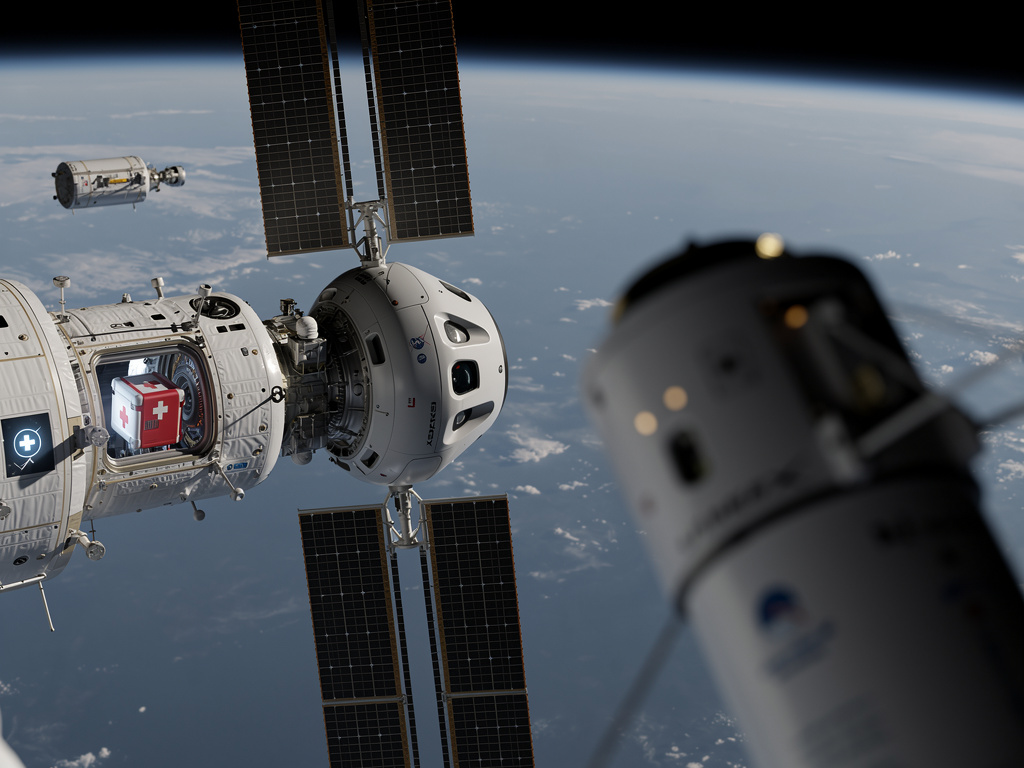
A SpaceX Crew Dragon capsule roared off the launch pad at NASA’s Kennedy Space Center early Friday, carrying a fresh crew to the International Space Station in what has become one of the most logistically complex crew rotations in the orbiting laboratory’s quarter-century history. The mission, known as Crew-10, was accelerated and restructured after a medical emergency forced one astronaut to be evacuated from the station weeks earlier — a rare and dramatic event that underscored both the vulnerabilities and resilience of human spaceflight operations in low-Earth orbit.
The launch, which took place at approximately 1:03 a.m. EDT on Friday, March 14, 2025, sent NASA astronauts Anne McClain and Nichole Ayers, along with JAXA astronaut Takuya Onishi and Roscosmos cosmonaut Kirill Peskov, on a trajectory to dock with the ISS. The crew is expected to remain aboard the station for a standard long-duration mission, but their arrival carries added urgency: they are effectively replacing a crew that was partially disbanded after astronaut Sunita Williams required an emergency return to Earth for medical reasons, as reported by Fox Business.
A Medical Emergency That Rewrote the Mission Manifest
The chain of events leading to this launch began in late February when NASA disclosed that Williams, a veteran astronaut who had already endured an unexpectedly prolonged stay aboard the ISS, was experiencing a medical condition serious enough to warrant her early return. Williams and fellow astronaut Butch Wilmore had originally launched to the station aboard Boeing’s Starliner capsule in June 2024 for what was supposed to be an eight-day test flight. Persistent issues with Starliner’s propulsion system led NASA to extend their stay indefinitely, and the pair were ultimately folded into the Crew-9 rotation, with plans to return aboard a SpaceX Dragon capsule.
Williams’s medical evacuation in early March was carried out using a SpaceX Dragon spacecraft that had been docked at the station as a lifeboat. According to Fox Business, the evacuation was the first medically motivated early return of a U.S. astronaut from the ISS in recent memory, drawing comparisons to a 2020 incident involving a Russian cosmonaut. NASA officials have been measured in their public comments about Williams’s specific condition, citing medical privacy, but confirmed that the decision to bring her home was made out of an abundance of caution and in consultation with flight surgeons on the ground and aboard the station.
SpaceX Steps In as NASA’s Indispensable Partner
The Crew-10 mission highlights the degree to which NASA has come to rely on SpaceX as its primary means of transporting astronauts to and from the ISS. Since the retirement of the Space Shuttle program in 2011, the agency has depended on commercial partners under its Commercial Crew Program, and SpaceX’s Crew Dragon has emerged as the workhorse vehicle. Boeing’s Starliner, which was intended to serve as a second crew transportation option, has been plagued by technical setbacks. The very situation that stranded Williams and Wilmore aboard the station for months was a direct consequence of Starliner’s thruster anomalies and helium leaks during its first crewed flight.
Elon Musk’s company has now completed multiple crew rotation missions, cargo resupply flights, and at least one emergency medical return — a portfolio of operations that would have been nearly unthinkable for a private spaceflight company just a decade ago. NASA Administrator Bill Nelson has publicly praised SpaceX’s reliability, though the agency continues to express its desire for a second commercial crew provider to reduce risk. Boeing, for its part, has said it remains committed to the Starliner program, but the company has taken billions of dollars in charges related to the vehicle’s development delays, and no timeline for a second crewed flight has been firmly established.
Inside the Crew-10 Mission: Who’s On Board and What’s at Stake
Commander Anne McClain, a U.S. Army colonel and veteran of a previous ISS expedition, leads the Crew-10 team. McClain, who spent 204 days in space during her first mission in 2018-2019, brings considerable experience in station operations and spacewalks. Pilot Nichole Ayers, a U.S. Air Force test pilot, is making her first trip to orbit — a milestone that underscores NASA’s continued investment in developing its next generation of astronauts. Japanese astronaut Takuya Onishi, flying under the banner of the Japan Aerospace Exploration Agency, returns to the ISS after a previous mission in 2016, while Roscosmos cosmonaut Kirill Peskov rounds out the international crew.
The four-person team will conduct a wide range of scientific experiments during their stay, including research into the effects of microgravity on human physiology — a subject that has taken on added relevance in light of Williams’s medical situation. NASA has more than 200 experiments planned for the current ISS increment, spanning disciplines from materials science to Earth observation to biotechnology. The station also continues to serve as a testbed for technologies that will be critical for the agency’s Artemis program, which aims to return humans to the Moon and eventually send crews to Mars.
The Broader Implications for Boeing’s Starliner Program
While SpaceX’s Crew Dragon continues to accumulate a track record of successful missions, the contrast with Boeing’s Starliner has become increasingly stark. The Starliner capsule that carried Williams and Wilmore to the station in June 2024 was returned to Earth uncrewed in September after NASA determined it was too risky to fly the astronauts home aboard the vehicle. That decision was a significant blow to Boeing’s aerospace division, which had already absorbed more than $1.5 billion in cost overruns on the Starliner program.
Industry analysts have questioned whether Boeing will ultimately pursue a second crewed test flight or whether the company might seek to renegotiate or exit its Commercial Crew contract with NASA. The situation is further complicated by Boeing’s broader corporate challenges, including ongoing scrutiny of its commercial aviation division following safety incidents with its 737 MAX and 787 Dreamliner aircraft. For NASA, the practical effect is that SpaceX remains the sole proven option for crewed access to the ISS — a single point of failure that the agency has long sought to avoid but has been unable to resolve.
Medical Evacuations and the Human Cost of Long-Duration Spaceflight
The evacuation of Sunita Williams has renewed attention on the physical toll of extended missions in microgravity. Astronauts on long-duration ISS stays routinely experience bone density loss, muscle atrophy, vision changes, and shifts in fluid distribution within the body. NASA’s Human Research Program has been studying these effects for decades, but each mission brings new data — and occasionally, new surprises. Williams’s situation, while not fully disclosed, serves as a reminder that even the most experienced astronauts are not immune to the hazards of living and working in space for months at a time.
NASA flight surgeons maintain continuous communication with crew members aboard the station and have the ability to conduct remote medical consultations, but the options for treating serious conditions in orbit remain limited. The decision to evacuate an astronaut is never taken lightly, as it requires reconfiguring spacecraft, adjusting crew assignments, and potentially disrupting ongoing experiments and maintenance schedules. In this case, the evacuation also necessitated changes to the Crew-10 launch timeline, as NASA and SpaceX worked to ensure that the station would not be left understaffed during the transition period.
What Comes Next for the International Space Station
The Crew-10 launch comes at a pivotal moment for the ISS program. The station, which has been continuously occupied since November 2000, is currently slated for decommissioning around 2030. NASA has contracted with SpaceX to build a deorbit vehicle that will guide the massive structure to a controlled reentry over the Pacific Ocean. In the meantime, the agency is working to transition low-Earth orbit operations to commercial space stations being developed by companies including Axiom Space, Blue Origin, and Vast.
For now, however, the ISS remains humanity’s primary outpost in space, and missions like Crew-10 are essential to maintaining its operations. The successful launch on Friday demonstrated that NASA and SpaceX can respond to unexpected contingencies — including medical emergencies — with speed and professionalism. But it also laid bare the fragility of a human spaceflight architecture that depends heavily on a single commercial provider. As the agency looks toward the Moon and Mars, the lessons of the past several months — from Starliner’s struggles to Williams’s evacuation to the flawless performance of Crew Dragon — will weigh heavily on the decisions that shape the next era of American space exploration.
Butch Wilmore, who remains aboard the station as part of the ongoing crew complement, is expected to return to Earth with the next available Dragon spacecraft. His extended stay, now approaching nine months, places him among the longest-serving American astronauts on a single ISS mission — an endurance record he never intended to set, but one that has provided NASA with valuable data on the effects of prolonged spaceflight on the human body.


 WebProNews is an iEntry Publication