
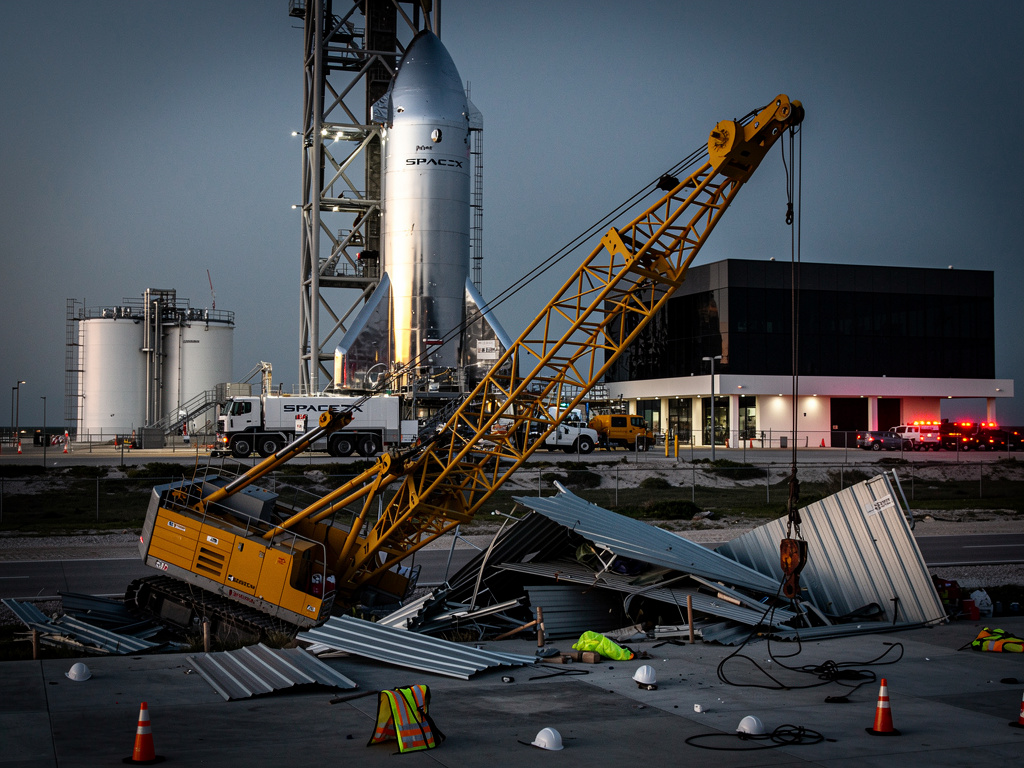
Starbase’s Tipping Point: How a Crane Collapse Exposed Cracks in SpaceX’s Safety Regime
In the high-stakes world of space exploration, where innovation races ahead at breakneck speed, safety protocols can sometimes lag behind. At SpaceX’s Starbase facility in South Texas, a crane collapse last year has thrust the company into a regulatory spotlight, revealing lapses that federal investigators say could have been prevented. The incident, which occurred amid the frenzy of preparing for ambitious Starship launches, underscores the tensions between rapid development and worker protection in an industry pushing the boundaries of human capability.
According to a recent report from the Occupational Safety and Health Administration (OSHA), SpaceX failed to adequately inspect a crane before it toppled, leading to serious injuries and a hefty fine. The agency detailed seven “serious” violations in its findings, slapping the company with a $115,850 penalty. This isn’t just a slap on the wrist; it’s a signal that even Elon Musk’s trailblazing enterprise isn’t immune to scrutiny from workplace watchdogs. The collapse happened at a critical juncture, as SpaceX ramps up operations for its Starship program, aiming for Mars missions and beyond.
Details from the investigation paint a picture of oversight failures. OSHA found that SpaceX did not ensure the crane was properly assembled and inspected, nor did it adequately train workers on the equipment’s risks. One worker suffered severe injuries when the crane buckled under load, crushing parts of his body. This event echoes broader concerns about safety at Starbase, a sprawling complex that’s become synonymous with SpaceX’s audacious goals.
Unpacking the Incident and Immediate Fallout
The crane in question was being used to hoist heavy components for Starship assembly, a routine but hazardous task in the facility’s bustling environment. Eyewitness accounts and preliminary reports suggest wind gusts may have played a role, but OSHA’s probe zeroed in on human error and procedural shortcomings. “The company didn’t properly inspect the crane before the collapse,” noted a Yahoo News article, highlighting the agency’s conclusion that basic checks could have averted the disaster.
SpaceX, for its part, has contested some of OSHA’s findings, arguing that the violations were overstated and that the company maintains rigorous safety standards. In a statement, representatives emphasized their commitment to employee well-being, pointing to investments in training and equipment. Yet, this isn’t the first time Starbase has drawn regulatory ire. A separate incident in December 2025 involved another crane mishap, where a subcontractor was crushed by a metal support, breaking multiple bones. That case, detailed in a TechCrunch exclusive, led to a lawsuit against SpaceX and the involved construction firm.
The financial penalty, while significant, pales in comparison to SpaceX’s overall budget—estimated in the billions for Starship development alone. But the reputational hit could be more damaging, especially as the company seeks to expand operations and secure government contracts. Industry analysts note that repeated safety issues might complicate partnerships with NASA, which has stringent requirements for contractor reliability.
Regulatory Scrutiny Intensifies Amid Expansion
OSHA’s involvement began shortly after the June 2025 collapse, with inspectors descending on Starbase to comb through records, interview workers, and reconstruct the event. Their report, released earlier this month, categorizes the violations as “serious,” meaning they posed a substantial probability of death or serious physical harm. Among the cited issues: inadequate hazard assessments and failure to implement engineering controls to stabilize the crane.
This latest fine adds to a growing dossier of concerns at Starbase. A CNBC report from mid-2025 first highlighted the initial OSHA probe, noting that the collapse prompted a broader review of site practices. Fast-forward to 2026, and the agency’s citations come as SpaceX accelerates its launch cadence, with infrastructure upgrades underway for more frequent Starship tests. A TipRanks analysis underscores how these regulatory hurdles coincide with heightened operational demands, potentially delaying timelines.
Beyond cranes, Starbase has faced other safety critiques. Environmental regulators have scrutinized water usage and potential contamination from launch activities, though those issues are separate from OSHA’s domain. Posts on X from SpaceX’s official account in recent months have defended the company’s safety record, emphasizing that all personnel were accounted for during anomalies and that independent tests confirm minimal risks. However, such assurances haven’t quelled worker advocates who argue that the pace of innovation at Starbase prioritizes speed over safeguards.
Worker Perspectives and Legal Ramifications
Interviews with current and former Starbase employees reveal a mixed bag. Some praise the company’s cutting-edge environment and opportunities for growth, but others whisper about grueling hours and pressure to cut corners. “It’s like building the future, but sometimes it feels like we’re the guinea pigs,” one anonymous technician told reporters last year. The injured subcontractor from the December incident is pursuing legal action, claiming negligence in site management.
Lawsuits like this one, covered in an Express-News piece, highlight the human cost. The plaintiff alleges that falling debris in an elevator shaft caused his injuries, pointing to broader construction hazards at the facility. SpaceX has moved to dismiss parts of the suit, but the case could set precedents for how aerospace firms handle subcontractor safety.
From a legal standpoint, OSHA’s fines are just the beginning. Repeat offenders can face escalated penalties, and if patterns emerge, the agency could mandate comprehensive safety overhauls. Industry insiders compare this to Boeing’s regulatory woes, where safety lapses led to grounded fleets and billions in losses. For SpaceX, avoiding a similar fate means addressing these issues head-on, perhaps by integrating more automated monitoring systems or third-party audits.
Broader Implications for the Aerospace Sector
The Starbase incidents ripple outward, influencing how competitors like Blue Origin and Rocket Lab approach their own facilities. In an era where private space firms are vying for dominance, safety records become a competitive edge. NASA, a key SpaceX partner, has remained publicly supportive but is undoubtedly monitoring the situation closely. A recent NASASpaceFlight.com update on Starship progress notes rapid advancements in launch infrastructure, but tacitly acknowledges the shadow of regulatory oversight.
Elon Musk, SpaceX’s CEO, has been vocal on X about unrelated technical matters, such as fuel calculations for Starlink-equipped flights, but has stayed relatively quiet on the OSHA findings. Posts from his account in early 2026 focus on operational successes, like Dragon capsule returns, suggesting a strategy of highlighting wins amid setbacks. This approach resonates with investors, who see Starbase as pivotal to SpaceX’s valuation, now hovering around $200 billion.
Yet, the crane collapse serves as a cautionary tale. As SpaceX eyes 2026 launches, including potential crewed missions, ensuring robust safety measures isn’t optional—it’s imperative. Experts suggest implementing AI-driven predictive maintenance for equipment like cranes, which could preempt failures through real-time data analysis.
Path Forward: Reforms and Resilience
SpaceX has already begun remedial actions, according to internal memos leaked to media outlets. These include enhanced training programs and partnerships with safety consultants. The company points to its track record: thousands of successful launches with minimal incidents. But critics argue that Starbase’s remote location and autonomous operations might foster a culture of self-regulation that’s insufficient.
Looking ahead, the aerospace industry watches closely. If SpaceX can turn this scrutiny into stronger protocols, it could emerge more resilient. A GoSuits blog from late 2025 recaps the initial collapse, emphasizing the need for transparency in investigations.
Ultimately, the Starbase crane saga illustrates the delicate balance between ambition and accountability. As SpaceX forges ahead, integrating lessons from OSHA’s verdict will be crucial to sustaining its momentum without compromising the workforce that makes it all possible.
Echoes of Innovation’s Risks
Delving deeper, the violations cited by OSHA include specifics like improper rigging and lack of load testing, details that resonate with engineers familiar with heavy-lift operations. In the context of Starship’s massive scale— the vehicle stands taller than the Statue of Liberty— such oversights amplify risks exponentially.
Comparisons to historical industrial accidents, like those in oil rigs or shipyards, reveal patterns: rapid scaling often outpaces safety infrastructure. SpaceX’s response, as gleaned from X posts by the company, stresses proactive measures, such as maintaining clear zones during tests.
For industry veterans, this moment is a pivot point. Strengthening oversight could inspire sector-wide standards, ensuring that the quest for the stars doesn’t leave earthly safeguards behind.


 WebProNews is an iEntry Publication