
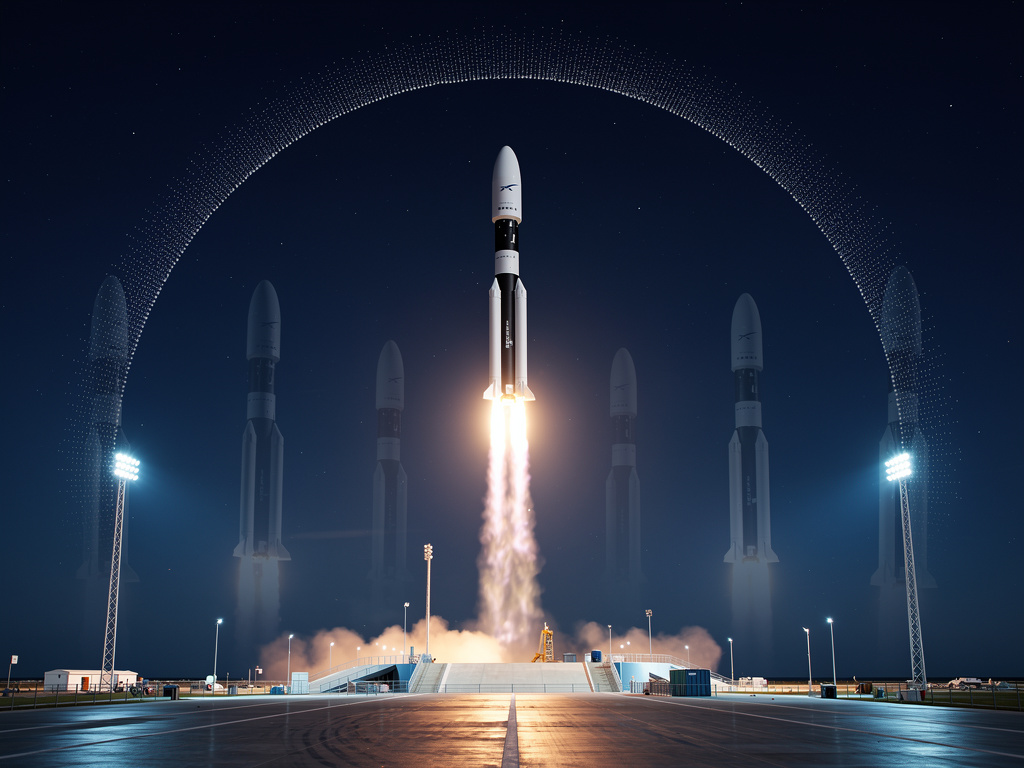
SpaceX’s Falcon 9: Rocketry’s Relentless Record-Breaker
In the high-stakes world of aerospace, where precision and reliability define success, SpaceX’s Falcon 9 rocket stands as a testament to innovation and operational prowess. For the sixth consecutive year, the company is poised to shatter its own annual launch record, a feat that underscores not just technological advancement but also a paradigm shift in how space missions are executed. According to a recent report from Digital Trends, SpaceX is on track to exceed its previous benchmarks, driven by the rocket’s reusable booster system that has dramatically reduced costs and increased flight frequency.
This year’s trajectory builds on a foundation laid over more than a decade. The Falcon 9, first launched in 2010, has evolved from an experimental vehicle into the workhorse of modern spaceflight. Its ability to land and be refurbished for multiple uses has not only cut expenses but also accelerated turnaround times between missions. Industry analysts note that this reusability has allowed SpaceX to dominate the orbital launch market, capturing a significant share of commercial and government contracts.
Recent missions highlight this dominance. Just last month, SpaceX achieved its 100th launch of the year from Florida’s Space Coast, a milestone that included deploying Starlink satellites to expand global internet coverage. Posts on X from the company’s official account celebrated the Falcon 9’s 400th successful mission overall, emphasizing the rocket’s reliability in delivering payloads ranging from scientific instruments to crewed capsules.
Pushing Boundaries with Reusability
The reusable aspect of the Falcon 9 is perhaps its most revolutionary feature. Boosters that once would have been discarded after a single use now return to Earth, landing on droneships or ground pads with pinpoint accuracy. A post on X detailed a recent landing as the 380th successful recovery, showcasing the engineering feats that make such consistency possible. This has implications far beyond cost savings; it enables a cadence of launches that rivals the output of entire national space programs.
For instance, in a mission covered by Space.com, SpaceX sent 29 Starlink satellites aloft from Cape Canaveral, marking a pivotal point in the year’s launch tally. The event was shrouded in fog, yet the rocket ascended flawlessly, demonstrating the robustness of SpaceX’s autonomous systems. Such reliability is crucial for clients like NASA, which relies on Falcon 9 for resupplying the International Space Station and ferrying astronauts.
Moreover, the rocket’s versatility extends to diverse payloads. From government reconnaissance satellites to private telecommunications arrays, the Falcon 9 handles a broad spectrum of missions. A report from Spaceflight Now described the Starlink 6-78 mission, where 29 satellites were deployed amid challenging weather, breaking the previous record of 93 launches from the Space Coast.
Milestones in a Year of Triumphs
This year’s achievements are not isolated events but part of a sustained surge. SpaceX has already surpassed 100 launches globally in 2025, with several originating from Vandenberg Space Force Base in California. A news piece from Gadgets 360 noted that a December 2 launch added 29 more satellites to the Starlink constellation, pushing the total beyond 9,100 units and enhancing broadband access in remote areas.
The company’s Transporter rideshare missions further illustrate its efficiency. These flights bundle multiple small satellites from various customers, democratizing access to space. An X post highlighted the 15th such mission, which delivered 140 payloads to orbit, a volume that would have been unthinkable without the Falcon 9’s rapid reusability.
Elon Musk, SpaceX’s founder, often emphasizes the economic model behind these successes. By refurbishing boosters—some of which have flown up to 30 times, as per another X update—the company minimizes waste and maximizes output. This approach has drawn scrutiny from competitors, who struggle to match the pace, but it has also attracted partnerships, including with international entities seeking affordable orbital insertion.
Engineering Feats and Operational Insights
Delving deeper into the technical side, the Falcon 9’s Merlin engines, nine in the first stage, provide the thrust needed for heavy lifts. Each engine is meticulously tested, contributing to a success rate that hovers near 100%. Industry insiders point to the rocket’s grid fins and cold gas thrusters as key to its landing precision, technologies refined over hundreds of flights.
A detailed recap from Florida Today on the Starlink 6-78 launch painted a vivid picture: liftoff at 10:39 p.m. from Kennedy Space Center, with the booster separating and returning successfully. Such operations require a symphony of ground teams, software algorithms, and real-time data analytics, all honed through iterative improvements.
Comparatively, earlier years saw fewer launches—31 in 2022, as mentioned in an older X post—but the progression is exponential. By 2023, the 200th booster recovery was achieved, per another X update, setting the stage for today’s records. This evolution reflects broader trends in aerospace, where data-driven refinements lead to unprecedented reliability.
Strategic Implications for Global Space Efforts
The Falcon 9’s milestones have ripple effects across the sector. For the U.S., it bolsters national security through rapid satellite deployments, essential for communications and intelligence. Internationally, Starlink’s expansion, fueled by these launches, is transforming connectivity in underserved regions, though it raises questions about orbital congestion.
Critics, however, warn of monopolistic tendencies. SpaceX’s market share, now over 60% of global launches, prompts regulatory scrutiny. Yet, as reported in a brief from KeepTrack, the company also engages in humanitarian efforts, like providing Starlink terminals in crisis zones, which softens some of the backlash.
Looking ahead, the integration of Falcon 9 with SpaceX’s Starship program promises even greater capabilities. While Starship aims for interplanetary travel, Falcon 9 remains the reliable backbone, with plans for more frequent flights. A recent X post on a Vandenberg launch of 27 Starlink satellites underscored this, marking the 60th liftoff from that site in 2025, as per Meyka.
Innovation Amid Competitive Pressures
Competition is intensifying, with players like Blue Origin and Rocket Lab developing their own reusable systems. Yet, SpaceX’s head start is evident in its launch cadence—sometimes multiple per week. The Starlink 6-95 mission, detailed in another Florida Today live update, exemplified this, launching from Cape Canaveral and adding to the constellation’s growth.
Financially, these achievements translate to robust revenue streams. Starlink alone generates billions, subsidizing further R&D. Insiders speculate that by 2026, SpaceX could aim for 150 launches annually, leveraging Falcon 9’s proven track record.
Moreover, environmental considerations are increasingly factored in. Reusability reduces the carbon footprint compared to expendable rockets, aligning with global sustainability goals. Posts on X frequently highlight these landings, not just as technical wins but as steps toward eco-friendly space access.
Future Horizons and Enduring Legacy
As SpaceX eyes Mars colonization and beyond, the Falcon 9’s role in building the necessary infrastructure cannot be overstated. Its milestones— from the 100th droneship landing, as celebrated on X, to breaking annual records—cement its place in history.
Collaborations with NASA continue to thrive, with Falcon 9 slated for more Crew Dragon missions. This partnership validates the private sector’s growing influence in space exploration.
Ultimately, the Falcon 9’s journey reflects a broader shift toward commercialized spaceflight, where innovation drives progress at an unprecedented pace. With each launch, SpaceX not only sets records but redefines what’s possible in the cosmos.
(The article draws on various sources including recent X posts from SpaceX, which provide real-time insights into launches and recoveries, emphasizing the company’s ongoing achievements without serving as definitive evidence on their own.)


 WebProNews is an iEntry Publication