
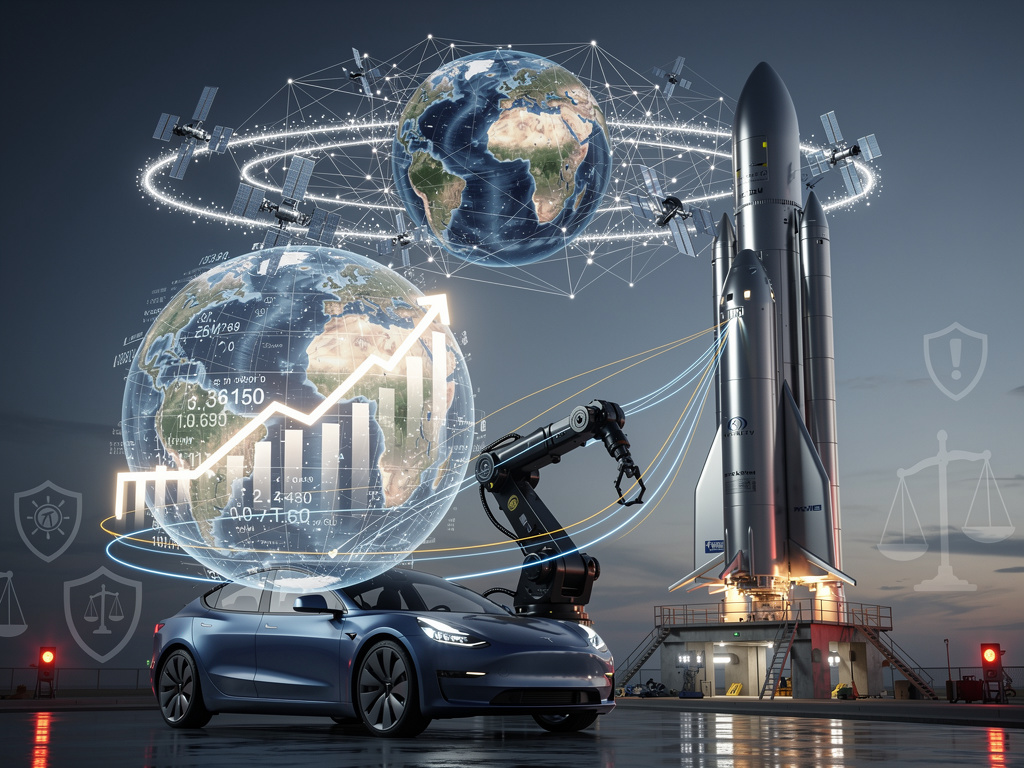
Elon Musk’s Stellar Leap: Unlocking Tesla’s AI Destiny Through a $1.5 Trillion SpaceX Debut
Elon Musk’s empire spans rockets, electric vehicles, and artificial intelligence, but the impending initial public offering of SpaceX at a staggering $1.5 trillion valuation could redefine the interplay between his ventures. Recent reports indicate that SpaceX is gearing up for what might be the largest IPO in history, potentially catapulting Musk’s net worth beyond $1 trillion and providing fresh capital for ambitious projects. This move comes as SpaceX, the private aerospace giant, has been valued at around $800 billion in recent tender offers, setting the stage for a public debut that investors are eagerly anticipating.
The excitement stems from SpaceX’s dominance in satellite technology and space exploration, with its Starlink network already revolutionizing global internet access. A successful IPO could infuse Musk’s ecosystem with unprecedented liquidity, allowing for cross-pollination of resources between SpaceX, Tesla, and xAI. Analysts suggest this financial windfall might accelerate Tesla’s push into autonomous driving and robotics, areas where AI plays a pivotal role. Musk himself has hinted at synergies, noting in posts on X that major valuation shifts for Tesla could occur with advancements in self-driving technology.
Drawing from recent coverage, Forbes reported that a SpaceX tender offer recently pushed Musk’s net worth to a record $677 billion, underscoring the company’s soaring trajectory. This valuation surge is not just about rockets; it’s about the broader implications for Musk’s vision of a multi-planetary future intertwined with AI-driven innovations.
The Financial Ripple Effects Across Musk’s Empire
As SpaceX prepares for its public offering, the potential $1.5 trillion valuation would more than double Musk’s current fortune, according to estimates from Bloomberg. Such a windfall could provide Musk with the leverage to invest heavily in Tesla’s AI initiatives, including the development of the Optimus robot and full self-driving capabilities. Tesla’s stock has already seen a “Musk premium,” where investor confidence in his leadership drives valuations beyond traditional metrics.
This interconnectedness is evident in how SpaceX’s satellite constellation could support Tesla’s autonomous vehicles. Starlink’s low-latency internet might enable real-time data sharing for AI training, enhancing Tesla’s neural networks that process vast amounts of driving data. Industry observers point out that this synergy could position Tesla as a leader in AI applications beyond automotive, potentially branching into home robotics and energy management.
Moreover, the IPO could attract institutional investors who have been sidelined from SpaceX’s private status. The New York Times highlighted a recent sale of insider shares at $421 each, making SpaceX the world’s most valuable private company and priming it for a 2026 listing. This transition to public markets might impose new scrutiny, but it also opens doors for strategic partnerships that benefit Tesla’s AI endeavors.
AI Synergies: From Satellites to Self-Driving Cars
Tesla’s future hinges on its AI prowess, particularly in achieving unsupervised autonomous driving at scale. Musk has repeatedly emphasized this on X, stating that such a breakthrough would trigger a massive valuation increase for Tesla. With SpaceX’s IPO proceeds, Musk could funnel resources into xAI, his startup aimed at understanding the universe, which in turn supports Tesla’s AI models.
Recent news from Investopedia suggests that the IPO would add hundreds of billions to Musk’s wealth, potentially accelerating investments in AI infrastructure. Imagine Starlink providing the backbone for a global AI network, where Tesla vehicles contribute data to a shared pool, refined by xAI’s Grok system. This ecosystem could outpace competitors like Waymo or Cruise by leveraging space-based connectivity for seamless updates and learning.
However, challenges loom. Regulatory hurdles for autonomous vehicles remain stringent, and SpaceX’s public status might invite antitrust scrutiny over Musk’s intertwined companies. Yet, as Fortune notes, the IPO could be Musk’s biggest headache due to increased transparency demands, but it also represents an opportunity to fund moonshot projects that spill over into Tesla’s AI realm.
Investor Sentiment and Market Dynamics
Investor enthusiasm is palpable, with Reuters reporting that some view the SpaceX debut as the “craziest IPO ever,” driven by Musk’s Mars ambitions. Posts on X reflect this hype, with Musk clarifying that SpaceX isn’t actively raising funds but providing liquidity through buybacks, while hinting at future growth potential reaching $100 trillion.
For Tesla, this could mean a boost in stock performance as investors bet on AI integrations. Yahoo Finance discusses how Tesla’s rally is tied to faith in Musk’s AI vision, including driverless cars and robotic assistants. A successful SpaceX IPO might validate this premium, encouraging more capital inflow to Tesla for AI R&D.
Bill Ackman’s proposal to structure the IPO via a SPARC vehicle, offering Tesla shareholders priority access, as covered by Benzinga, adds another layer. This could directly link the two companies’ investor bases, fostering a unified front for AI advancements.
Technological Crossovers and Future Visions
Delving deeper, SpaceX’s expertise in AI for satellite management could inform Tesla’s robotics. Optimus, Tesla’s humanoid robot, relies on advanced AI for tasks like manufacturing and household chores. Musk’s posts on X envision a future where AI and robotics eliminate scarcity, aligning with SpaceX’s goal of interplanetary colonization.
Recent developments, such as Musk becoming the first person worth $700 billion after a court ruling on his pay package, per Reuters, amplify his ability to steer these visions. This wealth could fund AI supercomputers, potentially powered by solar energy from SpaceX satellites, as Musk has mused.
Critics argue that over-reliance on Musk’s persona risks volatility, but supporters see it as a catalyst for innovation. Investopedia outlines how SpaceX is hearing pitches from banks for the IPO, signaling a strategic pivot that could reshape industry standards in AI and space tech.
Risks and Regulatory Horizons
Amid the optimism, risks abound. SpaceX’s transition to public company status will expose it to shareholder pressures and SEC oversight, potentially constraining Musk’s bold moves that benefit Tesla’s AI. Fortune’s analysis warns of scrutiny and regulatory burdens that private status has shielded.
On the AI front, Tesla faces competition from tech giants like Google and OpenAI. Yet, Musk’s xAI, bolstered by IPO funds, could challenge them, especially with Grok’s integration into Tesla products. Posts on X highlight Musk’s confidence in building AI-driven colliders or solar-powered satellites, pointing to expansive future applications.
Retail investors are keen, with TradingKey noting opportunities in private markets before the 2026 listing. This accessibility might democratize investment in Musk’s AI ecosystem, driving further innovation.
Broader Industry Implications
The SpaceX IPO could set precedents for how private tech behemoths go public, influencing sectors from aerospace to AI. Tesla’s AI future, intertwined with this event, might see accelerated development of neural networks trained on space-derived data, enhancing predictive algorithms for autonomous systems.
Musk’s historical tweets, like those comparing Tesla and SpaceX market caps, underscore his long-term strategy of building value through high-risk ventures. With combined valuations exceeding trillions, the IPO reinforces this narrative.
Looking ahead, as Benzinga reports Musk’s prediction of a $100 trillion SpaceX valuation, the ripple effects on Tesla could manifest in breakthroughs like AI-optimized energy grids or interstellar communication aiding robotic exploration.
Strategic Alliances and Innovation Pathways
Potential alliances post-IPO might include collaborations with governments or tech firms, leveraging SpaceX’s orbital assets for AI research. Tesla could benefit from this by accessing unique datasets from space, refining its Dojo supercomputer for better AI training.
Musk’s dismissal of short bets against Tesla, as shared on X, reflects resilience that could carry over to AI challenges. With wealth from the IPO, he might counter competitors by scaling xAI rapidly.
Ultimately, this IPO isn’t just a financial milestone; it’s a launchpad for Musk’s integrated vision where SpaceX’s stars align with Tesla’s AI horizons, promising a transformative era in technology. As the current date approaches the end of 2025, the anticipation builds for how this celestial event will ground-breakingly elevate earthly innovations.


 WebProNews is an iEntry Publication