
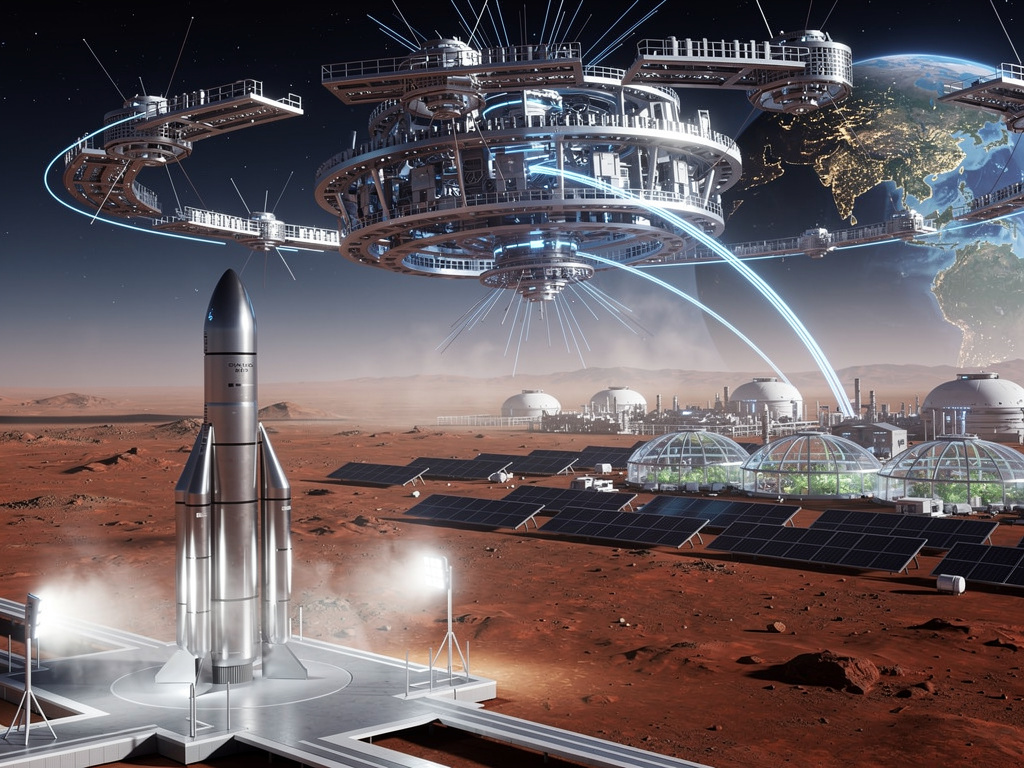
SpaceX’s board approved a compensation package for Elon Musk in January that ties his payout directly to otherworldly achievements. No base pay beyond his nominal $54,080 annual salary since 2019. Instead, 200 million super-voting restricted shares unlock only if the company hits a $7.5 trillion market value and establishes a permanent Mars colony with at least one million residents. Another 60.4 million shares, granted on March 23, vest upon separate valuation milestones plus space-based data centers delivering 100 terawatts of compute capacity—equivalent to 100,000 gigawatt nuclear reactors humming at once.
Details emerged from the company’s confidential SEC registration statement, reviewed by Reuters. Both awards carry Class B super-voting stock, 10 votes per share against one for Class A. They vest in tranches as valuations climb. Miss the targets? Musk gets nothing. As of December 31, he already holds 68.8 million Class B options with a $42 strike price, expiring in 2031.
The plan surfaces as SpaceX eyes an IPO around June 28—Musk’s birthday—potentially at $1.75 trillion, the largest public debut ever. That figure dwarfs current private valuations and sets the stage for raising over $50 billion, per New York Post reporting on the filings.
Musk’s Martian Ambition Meets Corporate Incentives
Musk founded SpaceX in 2002 with Mars as the endgame. A self-sustaining city needs about one million people, he argued in a 2017 International Astronautical Congress presentation, as noted by Teslarati. Starship designs—from payload to reusability—stem from that vision. Cost per ton to Mars must drop below $100,000 for mass migration. Now, for the first time, those dreams carry a formal price tag in SEC documents.
But realism lags. Starship remains in testing. Musk once aimed for a 2050 colony via 1,000 ships launching three daily. NASA eyes first human landings in the late 2030s, keeping crews small initially. Life there? Musk told TED’s Chris Anderson in 2022: “dangerous, cramped, difficult, hard work… you might not make it back. But it’ll be glorious,” according to Yahoo Finance.
Compensation experts call it unprecedented. “I’m not a physicist or astronomer and I wouldn’t know where to start,” said Eric Hoffmann, chief data officer at Farient Advisors, in the Reuters report. “The measuring stick is, has it been done in human history? These haven’t. So that’s hard.”
So why now? SpaceX must retain Musk amid his empire—$776 billion net worth by Forbes, 20% Tesla stake chasing its own milestones. Boards at both firms now bid for his time, Hoffmann added: “SpaceX and Tesla, both effectively controlled by Elon Musk, are now bidding against each other for his attention.” Equilar’s Courtney Yu noted such non-financial metrics are rare outside Tesla: “it does help with setting expectations for investors as to what the goals of the company really are.”
Musk’s control stays ironclad post-IPO. Dual-class structure gives his Class B shares outsized votes, securing about 79% voting power even after going public, per Yahoo Finance citing the filing.
Orbital Compute: AI’s Next Frontier or Pipe Dream?
The data center bonus aligns with Musk’s AI push. He sees orbit as prime for massive compute, unburdened by Earth’s limits. 100 terawatts dwarfs ground plans; his proposed SpaceX-Tesla Terafab chip plant targets one terawatt yearly, per Investor’s Business Daily. SpaceX filings mention unproven orbital centers, FCC petitions for spectrum, and ties to defense like Golden Dome missile tracking.
Recent X chatter amplifies the stakes. Posts highlight Musk’s all-in bet, with one noting he bought $1.4 billion in SpaceX stock last year. Others debate feasibility: Tesla robotaxi crash rates vs. Waymo, or change-of-control clauses potentially vesting shares on acquisition. But the core remains: no payout without delivery.
Risk abounds. Starship explosions. Regulatory hurdles. A $7.5 trillion cap towers over Apple’s $3.5 trillion market cap. Yet SpaceX dominates launches, Starlink beams internet globally, and contracts flow from NASA to Space Force. The IPO will test if investors buy the vision—and the pay tied to it.
Musk doesn’t need the money. He needs the alignment. This package bets humanity’s multi-planetary future on his focus. Fail, and shares stay unissued. Succeed? History rewritten, one rocket at a time.


 WebProNews is an iEntry Publication