
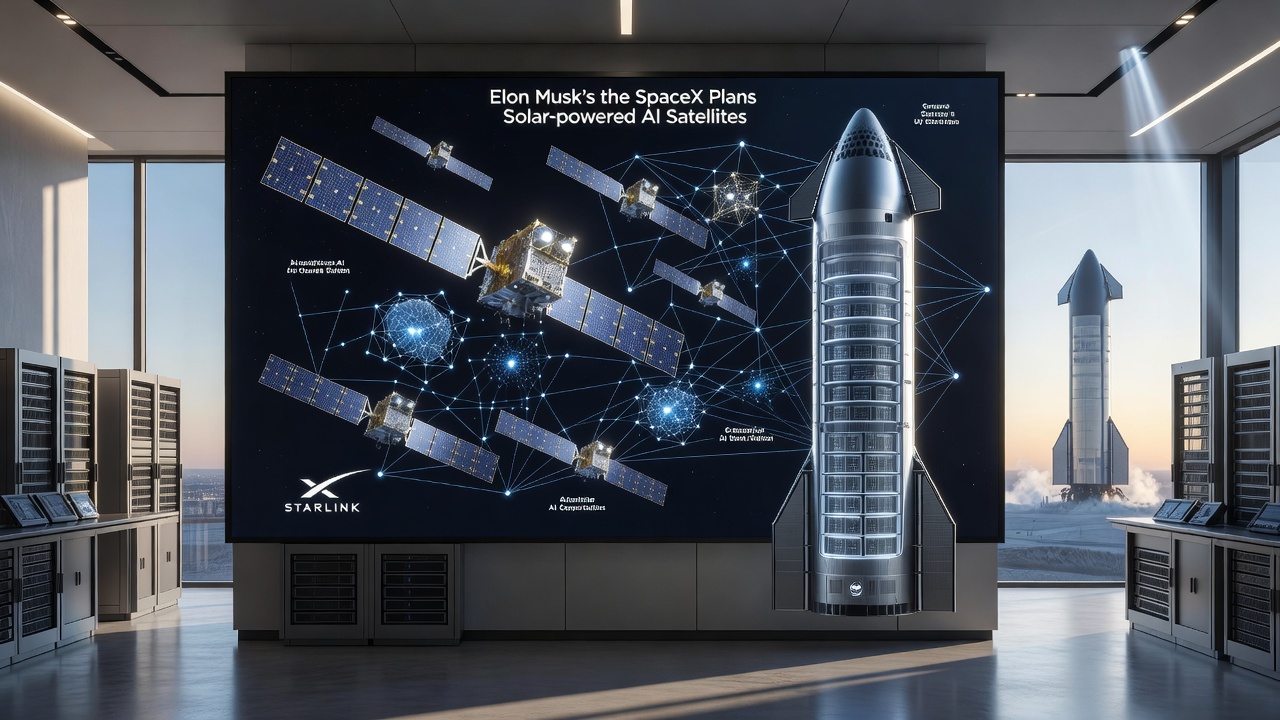
Elon Musk released a factory-floor video on X on June 9, 2026, laying out SpaceX plans for solar-powered satellites that double as orbital AI data centers. The discussion, posted under the handle @elonmusk with the caption “SpaceX AI Satellites,” frames the effort as the logical next step after Starlink. Musk described abundant solar energy in space and efficient heat radiation into vacuum as decisive advantages over terrestrial facilities strained by power grids and cooling demands.
Reuters reported on June 8 that Musk told viewers the engineering draws heavily from existing Starlink V3 technology. “A lot of this is technology we’ve already made for the Starlink V3 satellites,” he said. “We don’t think this is a super hard problem compared to the things we already do.” The video featured SpaceX engineer Ian Dahl outlining the first-generation design, labeled AI1.
Space-based compute sidesteps Earth-bound limits. Ground data centers compete for electricity, water for chillers, and real estate. In orbit, solar arrays capture energy without atmospheric losses or night cycles. Heat dissipates through radiation rather than mechanical systems. Musk called the Sun “the biggest source of energy” and said space offers “immense power.”
The AI1 satellite carries large deployable solar arrays with a wingspan of roughly 70 meters. Peak compute payload reaches 150 kW, with average sustained output around 120 kW—comparable to a high-end Nvidia GB300 rack. Power-to-weight ratio hits about 70 kW per ton. Thermal management relies on a deployable liquid radiator system with redundant loops and micrometeoroid shielding. The spacecraft connects to others through laser inter-satellite links, forming a mesh network for distributed processing.
Design choices simplify the satellite relative to Starlink.
Musk noted that phased-array antennas for user terminals add complexity absent here. “An AI satellite is essentially a lot of solar cells, a radiator, and you still need some laser links, but you don’t have all of the super complex phased-array antennas,” he said in the video. The result, he argued, makes the AI version easier to design and produce at scale.
Starship enables the vision. Its payload capacity and reusability support launching thousands of satellites per year initially, with ambitions scaling toward a constellation of up to one million units. Early deployments could begin as soon as 2028. Musk predicted that within 30 to 36 months space would become the cheapest location for AI compute. SpaceX plans a dedicated AI satellite factory in Bastrop, Texas, targeting meaningful production volumes by the end of 2027.
Broader partnerships signal commercial interest. The Wall Street Journal reported in May that Google is in talks with SpaceX for launch services tied to orbital data centers. Anthropic reached agreements in May that include potential future use of SpaceX orbital capacity alongside terrestrial resources. SpaceNews covered the January FCC filing for the million-satellite constellation and the February merger of SpaceX with xAI.
Technical hurdles remain. Radiation hardening for electronics, precise maintenance of laser links amid orbital motion, and regulatory approval for such a large constellation all require resolution. SpaceX’s S-1 filing, detailed by Reuters in April, cautioned that orbital AI initiatives involve “significant technical complexity and unproven technologies” and “may not achieve commercial viability.” The document also flagged dependence on Starship achieving high launch cadence and reusability.
Manufacturing volume stands as the central variable. Starlink already operates thousands of satellites with solar arrays, lasers, and thermal systems. Scaling those elements into compute-focused spacecraft shifts the challenge from invention to repetition. Musk emphasized the absence of magic: “Part of what we want to convey here is that there is not some magic that is necessary, that doesn’t exist.”
Recent coverage underscores momentum and skepticism. Forbes published analysis in late May questioning whether the 2028 launch timeline and million-satellite target could strain finances ahead of an IPO valued near $1.75 trillion. MIT Technology Review highlighted technological hurdles in April. Space & Telescope noted concerns over light pollution and debris in February reporting on the FCC application.
Longer-term concepts include integration with xAI models and potential lunar manufacturing to further cut costs. The immediate focus stays on proving the AI1 design and ramping production. Data processed in orbit could return results to Earth via laser downlinks or route between satellites for low-latency global inference.
SpaceX positions the satellites as computers that happen to orbit. The transition builds directly on proven hardware rather than requiring entirely new inventions. Success hinges on execution at factory scale and reliable Starship operations. Investors and competitors watch closely as the company prepares its public listing.


 WebProNews is an iEntry Publication