
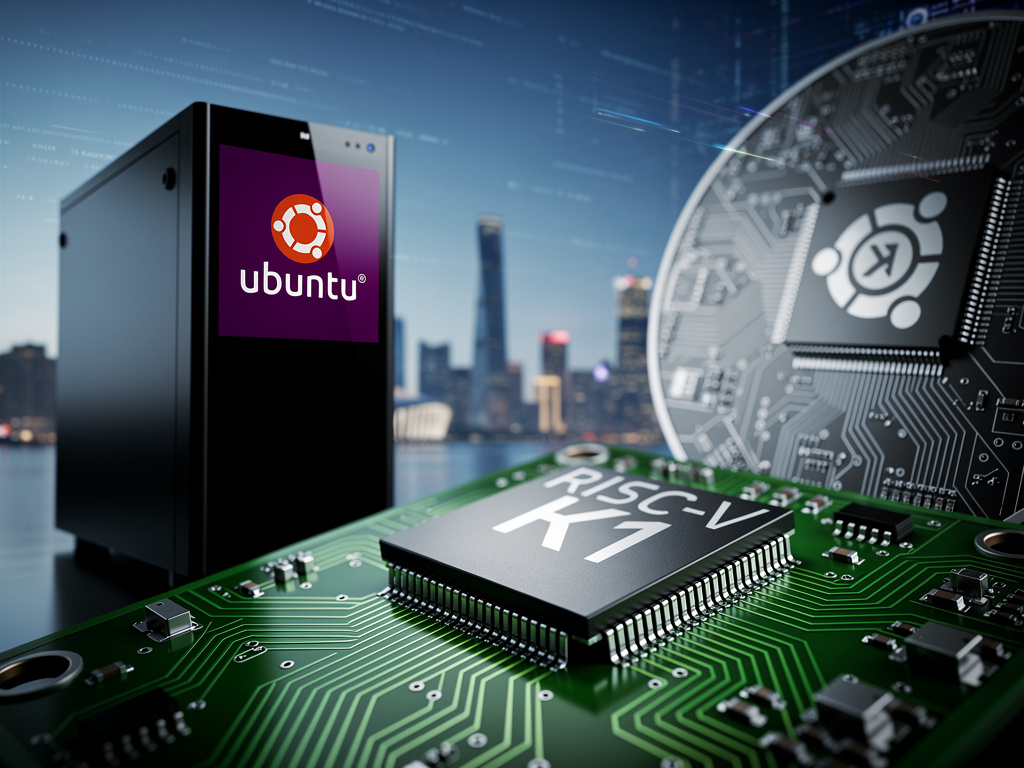
In a significant development for the RISC-V ecosystem, Canonical has announced official Ubuntu support for SpacemiT’s K1 processor, marking a pivotal moment in China’s ambitious push to establish alternatives to Western-dominated chip architectures. The move signals growing maturity in the RISC-V space and underscores how geopolitical tensions are accelerating investment in open-source processor technologies.
According to Phoronix, Canonical’s decision to provide official Ubuntu images for the SpacemiT K1 represents the first time a major Linux distribution has offered comprehensive support for a Chinese-designed RISC-V processor intended for consumer devices. The K1, an octa-core processor built on the RISC-V instruction set architecture, has been positioned by SpacemiT as a viable alternative for applications ranging from single-board computers to edge computing devices. This development comes as China intensifies efforts to reduce dependence on foreign semiconductor technology amid ongoing trade restrictions and export controls.
The SpacemiT K1 processor features eight cores running at up to 1.6 GHz, integrated graphics capabilities, and support for standard peripherals including USB, PCIe, and Ethernet connectivity. While performance metrics place it in the entry-level to mid-range category compared to established ARM or x86 processors, the significance lies not in raw computational power but in the strategic implications of having a domestically-produced, open-architecture processor with mainstream operating system support. The processor utilizes the RV64GC instruction set, which includes support for compressed instructions and atomic operations, making it suitable for general-purpose computing tasks.
Canonical’s Strategic Bet on RISC-V Architecture
Canonical’s involvement extends beyond merely providing compatible Ubuntu images. The company has committed to ongoing maintenance and updates for the SpacemiT platform, including security patches and kernel optimizations specifically tailored to the K1’s architecture. This level of commitment suggests that Canonical views RISC-V as more than a niche technology, instead positioning it as a potential mainstream alternative that warrants long-term investment. The Ubuntu images will support both desktop and server configurations, with particular emphasis on development environments and edge computing applications.
The timing of this announcement coincides with broader industry momentum behind RISC-V. Major technology companies including Google, Qualcomm, and Intel have increased their involvement in RISC-V development through the RISC-V International organization. However, Chinese companies have been particularly aggressive in their adoption, viewing the open-source architecture as a strategic pathway to semiconductor independence. SpacemiT, founded in 2021, has emerged as one of the most prominent Chinese RISC-V chip designers, having secured significant funding from state-backed investment vehicles and private equity firms focused on semiconductor development.
Technical Capabilities and Performance Benchmarks
Early benchmarking data suggests the SpacemiT K1 delivers performance roughly comparable to ARM Cortex-A53 processors, placing it in the category suitable for lightweight computing tasks, embedded systems, and educational purposes. The processor’s graphics capabilities, while modest, are sufficient for basic desktop environments and multimedia playback. Power consumption figures indicate the K1 operates in the 5-10 watt range under typical workloads, making it suitable for fanless designs and battery-powered applications. These specifications position the processor as a practical option for developers exploring RISC-V application development and for manufacturers seeking alternatives to established ARM-based solutions.
The K1’s memory controller supports LPDDR4X RAM, with configurations up to 16GB, while storage connectivity includes both eMMC and NVMe options. The integrated GPU, based on SpacemiT’s proprietary design, supports hardware video decoding for common formats including H.264 and H.265, though lacking the advanced graphics capabilities found in higher-end ARM or x86 processors. Despite these limitations, the comprehensive peripheral support and standard interfaces mean that developers can work with familiar hardware paradigms, reducing the friction typically associated with adopting new processor architectures.
China’s Semiconductor Independence Strategy
The SpacemiT-Ubuntu partnership must be understood within the context of China’s broader semiconductor strategy. Following the implementation of export controls by the United States and its allies, which have restricted Chinese access to advanced chip manufacturing equipment and certain processor designs, Beijing has dramatically increased funding for domestic chip development. RISC-V, as an open-source architecture free from licensing restrictions or geopolitical complications, has become a cornerstone of this strategy. Chinese companies have filed more RISC-V-related patents than entities from any other country, and domestic production of RISC-V processors has accelerated significantly over the past two years.
SpacemiT represents a new generation of Chinese semiconductor companies that have emerged specifically to capitalize on RISC-V opportunities. Unlike earlier efforts that focused on licensing existing ARM or x86 designs, these companies are building processors from the ground up using the open RISC-V instruction set. The availability of mature software ecosystems, exemplified by Ubuntu support, is critical to making these processors viable for actual deployment. Without operating system support and application compatibility, even technically competent processors remain curiosities rather than practical alternatives.
Implications for the Global Semiconductor Industry
The maturation of Chinese RISC-V processors with mainstream OS support carries significant implications for the global semiconductor industry. For ARM Holdings, which has dominated the mobile and embedded processor market, the emergence of credible RISC-V alternatives represents a potential long-term threat to its licensing-based business model. While current RISC-V processors lag behind ARM’s latest designs in performance and power efficiency, the gap is narrowing, and the cost advantages of open-source architectures are compelling for many applications. ARM’s recent public statements have acknowledged RISC-V as a competitive factor, though the company maintains that its ecosystem advantages and performance leadership will preserve its market position.
For Western technology companies, the rise of Chinese RISC-V capabilities presents a complex challenge. On one hand, RISC-V International remains a collaborative organization with global membership, and many Western companies contribute to RISC-V development. On the other hand, the technology is enabling Chinese semiconductor independence in ways that licensing restrictions cannot prevent. This dynamic has sparked debates within policy circles about whether open-source hardware architectures require different regulatory approaches than proprietary technologies. Some analysts argue that attempting to restrict RISC-V development would be both technically impractical and potentially counterproductive, while others contend that allowing unfettered access to cutting-edge processor technology undermines strategic objectives.
Developer Community and Ecosystem Development
The availability of Ubuntu for SpacemiT processors is expected to catalyze developer interest in RISC-V application development within China and potentially in other markets seeking alternatives to Western-dominated architectures. Ubuntu’s extensive package repositories and development tools mean that programmers can work with familiar environments while targeting RISC-V hardware. This reduces the learning curve and makes RISC-V development more accessible to the broader software community. SpacemiT has also committed to releasing development boards and documentation to support the developer ecosystem, following the model established by ARM-based single-board computers like the Raspberry Pi.
Early adopters of SpacemiT hardware are likely to include educational institutions, hobbyists, and companies developing embedded systems where cost considerations outweigh absolute performance requirements. The Chinese government has also indicated interest in deploying RISC-V processors in government systems as part of broader technology localization efforts. These initial use cases, while not representing high-volume markets, are critical for building the ecosystem of software, tools, and expertise necessary for broader adoption. The experience gained from these early deployments will inform future processor generations and help identify areas where RISC-V implementations need improvement.
Manufacturing and Supply Chain Considerations
SpacemiT manufactures the K1 using mature process nodes, currently 14nm technology, which are accessible through Chinese foundries including SMIC. This choice reflects both technical and strategic considerations. Advanced process nodes below 7nm remain largely inaccessible to Chinese companies due to export controls on extreme ultraviolet lithography equipment. However, 14nm processes are sufficient for many applications and can be produced entirely within China’s domestic supply chain. This approach prioritizes supply chain security and independence over absolute performance leadership, accepting somewhat lower performance and higher power consumption in exchange for reduced vulnerability to external supply disruptions.
The emphasis on supply chain resilience extends throughout SpacemiT’s operations. The company has reportedly prioritized relationships with domestic suppliers for packaging, testing, and other semiconductor services. This vertical integration within China’s borders represents a significant shift from the globalized supply chains that have characterized the semiconductor industry for decades. While this approach may result in higher costs and potentially lower yields compared to using best-in-class global suppliers, it aligns with Chinese policy priorities around technological self-sufficiency. As Chinese semiconductor manufacturing capabilities continue to improve, the performance and cost gaps are expected to narrow.
Market Reception and Future Prospects
Initial market reception to Ubuntu-compatible SpacemiT systems will likely be cautious but curious. Price points for development boards and consumer systems based on the K1 are expected to be competitive with comparable ARM-based alternatives, potentially offering cost advantages in volume production. However, the limited software ecosystem compared to mature ARM platforms remains a significant challenge. Applications must be compiled specifically for RISC-V, and while many open-source applications can be readily ported, proprietary software presents more significant obstacles. The success of SpacemiT and similar RISC-V initiatives will depend heavily on whether they can achieve sufficient scale to attract software vendors and create a self-reinforcing ecosystem.
Looking forward, SpacemiT has announced plans for more advanced processors, including designs targeting higher performance segments and specialized applications such as artificial intelligence inference. The company’s roadmap suggests ambitions extending well beyond entry-level computing, though achieving competitive performance in advanced applications will require significant technical progress. The broader RISC-V ecosystem is also evolving rapidly, with new extensions being developed for vector processing, security features, and other capabilities that will be necessary for RISC-V to compete across a wider range of applications. Whether Chinese RISC-V processors can close the performance gap with established architectures while maintaining the cost and supply chain advantages that motivate their development remains an open question that will shape the semiconductor industry’s evolution over the coming decade.


 WebProNews is an iEntry Publication