
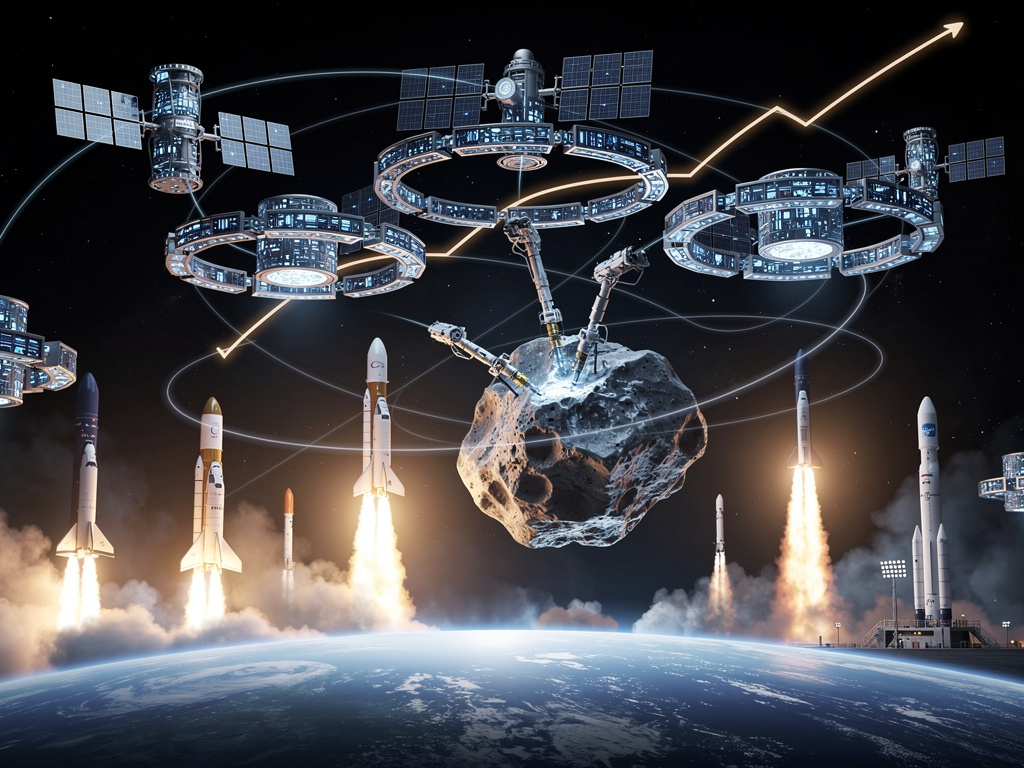
The space industry, once the domain of government agencies and a handful of visionary entrepreneurs, is now attracting unprecedented levels of capital from both public and private sources. In 2025, investments in space technology shattered records, reaching new heights that analysts predict will only climb higher this year. According to a recent report from investment firm Seraphim Space, global funding surged by 48% last year to $12.4 billion, with the U.S. alone accounting for $7.3 billion. This momentum is fueled by a confluence of factors, including heightened geopolitical tensions driving defense-related expenditures and breakthroughs in commercial launch capabilities.
Private investors are particularly bullish on companies enhancing satellite constellations and reusable rocket systems, viewing them as critical infrastructure for everything from global communications to national security. For instance, SpaceX’s ongoing advancements in Starship technology have not only reduced launch costs but also opened doors for more frequent missions, drawing in venture capital eager to capitalize on the expanding market. Meanwhile, government budgets, especially in the U.S. and Europe, are allocating billions toward sovereign satellite networks and missile defense systems, underscoring space as a strategic asset in an era of international rivalry.
Beyond defense, the integration of artificial intelligence into space hardware is emerging as a key growth driver. AI-powered analytics for Earth observation and orbital data processing are attracting tech giants and startups alike, promising efficiencies that could revolutionize industries from agriculture to logistics. As one investment analyst noted, the potential initial public offering of SpaceX could serve as a watershed moment, validating the sector for mainstream investors and paving the way for a slew of follow-on IPOs.
Defense Spending Fuels Orbital Ambitions
The defense sector’s role in propelling space investments cannot be overstated. Governments worldwide are ramping up spending on space-based assets to bolster national security, with satellite systems at the forefront. A report from Reuters highlights how this trend is expected to continue into 2026, with allocations for defense-linked satellites and AI-integrated hardware driving much of the projected growth. In the U.S., the Department of Defense’s budget proposals include significant outlays for space domain awareness and hypersonic missile tracking, areas where private firms are increasingly partnering with public entities.
This public-private synergy is evident in companies like AST SpaceMobile, which is developing satellite networks for global mobile connectivity with potential military applications. Posts on X from industry observers suggest that ASTS could see key catalysts this year, including launches of 45 to 60 satellites, potentially validating its technology for defense uses. Such developments are not isolated; they reflect a broader shift where space tech is intertwined with cybersecurity and intelligence gathering, making it a hotbed for investment.
Moreover, the prospect of orbital data centers—essentially computing infrastructure in space—is gaining traction among Wall Street firms. As detailed in an analysis from InvestorPlace, advancements in AI and policy tailwinds could make 2026 a breakout year for related stocks, with firms betting on low-latency data processing free from terrestrial constraints. This innovation addresses growing demands for edge computing in remote areas, further blurring the lines between commercial and defense applications.
Launch Capacity as the Backbone of Expansion
At the heart of the space sector’s growth is the dramatic improvement in launch capabilities, which has democratized access to orbit. Companies like SpaceX and Rocket Lab are leading the charge, offering low-cost, high-frequency launches that enable a proliferation of satellites and missions. According to data from TechRepublic, this segment alone is poised for substantial investment inflows in 2026, building on 2025’s record year where launch services saw heightened private sector bets.
Rocket Lab, for example, is positioning itself as a provider of dedicated launches for small to mid-sized payloads, integrating services that span from vehicle manufacturing to on-orbit operations. X posts from market analysts emphasize how firms like RKLB are essential for building the logistics layer of the space economy, potentially benefiting from the halo effect of a SpaceX IPO. This interconnected ecosystem means that successes in launch technology ripple outward, supporting ventures in Earth observation, telecommunications, and even asteroid mining.
Emerging trends in asteroid prospecting are also drawing investor interest, with micro-probe technologies forecasted to create a $1.96 billion market by 2030. A market report from GlobeNewswire outlines opportunities driven by miniaturization and AI, where probes could identify valuable resources in space, opening new revenue streams for mining companies. This niche, while speculative, exemplifies how technological advancements are expanding the sector’s horizons beyond traditional orbits.
AI Integration and the Path to IPOs
Artificial intelligence’s role in space tech is transforming raw data from satellites into actionable insights, a factor that’s accelerating investment. Firms are integrating AI for predictive maintenance on spacecraft, real-time analytics for climate monitoring, and autonomous navigation systems. The Reuters report notes that this integration is a primary driver for 2026’s expected funding surge, as investors see AI as the key to unlocking efficiencies in an increasingly crowded orbital environment.
The anticipation surrounding a potential SpaceX IPO is perhaps the most talked-about catalyst. Speculation on X, including from users tracking market trends, points to mid-2026 as a possible timeline, which could value the company at over $1 trillion and trigger a wave of listings from peers. An article from Gizmodo weighs the risks and rewards, noting that while SpaceX’s dominance in reusable rockets offers high upside, regulatory hurdles and competition from players like Blue Origin could pose challenges.
Beyond SpaceX, other companies are positioning for growth. Intuitive Machines and Planet Labs are highlighted in an Investing.com analysis as stocks with potential for massive gains, thanks to their focus on lunar missions and Earth imaging, respectively. These firms benefit from the broader trend where AI enhances data value, making space-derived information a commodity for industries like insurance and urban planning.
Geopolitical Rivalries Accelerate Funding
Geopolitical dynamics are intensifying the race for space supremacy, with nations viewing orbital assets as extensions of terrestrial power. China’s ambitious lunar program and Russia’s satellite deployments are prompting Western governments to counter with increased investments. The Seraphim Space insights, as reported across multiple outlets including Reuters, underscore how this competition is funneling money into defense-oriented space tech, from anti-satellite weapons to secure communication networks.
In Europe, the European Space Agency’s 2025 report on the space economy, accessible via ESA’s website, provides a comprehensive view of trends, noting Europe’s push to strengthen its position through investments in reusable launchers and satellite manufacturing. This regional focus is creating opportunities for cross-border collaborations, where private equity firms are funding joint ventures to compete globally.
X sentiment reflects this urgency, with posts highlighting how defense needs drove the 48% investment spike in 2025, setting the stage for even greater inflows. Analysts predict that as tensions rise, space will become a $1.8 trillion economy by the decade’s end, with 2026 marking a pivotal year for capital deployment.
Emerging Players and Market Diversification
Smaller players are carving out niches that diversify the sector’s growth drivers. For instance, Redwire Corporation is supplying critical components for space infrastructure, positioning itself as a key enabler in the supply chain. X discussions often pair it with AST SpaceMobile and Rocket Lab as must-watch stocks amid the SpaceX IPO buzz, emphasizing its role in hardware that supports expansive satellite constellations.
PwC’s analysis of space industry trends, found at PwC’s site, explores how innovation in policy and infrastructure is shaping business strategies, including the rise of space tourism and in-orbit servicing. Companies like Virgin Galactic and Astroscale are benefiting from this, with investments flowing into maintenance robots that extend satellite lifespans, reducing the need for costly replacements.
Furthermore, the integration of space tech with terrestrial industries is creating hybrid opportunities. For example, orbital compute advances could support AI training in zero gravity, as speculated in InvestorPlace coverage, potentially revolutionizing data centers by mitigating heat and energy issues faced on Earth.
Policy Tailwinds and Investor Sentiment
Supportive policies are providing a strong foundation for sustained growth. In the U.S., regulatory reforms under the new administration are expected to streamline approvals for commercial space activities, encouraging more startups to enter the fray. This environment is fostering optimism, as evidenced by X posts from investors like Shay Boloor, who outline watchlists for the 2026 space economy, including launch providers and communication specialists.
The potential for exponential growth curves, as decoded in an AInvest article, suggests that a SpaceX IPO could accelerate adoption across the sector, drawing parallels to past tech booms. MarketScreener echoes this, noting in its coverage at MarketScreener how private bets on launch capacity will compound with government spending.
Seeking Alpha’s take on AST SpaceMobile, available at Seeking Alpha, advises caution amid the hype, pointing to validation milestones like defense contracts that could solidify its position. As the year unfolds, these elements—defense imperatives, technological leaps, and market events—promise to elevate the space sector to new altitudes, rewarding those who invest wisely in its multifaceted expansion.


 WebProNews is an iEntry Publication