
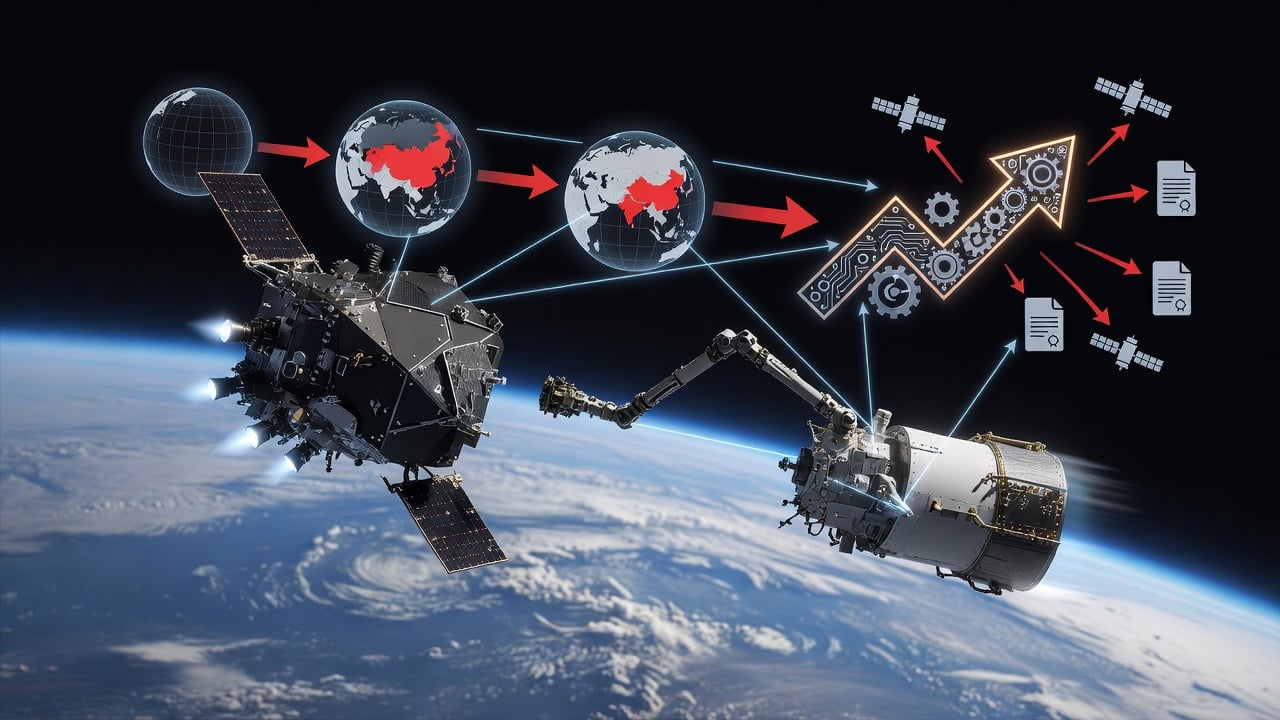
The U.S. military has a new set of wingmen in orbit. Two young space companies just pulled off a feat once reserved for government operators alone. Their satellites chased each other at 17,500 miles per hour. They met up. One snapped pictures of the other. All on short notice.
This wasn’t a one-off stunt. TechCrunch reported the details yesterday. The mission, called Victus Haze, marks a shift. The Space Force now counts on commercial firms to handle complex orbital reconnaissance. Fast. Repeatedly. Against real threats.
True Anomaly built the interceptor, a craft named Jackal. Rocket Lab launched the target, Puma. The exercise unfolded last month. Rocket Lab received the go-ahead and lofted its spacecraft just 16 hours and 42 minutes later. Most launches take months of preparation. Not this one.
Jackal waited in orbit. Its sensors picked up the newcomer from 2,000 kilometers away. Then it closed in. It circled the target. Cameras recorded views from multiple angles. The exact distance remains classified. The maneuver demanded precision at blistering speeds. Even Rogers, True Anomaly CEO and a former military space officer, called it one of the most complex rendezvous and proximity operations in modern history, outside of crewed NASA or Space Force flights.
“China and Russia launch capabilities to space on a regular basis, and part of the Space Force’s job is to understand what those capabilities are,” Rogers told TechCrunch. “Right now we have gaps in our collection capability.”
Those gaps matter. Adversaries test new weapons in orbit. The U.S. needs eyes on them quickly after launch. Traditional military satellites can’t scale to meet every demand. So the Pentagon turns to industry. True Anomaly and Rocket Lab showed they can deliver. Their success points to a future where private operators fly the majority of these tactical missions.
The companies plan tougher tests soon. Puma may try to slip away. Jackal could practice its own inspections while evading. Each round raises the stakes. Each builds experience that feeds back into doctrine.
The Private Sector’s Growing Role in Orbital Warfare
True Anomaly launched in 2022. Rogers and other veterans of military space programs saw the need. The Space Force stood up in 2019 with a mandate to treat space as a warfighting domain. That meant new tools. New tactics. The firm set out to supply both hardware and the software that ties them together.
It worked. The company has raised more than $1 billion so far, including a $650 million round this March. Seth Winterroth sits on its board. He works at Eclipse Ventures. He credits the firm’s edge to something harder to copy than any single satellite design. “It’s not one spacecraft architecture or one piece of software or a certain set of payloads — it’s a deep, deep understanding of what tactics and doctrine look like in this domain,” Winterroth said.
Rocket Lab brings its own strengths. Known for small satellite launches, the firm recently agreed to buy Iridium. That deal expands its reach. Its ability to respond in hours gives the military options that rigid government schedules cannot match.
Earlier private efforts offered hints. Northrop Grumman flies servicing satellites. Astroscale hunts orbital debris. Those missions move slower. They allow more time for adjustments. Victus Haze demanded quick decisions. Real-time sensing. Autonomous close approaches. The difference shows in the timeline. From alert to imagery in days instead of months.
The Space Force sees value here. It has budgeted $6.2 billion for the Andromeda program. That effort seeks exactly these kinds of agile reconnaissance tools from commercial partners. True Anomaly intends to bid on task orders. Rogers knows the score. “Flight heritage is everything, and demonstrated capability is what speaks the loudest with these opportunities,” he said.
Recent news reinforces the trend. A report published today highlights the $62 million invested in private innovation behind Victus Haze. It frames the mission as a bridge from simulation to actual orbital combat practice. The Space Force has also received new satellites designed for hands-on training in orbital maneuvers, according to posts and discussions circulating this week on X. These assets let operators move beyond theory.
Yet risks remain. Close approaches can create confusion. Or worse, collisions. Rules of the road in space stay murky. Commercial firms must coordinate tightly with military commanders. Any misstep could spark an international incident. Or hand adversaries propaganda wins.
Still, the Pentagon pushes forward. Budget pressures favor cheaper, faster commercial solutions. The pace of adversary activity leaves little choice. Rogers and his peers bet that private ingenuity can close the gaps faster than traditional acquisition ever could.
Success here could reshape how America defends its interests beyond the atmosphere. Satellites no longer drift as passive assets. They become active players in a dynamic arena. Pilots, even if they sit on the ground, now steer them through dogfights without atmosphere or gravity to slow the action.
The Jackal and Puma danced last month. They proved the concept. More dances lie ahead. Each one sharper. Each one closer to the real thing. The Space Force watches. So do its rivals. The orbital high ground just got a lot more crowded.


 WebProNews is an iEntry Publication