
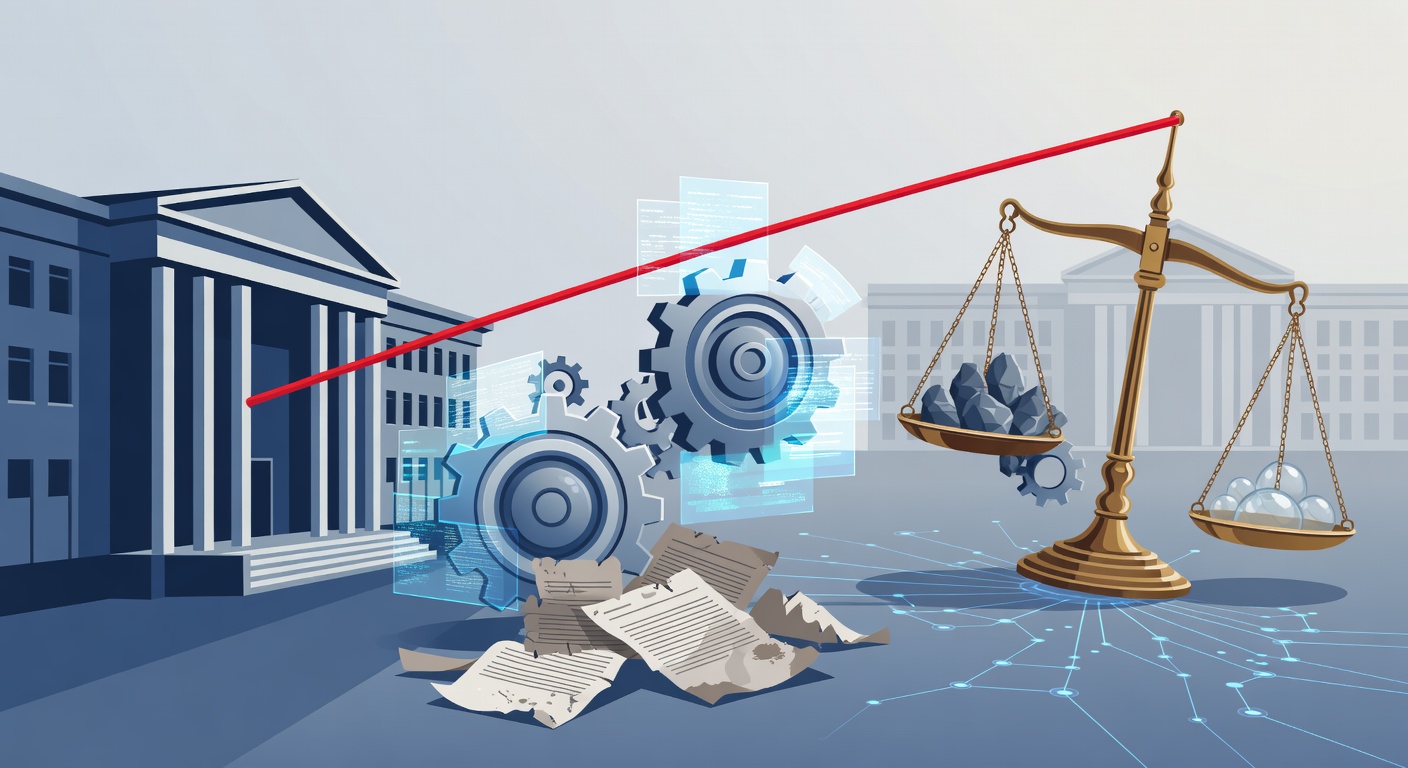
Two senior officials at South Africa’s Department of Home Affairs lost their posts this week. The reason? A list of bogus references tacked onto a freshly approved government white paper. The fake citations, products of artificial intelligence gone wrong, exposed a lapse that now ripples through the public service.
The Department of Home Affairs acted fast. It placed a chief director on precautionary suspension Thursday afternoon. A director tied to the drafting faces the same fate Monday. Both worked on the Revised White Paper on Citizenship, Immigration and Refugee Protection, a document Cabinet had just greenlit. Government statement detailed the moves without naming the pair.
Discovery came through the department’s own review. References in the standalone list proved untraceable or invented. None appeared in the main text. “It seems that these references were generated and attached to the document after the fact, as they are not cited in the body of the text,” the department said. The body of the paper, officials insisted, still captured government policy accurately. Yet the damage was done.
News24 first flagged the fictitious sources. Its reporting triggered the internal probe that confirmed the AI involvement. University of Cape Town academic Jonathan Shock reviewed the list. “It is very likely that these are AI hallucinations, and that an AI tool has been used to compile the reference list,” he told investigators. The term “hallucinations” describes the confident but false outputs common in large language models when data runs thin.
Home Affairs didn’t stop at suspensions. It hired two independent law firms. One will run the disciplinary hearings. The other will comb through every policy paper the department produced since November 30, 2022. That date marks the public launch of ChatGPT. From now on, AI checks and formal declarations will sit inside approval workflows. The reference list itself has been pulled pending the full inquiry.
The department offered a direct apology. “The Department nonetheless sincerely apologises for this unacceptable oversight.” It called the episode embarrassing but also an opening. “While regretting the embarrassment caused, the Department of Home Affairs is not only taking immediate corrective action but also regards this painful experience as an opportunity to further modernise our internal processes.”
Minister Leon Schreiber went further. He plans to raise the matter at the next Cabinet meeting. The goal is government-wide adoption of verification steps. “The development of AI presents extraordinary opportunities, but it must also be used responsibly and with integrity. We will ensure that is the approach into the future,” Schreiber said, according to Moneyweb.
This wasn’t an isolated stumble. Days earlier the Department of Communications and Digital Technologies withdrew its draft National AI Policy. That document cited at least six nonexistent academic works. Two officials there also faced immediate suspension. Minister Solly Malatsi owned the failure. “The most plausible explanation is that AI-generated citations were included without proper verification. This should not have happened.”
Public Interest SA chair Tebogo Khaas praised the swift response in both cases. “The minister didn’t obfuscate, he didn’t try blame shifting, he took responsibility and asked for heads to roll, which is what we expect of all ministers.” Still, Khaas warned that penalties alone won’t fix the problem. Stronger detection systems must be built into every department.
The timing carries extra sting. Both departments report to Democratic Alliance ministers inside the Government of National Unity. Questions linger about whether similar issues hide in policies from other parties. And the white paper at the center of the Home Affairs case aimed at major reform on immigration and refugee rules. It emerged from broad consultation across government and the public. Now its credibility carries a visible dent.
AI’s spread across South African institutions is no secret. Private companies and public bodies alike tap tools for drafting, research and analysis. The technology promises speed. It condenses weeks of literature review into minutes. But those gains vanish when outputs go unchecked. Models invent authors, fabricate journal titles, even conjure entire papers that never existed. Confidence in every sentence only makes the error harder to spot.
Experts have warned for years. Large language models interpolate from training data. When they hit gaps they improvise. The results sound scholarly. They include plausible volume numbers and DOIs. Only rigorous follow-up reveals the fiction. In a policy shop under deadline pressure, that follow-up sometimes slips.
Home Affairs now bets on process to close the gap. Mandatory declarations will force drafters to admit AI use. Separate verification layers will test every citation. The department also signaled a larger view. “It is a transformative but disruptive technology that is changing how organisations operate across the private and public sectors. We must now adapt to keep up.”
Yet adaptation demands more than new forms. It requires cultural change. Officials must accept that speed tools can undermine authority if treated as oracles. Senior leaders must model skepticism. And procurement rules may need tightening so that only vetted platforms enter sensitive drafting.
The parallel scandals arrive at a moment when South Africa debates its own AI strategy. The withdrawn DCDT policy was meant to set national direction. Its flaws now serve as Exhibit A for why governance of the technology matters. One department drafting rules on AI fell victim to the very weakness it sought to address.
Public trust hangs in the balance. Citizens expect policy to rest on evidence, not invention. When references evaporate under scrutiny, confidence erodes. The four suspensions send a signal. Accountability applies even at senior levels. But the deeper test will be whether other departments quietly run similar audits or wait for the next exposé.
So far the reaction mixes relief and concern. Relief that action was immediate. Concern that the incidents surfaced only after external scrutiny in one case and internal review in the other. How many more documents contain hidden fabrications? The law-firm review at Home Affairs may offer early answers.
Schreiber’s push for Cabinet-level discussion could lift the issue beyond two departments. A uniform standard across national government would mark progress. It would also acknowledge a truth many technologists have stressed: AI augments human work. It does not replace the duty to verify.
The white paper’s core arguments survive for now. Immigration reform, citizenship rules, refugee protection pathways. All remain on the table. Yet the episode underscores a broader tension. Governments everywhere race to harness AI while guarding against its defects. South Africa just received a very public lesson in the cost of falling short.
And the story isn’t finished. Disciplinary proceedings will unfold. The full policy audit will conclude. New protocols will roll out. Each step will be watched. Because in the end, the machines only reflect the discipline of the people who wield them. When that discipline slips, even a reference list can bring senior careers to a halt.


 WebProNews is an iEntry Publication