
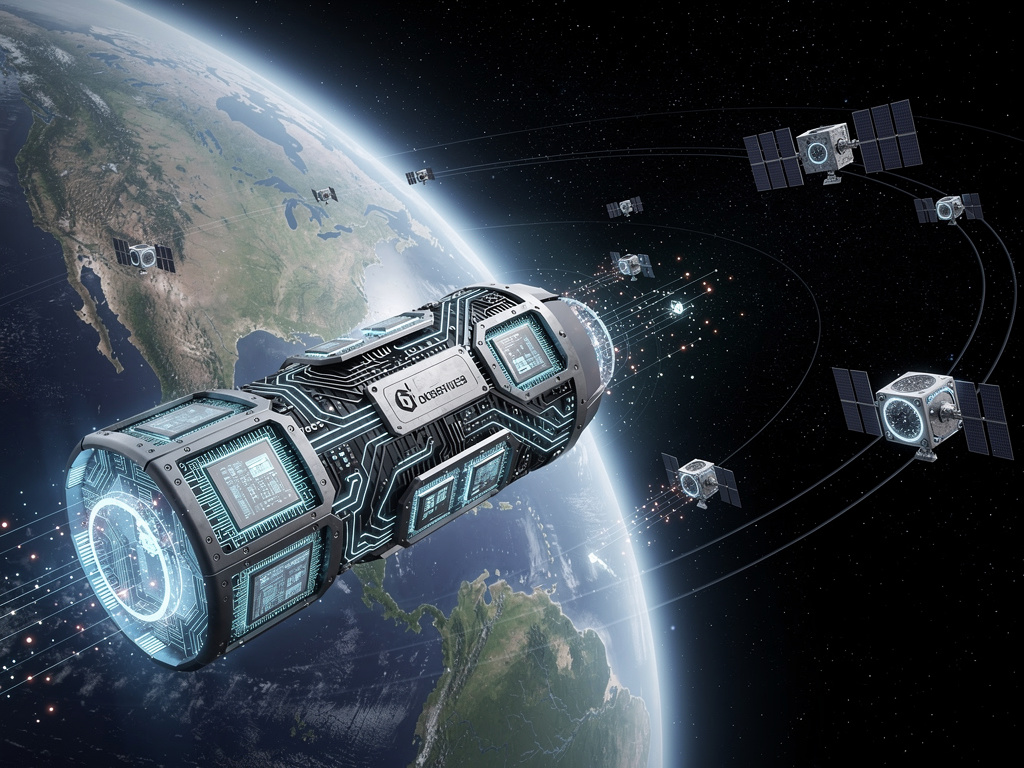
A small startup out of Los Angeles is making an audacious wager: that the decades-old approach to building computers for space is fundamentally broken, and that a new generation of radiation-hardened processors can unlock capabilities that have long eluded satellite operators and defense agencies alike. Sophia Space, which emerged from stealth in late 2025, has raised $10 million in seed funding to demonstrate its novel space computing architecture in orbit — a mission that could reshape how the commercial and government space sectors think about onboard data processing.
The round, first reported by TechCrunch, was led by prominent venture investors with deep ties to the aerospace and defense sectors. The funding will be directed toward an orbital demonstration mission expected to take place within the next 18 months, during which Sophia Space plans to validate its proprietary computing hardware under the extreme conditions of low Earth orbit — including exposure to radiation, thermal cycling, and the vacuum of space.
Why Space Computers Have Lagged Behind Their Terrestrial Counterparts
The gap between computing power available on the ground and what flies in orbit has been widening for years. Traditional space-grade processors, known as radiation-hardened or “rad-hard” chips, are typically based on silicon architectures that are one or two decades behind the current state of the art in consumer and enterprise computing. The reason is straightforward: qualifying a chip for the space environment is an extraordinarily expensive and time-consuming process, meaning that by the time a processor is certified for flight, it is already generations old by commercial standards.
This constraint has had cascading effects across the space industry. Satellites that cost hundreds of millions of dollars to build and launch often carry onboard computers with less processing power than a modern smartphone. For missions that require real-time image processing, autonomous decision-making, or the handling of large data streams — think Earth observation, missile warning, or space domain awareness — the bottleneck is not the sensor or the communications link, but the computer sitting between them.
Sophia Space’s Architectural Approach
Sophia Space is attacking this problem from a different angle than most of its predecessors. Rather than simply trying to harden existing commercial chips — an approach that several other startups and established defense contractors have pursued with mixed results — the company has designed a computing architecture from the ground up that is intended to tolerate radiation effects while still delivering processing performance that approaches what is available in terrestrial data centers.
Details of the architecture remain closely held, but according to the TechCrunch report, the company’s system incorporates a combination of custom hardware design, advanced error-correction techniques, and a software layer that can dynamically manage computational workloads even as individual components experience radiation-induced faults. The goal is not merely incremental improvement but a step-function increase in the processing power available to spacecraft — potentially by an order of magnitude or more compared to current rad-hard solutions.
The Commercial and National Security Stakes
The timing of Sophia Space’s emergence is no accident. Both the commercial satellite industry and the U.S. Department of Defense have been signaling for years that onboard computing is among the most pressing technology gaps in the space sector. The Pentagon’s Space Development Agency, for instance, has been building out a proliferated constellation of satellites in low Earth orbit designed to provide missile tracking and data transport services. These satellites need to process sensor data quickly and autonomously, particularly in scenarios where ground-based communication links may be degraded or denied.
On the commercial side, the explosion of Earth observation constellations — operated by companies like Planet Labs, BlackSky, and Maxar — has created enormous demand for onboard processing. Downloading raw imagery to the ground for processing is bandwidth-intensive and introduces latency. If satellites could perform meaningful analysis in orbit, operators could deliver actionable intelligence to customers in near-real time, a capability that commands a significant premium in markets ranging from agriculture to insurance to commodity trading.
A Crowded Field With High Barriers to Entry
Sophia Space is not operating in a vacuum, figuratively speaking. Several other companies have been working on the space computing problem, though from varying angles. Xplore, based in Redmond, Washington, has focused on providing in-space computing services. Meanwhile, companies like Aethero and Maris, both venture-backed startups, have been developing their own radiation-tolerant processing hardware. Established defense primes such as BAE Systems and Northrop Grumman continue to supply the majority of rad-hard processors used in government missions, though their products are often criticized for their high cost and limited performance.
What distinguishes Sophia Space, according to people familiar with the company’s technology, is the degree to which it has integrated hardware and software into a single system designed specifically for the space environment. This full-stack approach — designing the chip, the board, and the software together — is reminiscent of the strategy that has proven successful for companies like Apple in the consumer electronics world and SpaceX in launch vehicle avionics. Whether it can translate to the space computing domain, where the physics of radiation effects impose constraints that do not exist on Earth, remains to be proven.
The Orbital Demo: A Critical Milestone
The planned orbital demonstration will be the first real test of Sophia Space’s claims. Space hardware companies face a credibility gap that can only be closed by flying actual hardware in actual space. Ground-based testing, including radiation exposure in particle accelerators and thermal vacuum chambers, can simulate many of the conditions a computer will face in orbit, but it cannot replicate all of them simultaneously or for extended durations. An on-orbit demonstration that shows the system performing as advertised under real-world conditions would be a significant validation — and likely a catalyst for follow-on funding and customer contracts.
The $10 million seed round, while substantial for a pre-revenue hardware startup, is modest by the standards of the broader space industry. Building and launching a demonstration payload, even as a secondary payload on a rideshare mission, can easily consume the majority of such a round. The company will almost certainly need to raise additional capital — likely a Series A in the range of $30 million to $50 million — to move from demonstration to production and begin delivering systems to paying customers, as noted by TechCrunch.
Investor Confidence and the Broader Venture Climate for Space Hardware
The willingness of investors to back a space hardware startup at the seed stage reflects a broader shift in venture capital appetite for deep-tech companies with long development timelines and significant technical risk. After a period of retrenchment in 2023 and 2024, during which many space-focused venture funds pulled back from early-stage hardware bets, capital has begun flowing again — driven in part by strong demand signals from the Department of Defense and intelligence community, and in part by the maturation of the commercial satellite market.
Space-focused venture funds, including those affiliated with major defense contractors and government-adjacent investment vehicles, have been particularly active in the computing and electronics segment. The logic is straightforward: as the number of satellites in orbit grows — estimates suggest there could be more than 100,000 active satellites by the early 2030s — the aggregate demand for onboard computing hardware will grow proportionally. A company that can capture even a small share of that market could generate significant returns.
What Comes Next for Sophia Space and the Industry
For Sophia Space, the path forward is clear but demanding. The company must finalize its demonstration hardware, secure a launch slot, execute the on-orbit test, and then translate the results into a product roadmap that addresses the needs of both commercial and government customers. Each of these steps carries risk, and the history of space hardware startups is littered with companies that demonstrated promising technology but failed to make the transition to production and revenue.
Yet the opportunity is undeniable. The space industry’s reliance on computing hardware that would have been considered outdated a decade ago on Earth is not merely an inconvenience — it is a structural limitation that constrains what satellites can do and how quickly they can do it. If Sophia Space can deliver on its promise of bringing modern computing performance to the orbital environment, the implications would extend far beyond a single company’s balance sheet. It would change the calculus for satellite designers, mission planners, and the growing number of organizations — from intelligence agencies to agricultural firms — that depend on space-based data to make decisions that matter on the ground.


 WebProNews is an iEntry Publication